Facts
The applicant (original complainant) lodged an FIR at Naroda Police Station against Respondent No. 2 for offences under Sections 323, 294(B), and 506(2) of the Indian Penal Code (IPC) and Section 135(1) of the Bombay Police Act
Source reference: p. 1-2Following a police investigation and chargesheet, the trial court examined five witnesses and documentary evidence, including recovery and scene-of-offence panchnamas
Source reference: p. 2The Trial Court acquitted the accused on 27.11.2008, noting a 28-hour unexplained delay in filing the FIR, hostile witnesses, and testimony "improvements"
Source reference: p. 2, 4The Court also noted that the complaint appeared to be a counter-blast to a pending Section 307 IPC case filed by the accused against the complainant’s husband
Source reference: p. 3-4The applicant moved the High Court in revision to quash this acquittal
Source reference: p. 2Issues
1. Whether the trial court's order of acquittal was perverse or suffered from a jurisdictional error warranting interference under revisional jurisdiction
Source reference: p. 42. Whether the High Court can re-appreciate evidence and substitute its own findings of fact for those of the trial court in a revision application
Source reference: p. 4-5Law Applied
The Court applied Sections 397 and 401 of the Code of Criminal Procedure (CrPC), which govern the High Court's revisional powers to ensure the correctness, legality, and propriety of lower court findings
Source reference: p. 1, 5It relied on the principle from Amit Kapoor v. Ramesh Chander (2012) 9 SCC 460, which establishes that revisional jurisdiction is limited and should not be used to substitute findings of fact unless they are perverse or arbitrary
Source reference: p. 3-4It further applied Malkeet Singh Gill v. State of Chhattisgarh (2022) 8 SCC 204, which holds that a revisional court does not dwell at length upon evidence to reverse findings unless there is a patent defect or error of jurisdiction
Source reference: p. 5Reasoning
The Court analyzed the trial court's reasoning and found that the acquittal was based on a sound appreciation of the evidence.
Source reference: p. 4It noted that the alleged incidents occurred on 14.11.2005 and 15.11.2005, yet the FIR was delayed by 28 hours without adequate explanation
Source reference: p. 4Furthermore, the prosecution's case was weakened by eye-witnesses turning hostile and the complainant making material "improvements" during testimony
Source reference: p. 4The High Court observed that the trial court correctly identified the potential for malice, given the pending Section 307 IPC litigation between the parties' families
Source reference: p. 4Applying the Amit Kapoor and Malkeet Singh Gill precedents, the Court reasoned that findings of fact cannot be upset in revision unless they are totally perverse; here, the trial court’s conclusions were plausible and supported by the record
Source reference: p. 4-5Holding
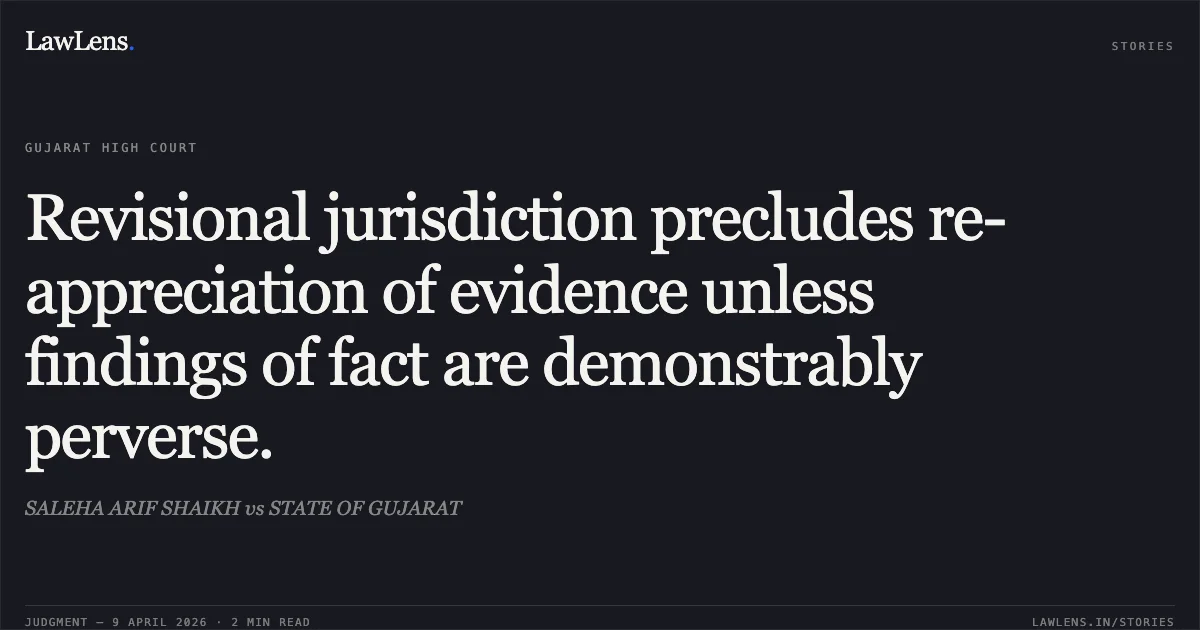
The High Court held that the trial court committed no palpable error or jurisdictional illegality in its judgment
The Court affirmed that revisional jurisdiction is not a tool for the re-appreciation of evidence or the substitution of facts
Source reference: p. 5Consequently, the revision application was dismissed, the rule was discharged, and any interim relief previously granted was vacated
Source reference: p. 5Acts & Sections Cited
7 provisions across 2 statutes referred to in this judgment. Each provision opens on LawLens.
Code of Criminal Procedure, 19733
Indian Penal Code, 18604
Original Court PDF
SALEHA ARIF SHAIKHvsSTATE OF GUJARAT
Click to open original judgment
Original judgment, available to read, download and summarize on LawLens.in