Facts
The respondent-landlord instituted Eviction Suit No. 1 of 2014 under Section 11(1)(c) of the Bihar Building (Lease, Rent & Eviction) Control Act, 1982 (“B.B.C. Act”), seeking eviction of the petitioners from three rooms forming part of a six-room house situated over Plot No. 1963, Khata No. 165.
Source reference: pp. 2–3, paras. 3–4According to her, the three rooms were orally let to the petitioners, her sister and brother-in-law, on 7 April 2010 at a monthly rent of ₹1,800, and were required for her husband’s proposed medical clinic after his return from Itanagar.
Source reference: pp. 2–3, paras. 3–4The petitioners denied the existence of a landlord–tenant relationship and asserted that the property was joint family property acquired from joint family income.
Source reference: p. 3, para. 4The Trial Court relied on oral evidence and the registered title documents, held that an oral tenancy and the respondent’s better right in the premises had been established, found the requirement bona fide and reasonable, and decreed eviction on 29 November 2022.
Source reference: pp. 4–6, para. 7Issues
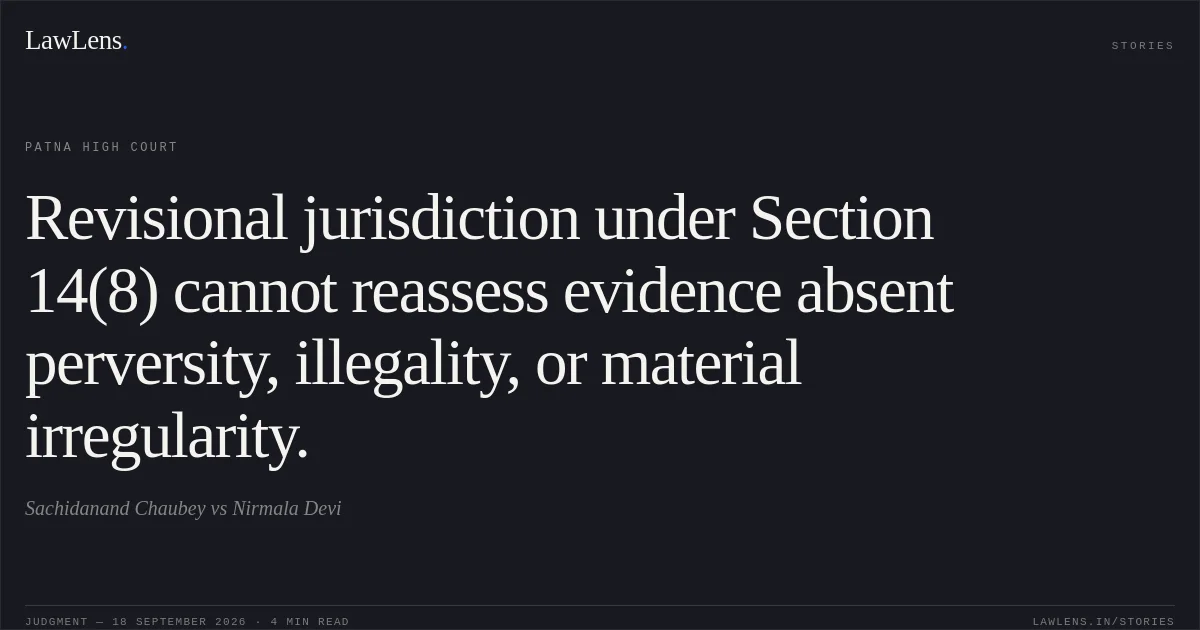
Whether the judgment and decree dated 29 November 2022 suffered from illegality, material irregularity, or perversity warranting interference in revisional jurisdiction under Section 14(8) of the B.B.C. Act?
Source reference: p. 9, para. 12Whether the relationship of landlord and tenant was established despite the absence of a written rent agreement or rent receipts?
Source reference: pp. 15–16, para. 18Whether the respondent established a bona fide and reasonable personal necessity for eviction under Section 11(1)(c) of the B.B.C. Act, and whether the entire premises was required rather than only a portion?
Source reference: pp. 17–18, paras. 20–21Whether the respondent’s title or right in the premises could be finally adjudicated in the eviction proceeding?
Source reference: pp. 14–15, paras. 16–17Law Applied
The Court applied Sections 11(1)(c) and 14(8) of the B.B.C. Act: eviction may be ordered on the ground of the landlord’s bona fide and reasonable personal necessity, while the High Court’s revisional jurisdiction is confined to examining the legality, propriety, and regularity of the eviction order.
Source reference: pp. 9–13, para. 14Relying on Hindustan Petroleum Corporation Ltd. v. Dilbahar Singh, (2014) 9 SCC 78, the Court held that revisional jurisdiction is narrower than appellate jurisdiction and does not permit a fresh reappraisal of evidence unless the findings are perverse, unsupported by evidence, legally erroneous, or result in miscarriage of justice.
Source reference: pp. 9–13, para. 14Under Keshar Bai v. Chhunulal, (2014) 11 SCC 438, title may be incidentally considered in eviction proceedings but cannot be finally adjudicated therein; the landlord–tenant relationship, rather than ultimate title, is ordinarily material.
Source reference: pp. 14–15, para. 17Relying on Som Nath v. Ravinder Kumar, Civil Appeal No. 4484 of 2025, the Court recognised that tenancy may be created orally and that concurrent findings based on oral evidence should not be disturbed merely because no written tenancy agreement or rent receipt exists.
Source reference: pp. 16–17, para. 19The Court further applied the principle in Kanahaiya Lal Arya v. Md. Ehshan, 2025 SCC OnLine SC 432, that bona fide need must be real rather than a mere desire, and that the landlord is generally the best judge of the premises required to satisfy that need.
Source reference: p. 17, para. 21The principle of estoppel under Section 116 of the Evidence Act was also noted in relation to a tenant’s challenge to the landlord’s title.
Source reference: pp. 14–15, para. 17Reasoning
The Court held that the Trial Court had relied on legally relevant evidence, including the respondent’s oral testimony and that of her witnesses regarding the letting of the three rooms, and had therefore validly found an oral landlord–tenant relationship despite the absence of written rent documentation.
Source reference: p. 16, para. 18The registered sale deed, Bakshishnama, revenue records, and electricity documents were considered only to assess the respondent’s right and interest in the premises and the relationship between the parties, not to finally determine title in a title suit.
Source reference: p. 14, para. 16The petitioners’ challenge essentially sought a reappreciation of evidence, which was impermissible in revision absent perversity, misreading of evidence, or a finding based on no evidence.
Source reference: pp. 9–13, para. 14; p. 18, para. 23On personal necessity, the Trial Court had accepted the evidence that the respondent’s husband intended to return from Itanagar and resume medical practice by establishing a clinic in the premises.
Source reference: p. 17, para. 20The High Court found that this constituted a genuine and reasonable requirement and accepted the finding that the entire premises was necessary for that purpose.
Source reference: p. 17, para. 20No material illegality, irregularity, or perversity was shown.
Source reference: no citationHolding
The High Court answered the issues against the petitioners.
It held that the oral landlord–tenant relationship was sufficiently established, that the respondent’s personal necessity was bona fide and reasonable, and that the Trial Court had not finally adjudicated title beyond what was permissible in an eviction proceeding.
Source reference: pp. 16–18, paras. 18–23Finding no ground for interference under Section 14(8) of the B.B.C. Act, the Court affirmed the judgment and decree dated 29 November 2022 directing the petitioners to vacate the disputed premises within sixty days.
Source reference: p. 18, paras. 24–27The civil revision application was dismissed; interim orders, if any, were vacated, with no order as to costs.
Source reference: p. 18, paras. 24–27Acts & Sections Cited
1 provisions across 1 statute referred to in this judgment. Each provision opens on LawLens.
Code of Civil Procedure, 19081
Original Court PDF
Sachidanand ChaubeyvsNirmala Devi
Click to open original judgment
Original judgment, available to read, download and summarize on LawLens.in