Facts
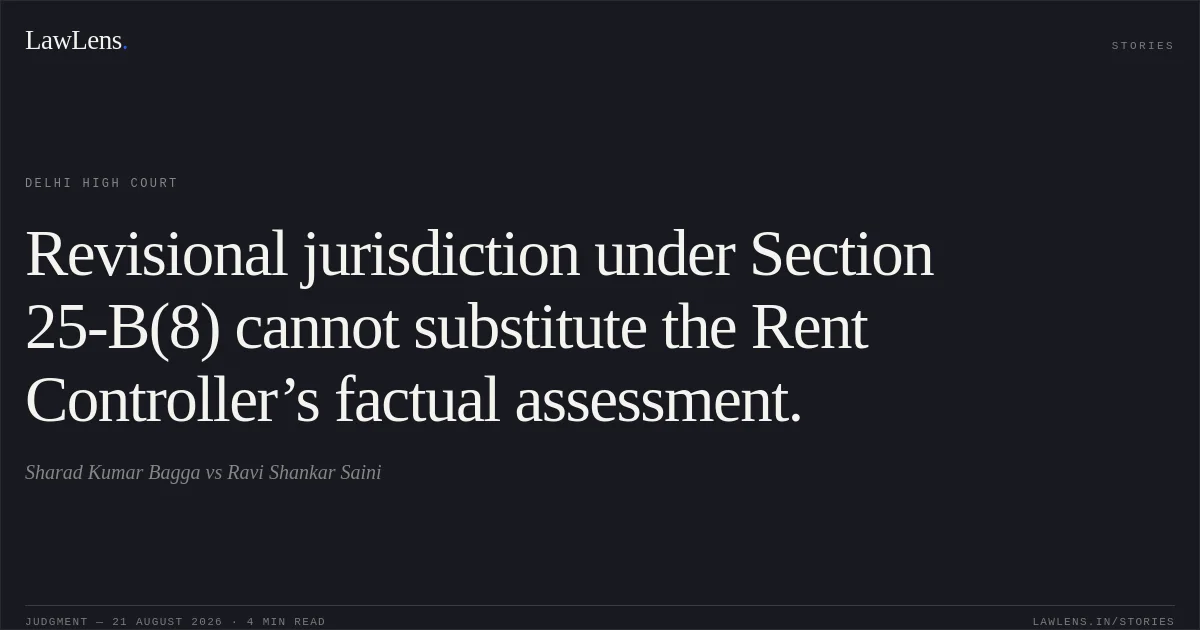
The Respondent-landlord instituted Eviction Petition No. RC-ARC 530/2022 concerning Shop No. 4316/14, Ground Floor, Property No. 4316, Gali Bahuji, Bahadurgarh Road, Sadar Bazar, Delhi.
Source reference: p. 6, para. 15The eviction was sought on the ground of bona fide requirement for establishing the office of his daughter, Ms. Shilpa Saini, who was stated to have been practising law since 2016.
Source reference: p. 6, para. 15The Petitioner-tenant opposed the eviction and sought leave to defend, alleging that the landlord habitually filed eviction petitions and settled them thereafter, that the present requirement was not bona fide, and that the landlord possessed suitable alternative commercial accommodation.
Source reference: pp. 5–8, paras. 13–24The learned ARC allowed the eviction petition and dismissed the application for leave to defend by judgment dated 5 February 2026. The tenant challenged that decision under the proviso to Section 25-B(8) of the Delhi Rent Control Act, 1958.
Source reference: p. 1, para. 1Issues
1. Whether the learned ARC committed a jurisdictional error or material irregularity by refusing to formally consider documents filed with the tenant’s rejoinder concerning the landlord’s previous eviction proceedings and settlements.
Source reference: pp. 5, 9–10, paras. 13, 15–182. Whether the alleged similarity or “cyclostyled” nature of the landlord’s earlier eviction petitions raised a triable issue regarding the bona fide nature of the present requirement.
Source reference: p. 12, para. 263. Whether the tenant’s allegation that the landlord possessed suitable alternative commercial accommodation raised a triable issue warranting grant of leave to defend.
Source reference: pp. 7–9, 11–12, paras. 18–254. Whether the High Court, in exercise of revisional jurisdiction under the proviso to Section 25-B(8) of the DRC Act, could reappreciate the evidence and substitute its view for that of the learned ARC.
Source reference: pp. 3–4, 9–14, paras. 8–12, 30–33Law Applied
The Court held that the jurisdiction under the proviso to Section 25-B(8) of the Delhi Rent Control Act, 1958 is supervisory and revisional, not appellate; interference is warranted only for a jurisdictional error, manifest illegality, material irregularity, perversity, an error apparent on the face of the record, or absence of adjudication.
Source reference: pp. 3–4, paras. 8–12Relying on Sarla Ahuja v. United India Insurance Co. Ltd., (1998) 8 SCC 119, and Baldev Singh Bajwa v. Monish Saini, (2005) 12 SCC 778, the Court reiterated that once the landlord establishes a prima facie case of bona fide requirement, a presumption arises in the landlord’s favour and the tenant must place specific material to rebut it.
Source reference: pp. 6–7, paras. 16–17The Court also relied on Ravichandran v. Natrajan Nadar, (2004) 1 MLJ 458, and Ragavendra Kumar v. Firm Prem Machinery, AIR 2000 SC 534, for the principle that the landlord is ordinarily the best judge of the premises required for his business and the tenant cannot dictate which premises should be used.
Source reference: pp. 8–9, paras. 21–23The limited scope of revision was further supported by Hindustan Petroleum Corporation Ltd. v. Dilbahar Singh, (2014) 9 SCC 78, Abid-Ul-Islam v. Inder Sain Dua, (2022) 6 SCC 30, Pankaj Pahwa v. Prem Wati, 2024:DHC:9322, and Sanjeev Hiranandani v. Sunny Grover, 2025:DHC:11285.
Source reference: pp. 3–4, paras. 8–12Reasoning
The High Court found that the ARC had not relied merely on the landlord’s assertion of bona fide need. Although the ARC initially observed that the documents filed with the rejoinder were not properly brought on record, it expressly considered them alternatively and held that withdrawal of earlier eviction petitions after settlement did not, by itself, negate the present bona fide requirement.
Source reference: pp. 5, 9–10, paras. 13, 15–18The allegation that the earlier petitions were similarly worded or cyclostyled also did not disclose material sufficient to rebut the present requirement or raise a triable issue.
Source reference: p. 12, para. 26The ARC independently considered the stated need for the landlord’s daughter’s law office and found that the tenant had produced no specific material showing lack of bona fides.
Source reference: pp. 6, 10–11, paras. 15–20On alternative accommodation, the ARC compared the competing site plans and found that the shops alleged to be vacant corresponded to Shop No. 4316/15 and an adjoining portion shown in the landlord’s plan as occupied by identified persons; the tenant had not disputed those occupations.
Source reference: pp. 7–8, 11–12, paras. 18–24The High Court held that these findings reflected proper consideration of the material and that the tenant’s challenge essentially sought a fresh appreciation of evidence, which was impermissible in Section 25-B(8) revision.
Source reference: pp. 12–14, paras. 28–33Holding
The Court answered the issues against the tenant. It held that the learned ARC had duly considered the previous eviction proceedings, the rejoinder documents, the plea of cyclostyled petitions, and the alleged alternative accommodation, and that its conclusions disclosed no jurisdictional error, manifest illegality, material irregularity, perversity, or error apparent on the face of the record.
The revision petition was dismissed, and the pending applications, including the stay application, were disposed of accordingly.
Source reference: p. 14, paras. 34–35Acts & Sections Cited
1 provisions across 1 statute referred to in this judgment. Each provision opens on LawLens.
Code of Civil Procedure, 19081
Original Court PDF
Sharad Kumar BaggavsRavi Shankar Saini
Click to open original judgment
Original judgment, available to read, download and summarize on LawLens.in