Facts
The second respondent, a hatchery branch manager, alleged that on 10 January 2026 the petitioners obstructed poultry vehicles transporting chicks, intercepted one vehicle, pelted stones at it, damaged it, and threatened its driver and cleaner.
Source reference: p. 2–4The petitioners said they were members of a farmers’ organisation seeking improved poultry wages and that the vehicle stoppage formed part of a previously announced production-stoppage strategy.
Source reference: p. 2–4The petition was brought under Section 528 of the Bharatiya Nagarik Suraksha Sanhita, 2023, seeking to quash the FIR.
Source reference: p. 1, 3, 8The judgment identifies the FIR as Crime No. 9 of 2026 in the prayer and operative order, but paragraph 4 states that the FIR was registered as Crime No. 24 of 2026.
Source reference: p. 1, 3, 8Issues
Whether the allegations disclosed the ingredients of rioting, wrongful restraint, obscene acts or words, and criminal intimidation under Sections 191(2), 126(2), 296(b), and 351(3) of the Bharatiya Nyaya Sanhita, 2023
Source reference: p. 4–7Whether the FIR warranted quashing under the High Court’s inherent jurisdiction as an abuse of process
Source reference: p. 7Law Applied
The Court exercised its quashing jurisdiction under Section 528 of the Bharatiya Nagarik Suraksha Sanhita, 2023.
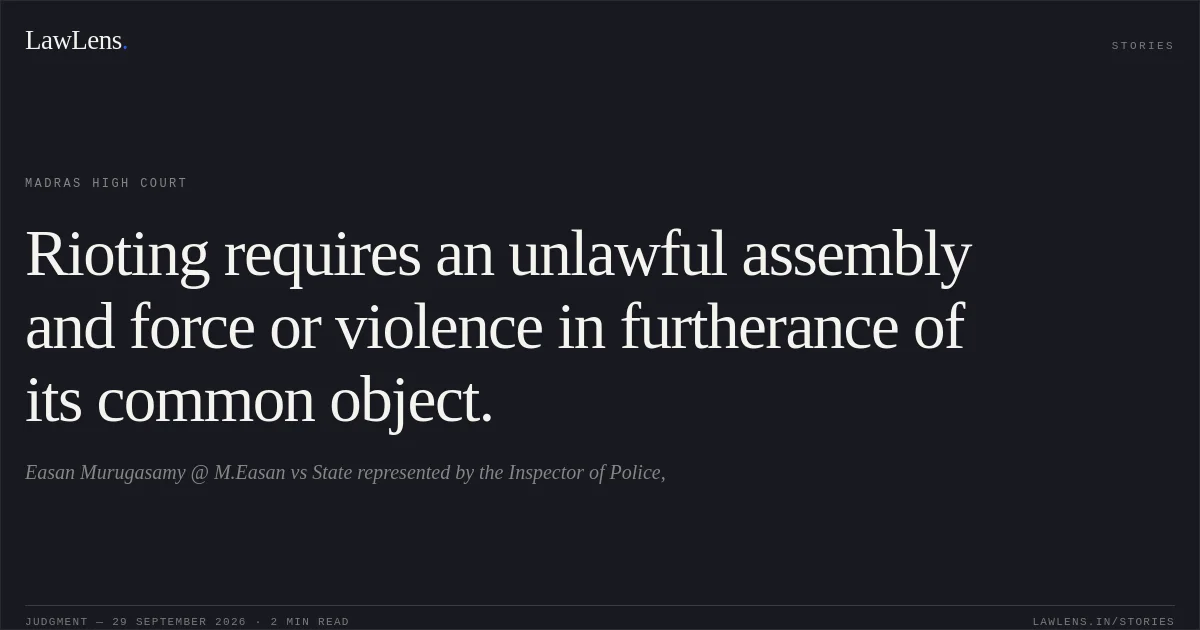
Source reference: p. 1It stated that rioting under Section 191(2) BNS requires an unlawful assembly with a common object and the use of force or violence; wrongful restraint under Section 126(2) requires a specific restraint of a person from proceeding in a direction in which that person has a right to proceed; and Section 296(b) requires obscene words uttered in or near a public place to the annoyance of others.
Source reference: p. 4–6For criminal intimidation under Section 351(3), the Court identified a threat and an intention to cause alarm, together with the relevant intention to compel or prevent an act.
Source reference: p. 6It relied on K. Jeyaramanuju v. Janakaraj & Anr., 1996 (1) CTC 470, for the proposition that utterance of obscene words alone is insufficient without proof of annoyance, and referred to the quashing categories in State of Haryana v. Bhajan Lal, including proceedings maliciously instituted with an ulterior motive.
Source reference: p. 6–7Reasoning
The Court considered the allegations against the petitioners vague and omnibus, finding no specific acts of violence or particulars establishing an unlawful assembly and common object for Section 191(2), or personal restraint satisfying Section 126(2).
Source reference: p. 4–5It found no pleaded obscene words or evidence of annoyance to support Section 296(b).
Source reference: p. 5–6As to Section 351(3), it characterized the alleged threats as “empty threats” that had no effect on the complainant.
Source reference: p. 7It accepted the petitioners’ contention that the FIR was an abuse of process and liable to be quashed.
Source reference: p. 7The judgment does not separately analyze Section 49 BNS or Section 3 of the Tamil Nadu Public Property (Prevention of Damage and Loss) Act, 1992, although the FIR is quashed in its entirety.
Source reference: no citationHolding
The Court allowed the petition and quashed the FIR identified in the operative order as Crime No. 9 of 2026 on the file of Dhally Police Station; the connected miscellaneous petition was closed.
The judgment’s reference to Crime No. 24 of 2026 in paragraph 4, rather than Crime No. 9 of 2026, is an internal inconsistency.
Source reference: p. 3, 8Acts & Sections Cited
8 provisions across 4 statutes referred to in this judgment. Each provision opens on LawLens.
Bharatiya Nagarik Suraksha Sanhita, 20231
Bharatiya Nyaya Sanhita, 20235
Indian Penal Code, 18601
Code of Criminal Procedure, 19731
Original Court PDF
Easan Murugasamy @ M.EasanvsState represented by the Inspector of Police,
Click to open original judgment
Original judgment, available to read, download and summarize on LawLens.in