Facts
The petitioner, Gorakhnath, claimed that his residential house and boundary wall stood on his own land comprised in Gata Nos. 949, 953 and 955, and that he had not encroached upon adjoining public land recorded as Naveen Parti.
Source reference: para. 10Proceedings under Section 67 of the U.P. Revenue Code, 2006 were initiated on the basis of a Lekhpal’s report dated 24 April 2018, alleging that the petitioner had illegally occupied 0.006 hectare of Gata No. 954-Kha, recorded as Gaon Sabha Naveen Parti land, and had constructed a pucca house and boundary wall thereon.
Source reference: para. 10The petitioner filed an objection on 9 July 2018 and sought time to produce evidence. The proceedings remained pending until March 2023, but the petitioner did not produce supporting evidence.
Source reference: paras. 11–13The competent authority thereafter ordered his eviction and imposed compensation of ₹5,000 and execution expenses of ₹5.
Source reference: paras. 11–13The petitioner’s appeal was initially dismissed in default, later restored, and ultimately dismissed on merits after the appellate authority affirmed the finding of encroachment.
Source reference: paras. 14–17Issues
Whether the petitioner was denied an effective opportunity of hearing in the proceedings under Section 67 of the U.P. Revenue Code, 2006?
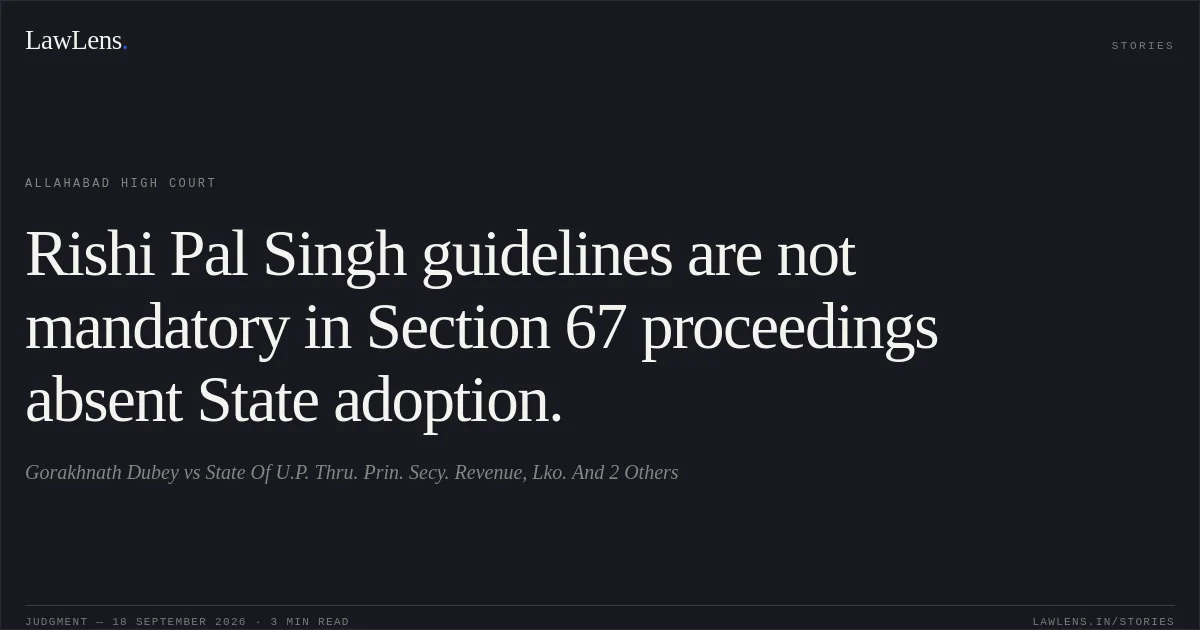
Source reference: paras. 22–27Whether the procedure and guidelines laid down in Rishi Pal Singh v. State of U.P. were mandatory and had not been followed, thereby invalidating the proceedings?
Source reference: paras. 4–5, 19–22Whether the concurrent findings of encroachment recorded by the revenue authorities were perverse, unsupported by evidence, or otherwise amenable to interference under Article 226 of the Constitution?
Source reference: paras. 25, 29Law Applied
The Court applied Section 67 of the U.P. Revenue Code, 2006, concerning removal of unauthorized occupation from public or Gaon Sabha land, along with the procedure prescribed under the U.P. Revenue Code Rules, 2016.
Source reference: no citationIt considered Rishi Pal Singh v. State of U.P., 2022 SCC OnLine All 829, which laid down procedural guidelines for proceedings under Sections 67, 67-A and 26; however, relying on Shahban v. State of U.P., 2026 SCC OnLine All 1246, the Court held that those guidelines were not mandatory unless adopted by the State through amendment of the Rules, particularly because some directions would convert the summary statutory procedure into a regular trial-like procedure.
Source reference: paras. 19–21The Court further applied the principle that concurrent findings of fact are ordinarily not disturbed under Article 226 unless they are perverse, based on no evidence, or suffer from an error of law, as recognized in Municipal Corporation, Aurangabad v. State of Maharashtra, (2015) 16 SCC 689 and Surinder Singh v. S. Teja Singh Manshia, (2007) 15 SCC 785.
Source reference: para. 25It also relied on Kaniz Ahmed v. Sabuddin, 2025 SCC OnLine SC 995, reiterating that courts must adopt a strict approach toward illegal construction and should not facilitate or regularize unlawful occupation or construction.
Source reference: para. 18Reasoning
The Court found that the petitioner had filed an objection and had expressly sought time to produce evidence, but failed to produce any evidence during the nearly five-year pendency of the proceedings.
Source reference: paras. 11, 23The record therefore did not support the allegation that he had been denied a hearing.
Source reference: no citationThe plea of chronic illness was rejected because the medical documents produced related to a period after the order under Section 67 had already been passed and did not establish incapacity during the relevant proceedings.
Source reference: para. 24The Court further held that the petitioner’s reliance on Rishi Pal Singh was misplaced because, under Shahban, the additional guidelines were not mandatory absent their statutory adoption by the State; moreover, the petitioner did not identify any express procedure under the Code or Rules that had been violated.
Source reference: paras. 20–22The Lekhpal’s report, revenue entries, and concurrent findings of the authorities established unauthorized occupation of public land, and no perversity, legal error, or evidentiary failure warranting Article 226 interference was demonstrated.
Source reference: paras. 28–29Holding
The High Court held that the petitioner had been afforded adequate opportunity, that his illness did not justify reopening the proceedings, and that the guidelines in Rishi Pal Singh were not mandatory in the absence of their adoption into the statutory framework.
Finding no illegality, infirmity, perversity, or jurisdictional error in the concurrent orders directing eviction from 0.006 hectare of Gaon Sabha Naveen Parti land, the Court dismissed the writ petition and declined to interfere under Article 226 of the Constitution.
Source reference: para. 29The reliefs seeking quashing of the orders and dropping of the Section 67 proceedings were consequently refused.
Source reference: para. 30Acts & Sections Cited
3 provisions across 1 statute referred to in this judgment. Linked provisions open on LawLens.
U.P. Revenue Code, 20063
Original Court PDF
Gorakhnath DubeyvsState Of U.P. Thru. Prin. Secy. Revenue, Lko. And 2 Others
Click to open original judgment
Original judgment, available to read, download and summarize on LawLens.in