Facts
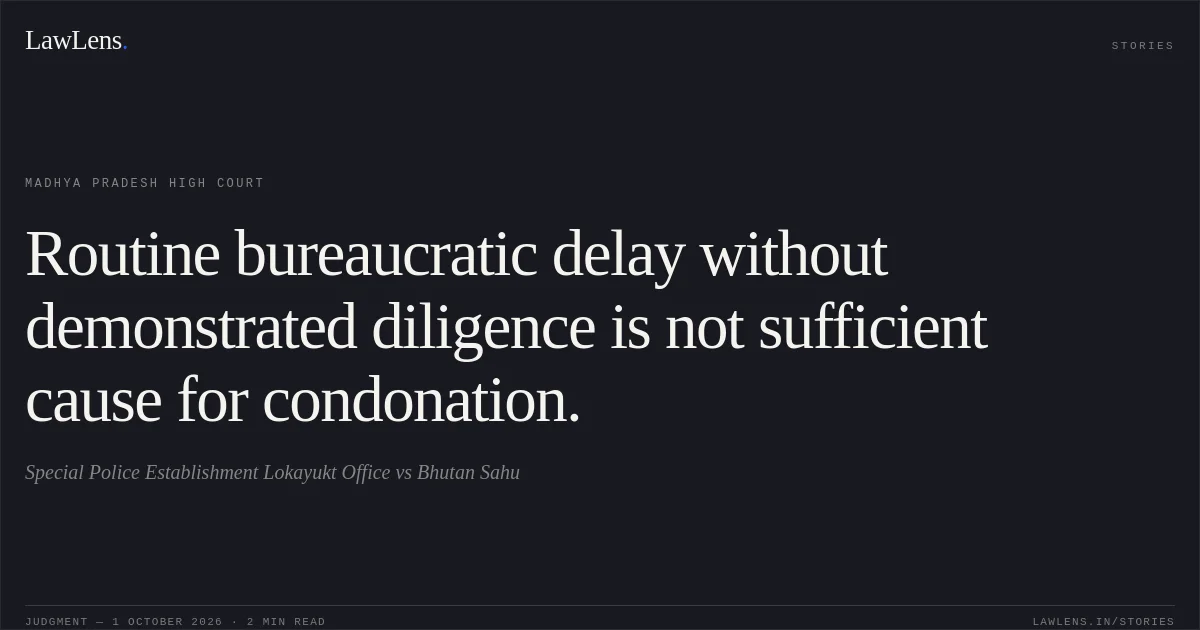
The Special Police Establishment, Lokayukta, sought leave to appeal against the respondent’s acquittal, dated 10 September 2025, of offences under Sections 7 and 13(1)(d) read with Sections 13(2) and 10 of the Prevention of Corruption Act.
Source reference: para. 2–6The application for leave was filed 236 days beyond the prescribed 90-day period. The appellant attributed the delay to the process of obtaining the prosecutor’s opinion and headquarters’ approval, appointing an officer-in-charge, and preparing and submitting the appeal; it also relied on the time consumed by government procedures. The respondent opposed condonation, arguing that the explanation was vague and insufficient.
Source reference: para. 2–6Issues
Whether the appellant established “sufficient cause” under Section 5 of the Limitation Act for condoning the 236-day delay in filing its application for leave to appeal against acquittal.
Source reference: para. 11–15Whether the appellant’s reliance on bureaucratic processes and procedural delays warranted any special latitude because it was a State agency.
Source reference: para. 11, 14Law Applied
Section 5 of the Limitation Act permits condonation only where sufficient cause is established; the length of delay is not decisive, but the explanation must be acceptable and must account for the failure to act within the prescribed period (*Sheo Raj Singh v. Union of India*, as discussed at para 8; *DDA v. Tejpal*, para 9).
Source reference: para. 8–9Government entities receive no automatic or preferential treatment: bureaucratic red tape, file movement, or administrative inefficiency, without a cogent showing of bona fide conduct and reasonable diligence, is not by itself sufficient cause (*DDA v. Tejpal*, para 9; *Shivamma v. Karnataka Housing Board*, paras 210–219, 231–233, discussed at para 10).
Source reference: para. 9–10Although *State of Nagaland v. Lipok AO* recognised latitude for the State in appropriate circumstances, the court considered that principle in light of the later authorities and the requirement to assess each explanation on its facts.
Source reference: para. 7, 11Reasoning
The appellant’s account described the movement of documents and approvals through official channels but did not identify genuine impediments explaining why the delay occurred or demonstrate reasonable diligence despite efforts to file within time. The Court therefore treated the explanation as bureaucratic lethargy and avoidable inaction, rather than sufficient cause.
Source reference: para. 11, 14–15It also noted that the acquittal after trial fortified the respondent’s presumption of innocence and that a delayed challenge would affect the liberty of an acquitted person; the seriousness of the alleged offences did not excuse the appellant’s lack of diligence.
Source reference: para. 12–13Holding
The Court held that the appellant had not satisfactorily explained the 236-day delay or established sufficient cause under Section 5 of the Limitation Act.
It dismissed I.A. No. 22678/2026 for condonation of delay and, consequently, dismissed the criminal appeal.
Source reference: para. 15–17Acts & Sections Cited
7 provisions across 4 statutes referred to in this judgment. Each provision opens on LawLens.
Bharatiya Nagarik Suraksha Sanhita, 20231
Code of Criminal Procedure, 19731
Prevention of Corruption Act, 19883
Original Court PDF
Special Police Establishment Lokayukt OfficevsBhutan Sahu
Click to open original judgment
Original judgment, available to read, download and summarize on LawLens.in