01Facts
The petitioner, appearing in person, filed an RTI application dated 04.01.2022 seeking the status of his representation dated 28.10.2020 to the Secretary (Power), Ministry of Power (MoP).
¶ 1He also sought certified copies of file notings, the Secretary's comments and findings, an office order of disposal, and an MoP order directing the Board of Directors of PFC to issue a speaking or appeal order on his appeal dated 06.06.2019.
¶ 1By order dated 29.11.2023, the Court directed the respondents to seek instructions on when the information would be furnished.
¶ 2Over subsequent hearings, the Court issued further directions requiring the respondents to state their position on disclosure.
¶ 3By order dated 06.04.2026, the petitioner was directed to inspect records before the PIO on 08.04.2026, which he did.
¶ 4On 10.04.2026, the respondents stated that all available disclosable documents had been furnished, and the petitioner submitted a tabular chart alleging non-supply of certain documents.
¶ 5At the present hearing, the petitioner again alleged non-compliance.
¶ 6–7The respondents filed an item-wise tabular response identifying documents already handed over and those not available, with explanations.
¶ 6–7The response records, among other things, that PFC's reply to the representation dated 28.10.2020 was sent to MoP on 15.01.2021.
¶ 702Issues
i.1. Whether the respondents complied with the Court's earlier directions by furnishing the information and documents sought under the RTI application dated 04.01.2022.
¶ 6 · ¶ 11ii.2. Whether the petitioner's dissatisfaction with the sufficiency of the response, including his contention that records could not be unavailable after a lapse of time, warrants continuation of the proceedings or further directions.
¶ 9 · ¶ 10iii.3. Whether the right to information extends to information not held by, or under the control of, the public authority.
¶ 1003Law Applied
The judgment does not expressly cite the RTI Act, 2005, any specific section, or any precedent.
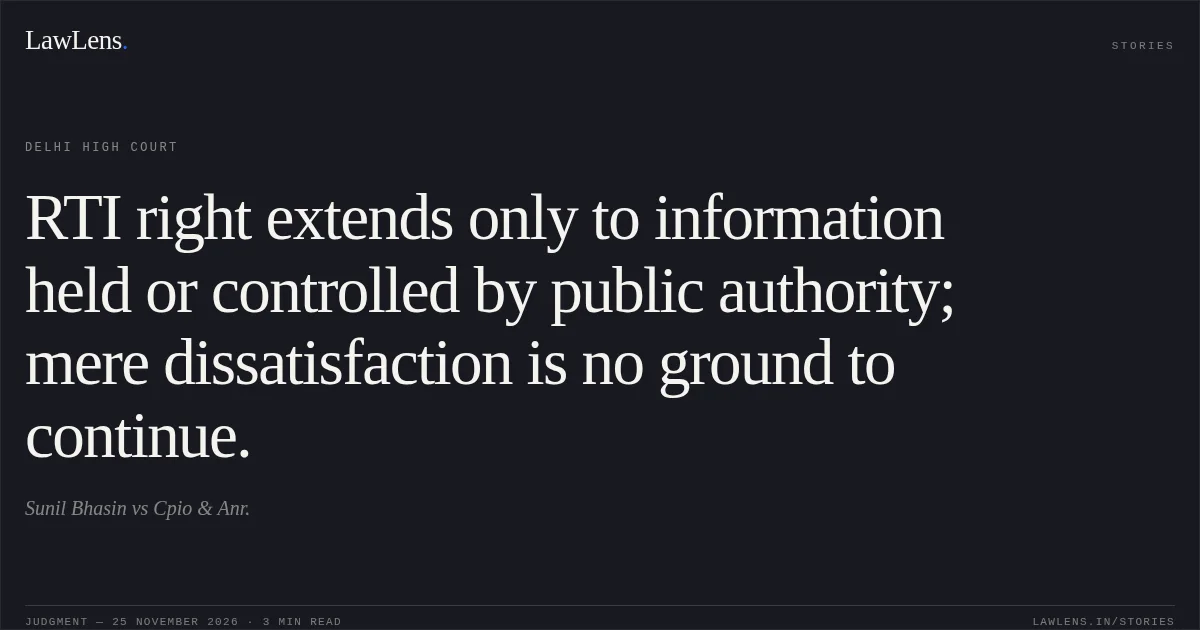
The Court's reasoning rests on the principle that the right to information extends only to information and records held by or under the control of the public authority.
¶ 10It also relies on the proposition that a party's dissatisfaction with a response is not, by itself, a ground to keep proceedings alive where the authority has furnished the information available and has stated its position on the rest.
¶ 10The Court's earlier orders of 29.11.2023 and 06.04.2026 defined the scope of the directions that the respondents were required to comply with.
¶ 2, 4, 1104Reasoning
The Court examined the respondents' item-wise chart and found that, wherever relevant records existed, they had been furnished or the petitioner had been referred to copies already supplied.
¶ 8Where records were not available, the respondents specifically explained their non-availability.
¶ 8The petitioner's challenge to the credibility of the non-availability position, based on the passage of time, did not alter this assessment.
¶ 9Applying the principle that the right to information is confined to information held or controlled by the public authority, the Court held that the petitioner could not compel disclosure of records the respondents stated did not exist.
¶ 10The Court therefore treated the respondents' explanations as satisfying its earlier directions, since the petitioner's dissatisfaction with the response did not establish non-compliance.
¶ 10–1105Holding
The respondents complied with the Court's directions. The information available with them was furnished, and the status of the remaining documents was specifically explained.
¶ 11The Court held that no further direction was called for.
¶ 12The petition is accordingly disposed of.
¶ 13Original Court PDF
Sunil BhasinvsCpio & Anr.
Click to open original judgment
Original judgment, available to read, download and summarize on LawLens.in