Facts
Bharat Heavy Electricals Limited (“the Appellant”) was registered under the service-tax regime and provided taxable services, including works contract, repair and commissioning services.
Source reference: p.2It availed CENVAT credit and, in respect of common input services used for taxable and allegedly exempt activities, reversed credit under Rule 6(3A) of the CENVAT Credit Rules, 2004 (“CCR”).
Source reference: p.2The Appellant calculated the reversal with reference to common CENVAT credit, excluding credit attributable exclusively to taxable output services or dutiable goods.
Source reference: pp.2–3Following investigation by the DGGI, a show-cause notice dated 17 September 2020 proposed recovery of ₹10,99,10,976 for 2014–15 and 2015–16, alleging that the Appellant ought to have used its total CENVAT credit, rather than common CENVAT credit, in the Rule 6(3A) formula.
Source reference: p.3The notice also invoked the extended limitation period, interest and penalties.
Source reference: p.3The adjudicating authority confirmed the demand on the same basis.
Source reference: p.3Issues
1. Whether, for computing the proportionate reversal under Rule 6(3A) of the CCR, “total CENVAT credit” included credit attributable exclusively to taxable output services or dutiable goods, or was confined to common CENVAT credit
Source reference: pp.5, 8–92. Whether trading activity could be treated as an exempted service for purposes of Rule 6 of the CCR
Source reference: pp.9–103. Whether the extended limitation period could be invoked in the absence of fraud, wilful misstatement, suppression of facts, or intent to evade service tax
Source reference: pp.6–8Law Applied
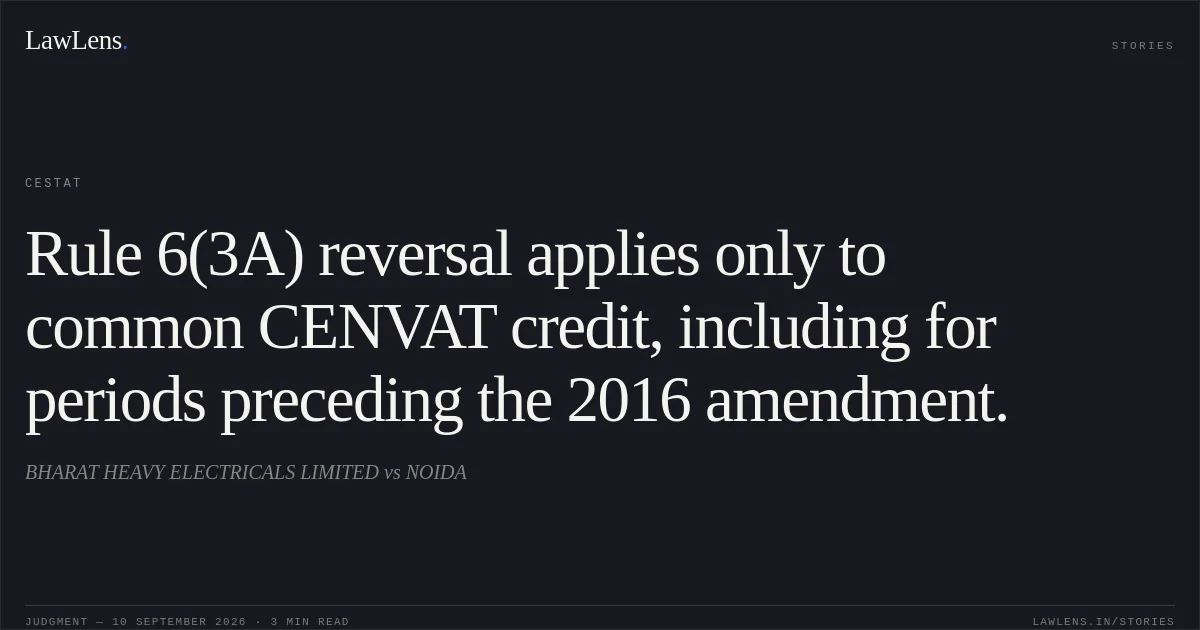
The Tribunal applied Rule 6(1), 6(2) and 6(3A) of the CENVAT Credit Rules, 2004, holding that the proportionate reversal mechanism concerns common input-service credit and does not require disallowance of credit exclusively used for taxable output services or dutiable goods.
Source reference: pp.8–9It relied on CCE & ST v. Reliance Industries Ltd., 2019 (28) G.S.T.L. 96 (Tri.-Ahmd.), which held that “total CENVAT credit” in the Rule 6(3A) formula means the total common credit for the relevant purpose.
Source reference: p.8The Tribunal treated the 2016 amendment to Rule 6(3A) as clarificatory and therefore retrospective.
Source reference: p.9It further applied Rule 2(e) of the CCR and Sections 65B(25), 65B(44), 66B and 66D of the Finance Act, 1994, holding that trading or sale of goods is not a service and cannot be treated as an exempted service merely for Rule 6 purposes.
Source reference: pp.9–10On limitation, the Tribunal applied the settled principle that extended limitation requires deliberate fraud, collusion, wilful misstatement, suppression of facts, or contravention with intent to evade duty; mere omission, negligence, bona fide error, or a different interpretation of law is insufficient.
Source reference: pp.6–8It relied, inter alia, on Pushpam Pharmaceuticals Co. v. Collector of Central Excise, Bombay, 1995 (78) E.L.T. 401 (S.C.), and G.D. Goenka, Final Order No. 51088/2023.
Source reference: pp.6–8Reasoning
The Tribunal found that the Appellant had disclosed its CENVAT-credit reversals in its ST-3 returns and had adopted a legally sustainable interpretation of Rule 6(3A).
Source reference: pp.8–9Credit exclusively attributable to taxable services or dutiable goods could not be included in the denominator for calculating the amount attributable to exempt activities, since doing so would effectively disallow otherwise admissible credit.
Source reference: pp.8–9The Tribunal also held that the department’s treatment of trading as an exempted service was conceptually and legally incorrect: trading involves transfer of title in goods and is outside the statutory definition of “service”.
Source reference: pp.9–10As to limitation, the Appellant’s returns disclosed the relevant credit and reversal figures, enabling departmental scrutiny.
Source reference: pp.6–8The mere fact that the department detected the alleged short-reversal during a later investigation did not establish intentional suppression or an intent to evade tax.
Source reference: pp.6–8The Tribunal therefore held that the extended limitation period was unavailable.
Source reference: pp.6–8In light of the correct interpretation of Rule 6 and the absence of suppression, the entire demand, interest and penalties could not be sustained.
Source reference: no citationHolding
The Tribunal answered the issues in favour of the Appellant.
It held that only common CENVAT credit was relevant for the proportionate reversal under Rule 6(3A), that trading could not be treated as an exempted service for this purpose, and that the extended limitation period was not invocable without proof of deliberate suppression or intent to evade tax.
Source reference: pp.8–10The impugned order was set aside, and the appeal was allowed with consequential relief, if any, in accordance with law.
Source reference: p.10Acts & Sections Cited
1 provisions across 1 statute referred to in this judgment. Each provision opens on LawLens.
Central Excise Act, 19441
Original Court PDF
BHARAT HEAVY ELECTRICALS LIMITEDvsNOIDA
Click to open original judgment
Original judgment, available to read, download and summarize on LawLens.in