Facts
M/s Gayatri Sugars Ltd. manufactured sugar and molasses, on which central excise duty was paid.
Source reference: para. 3Bagasse arose as an agricultural by-product during crushing of sugarcane; the appellant used part of it to generate electricity for captive consumption and sold the remaining electricity to APTRANSCO.
Source reference: para. 3Press-mud, another by-product, was distributed free of cost to cane growers as manure.
Source reference: para. 3The appellant did not maintain separate accounts for inputs and input services used in the manufacture of dutiable sugar and molasses and the non-dutiable by-products.
Source reference: para. 4The Department issued a show-cause notice dated 22 May 2013 for the period April 2008 to March 2013, proposing recovery under Rule 6(3) of the Cenvat Credit Rules, 2004 (“CCR”) of Rs. 80,07,233 on electricity sold to APTRANSCO and Rs. 20,915 on press-mud.
Source reference: para. 5The Commissioner confirmed the demands, along with interest and penalty, by Order-in-Original dated 3 January 2014.
Source reference: paras. 1, 6The appellant challenged that order before the CESTAT.
Source reference: no citationIssues
1. Whether Rule 6(3) of the CCR could be invoked to demand an amount on electricity generated from bagasse, when bagasse is an agricultural waste or residue and is not the result of a manufacturing process.
Source reference: paras. 7–8, 12–132. Whether the Department could directly select and enforce the payment option under Rule 6(3), instead of allowing the assessee to exercise the applicable options under Rule 6.
Source reference: para. 7; para. 133. Whether reversal of proportionate Cenvat credit by the appellant amounted to non-availment of credit, thereby negating the demand, interest and penalty.
Source reference: paras. 9–10, 13Law Applied
The Tribunal applied Rule 6 of the Cenvat Credit Rules, 2004, which regulates credit attributable to exempt or non-dutiable goods and prescribes alternative methods for compliance.
Source reference: paras. 7, 13It relied on Union of India v. DSCL Sugar Ltd., 2015 (322) E.L.T. 769 (S.C.), holding that bagasse is agricultural waste or residue, is not the result of manufacture under Section 2(f) of the Central Excise Act, 1944, and consequently does not attract Rule 6 of the CCR.
Source reference: para. 12It further relied on Tiara Advertising v. Union of India, 2019 (10) TMI 27 (Telangana and Andhra Pradesh High Court), for the proposition that the Department cannot compel recovery under one particular option of Rule 6(3) when the rule provides alternative mechanisms available to the assessee.
Source reference: paras. 7, 13The Tribunal also applied Chandrapur Magnets Pvt. Ltd. v. CCE, 1996 (81) E.L.T. 3 (S.C.), which recognises that reversal of credit is equivalent to non-availment of credit.
Source reference: paras. 9, 13Interest and penalty cannot survive where the underlying demand is unsustainable.
Source reference: para. 10Reasoning
The Tribunal found the case materially covered by DSCL Sugar Ltd.
Source reference: para. 12Bagasse was treated as agricultural waste or residue arising during the manufacture of sugar, rather than as a manufactured or excisable product.
Source reference: para. 12Since bagasse was not the result of manufacture under Section 2(f), the foundational condition for applying Rule 6 of the CCR was absent; consequently, Rule 6 could not be invoked merely because electricity generated from bagasse was sold to APTRANSCO.
Source reference: para. 12The Tribunal additionally accepted that the Department could not unilaterally impose the Rule 6(3) payment mechanism in view of Tiara Advertising.
Source reference: para. 13It also accepted the appellant’s contention that the proportionate reversal of Rs. 5,53,773 in Cenvat credit was legally equivalent to not availing that credit, applying Chandrapur Magnets.
Source reference: paras. 9, 13These findings rendered the demand, and consequently the related interest and penalty, unsustainable.
Source reference: no citationHolding
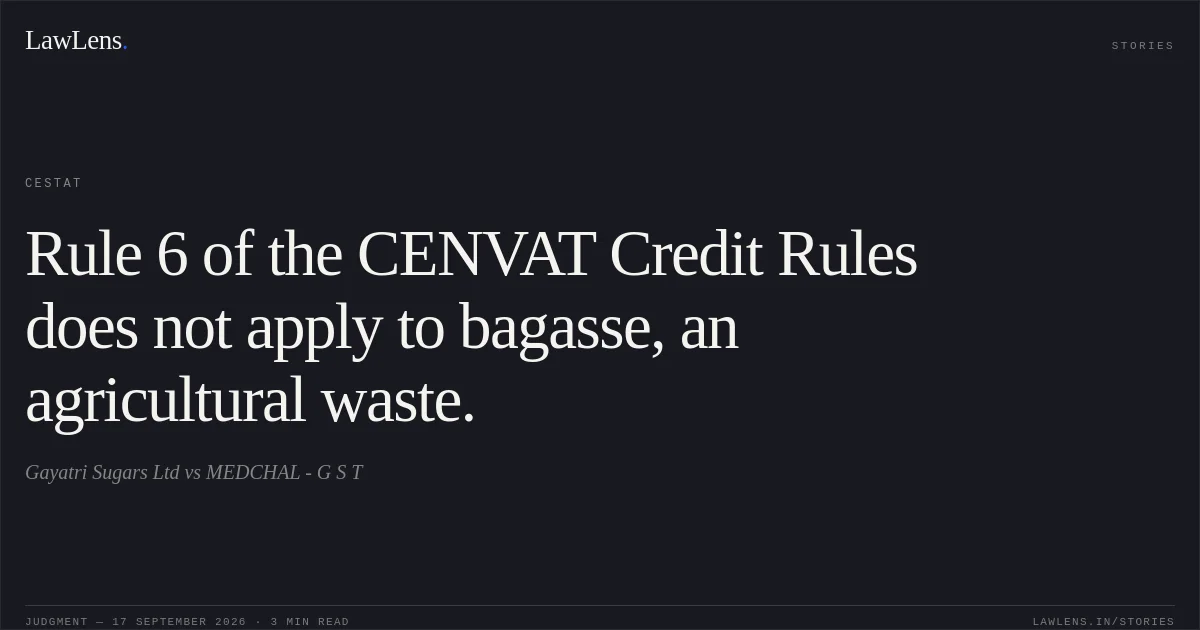
The Tribunal held that the impugned demand under Rule 6(3) of the CCR was not legally sustainable, principally because bagasse was not a manufactured product and Rule 6 therefore had no application.
It also accepted the appellant’s alternative contentions concerning the impermissible selection of the Rule 6(3) option and reversal of proportionate credit.
Source reference: para. 13The appeal was allowed, the Order-in-Original dated 3 January 2014 was set aside, and consequential relief was granted to the appellant.
Source reference: para. 14Acts & Sections Cited
3 provisions across 1 statute referred to in this judgment. Each provision opens on LawLens.
Central Excise Act, 19443
Original Court PDF
Gayatri Sugars LtdvsMEDCHAL - G S T
Click to open original judgment
Original judgment, available to read, download and summarize on LawLens.in