Facts
The petitioner, formerly Superintendent, Central Jail, Raipur, superannuated on 31 August 2010.
Source reference: paras. 3, 12–13Allegations concerned irregularities in procurement during 2004–05 and 2005–06, including failure to accept the lowest tender and an alleged loss of ₹1,09,975 to the State.
Source reference: paras. 3, 12–13On 22 January 2013, the Council of Ministers permitted institution of departmental proceedings under Rule 9 of the Chhattisgarh Civil Services (Pension) Rules, 1976 (“1976 Rules”).
Source reference: para. 11Although the alleged events were more than four years old, the State purported to relax the four-year restriction under Rule 79, after obtaining Finance Department concurrence; however, the Administrative Department did not record reasons for the relaxation.
Source reference: paras. 12–13A charge-sheet was issued on 29 May 2013, and disciplinary proceedings were thereafter conducted.
Source reference: paras. 3, 13–14By order dated 18 October 2019, the State imposed recovery of ₹1,09,975 from the petitioner’s retiral benefits under Rule 9(5) of the 1976 Rules.
Source reference: paras. 2, 14–15The petitioner challenged the order as being barred by Rule 9(2)(b)(ii).
Source reference: no citationIssues
Whether departmental proceedings could be instituted against the retired petitioner in respect of events occurring more than four years before their institution, contrary to Rule 9(2)(b)(ii) of the 1976 Rules.
Source reference: para. 1Whether the State Government could invoke the general power of relaxation under Rule 79 to dispense with or extend the mandatory four-year limitation under Rule 9(2)(b)(ii).
Source reference: paras. 1, 23–24Whether the purported relaxation was invalid because the Administrative Department failed to record reasons in writing as required by Rule 79.
Source reference: paras. 4, 13, 35Law Applied
Rule 9(2)(b)(i) of the 1976 Rules requires Government sanction before instituting post-retirement departmental proceedings, while Rule 9(2)(b)(ii) prohibits proceedings relating to an event occurring more than four years before their institution.
Source reference: paras. 16–18The Court treated these provisions as mandatory safeguards intended to protect retired government servants from stale and unwarranted proceedings.
Source reference: paras. 18–22Rule 79 permits relaxation only where operation of a rule causes undue hardship in a particular case, for reasons recorded in writing, and in a just and equitable manner, subject to Finance Department concurrence.
Source reference: para. 23Relying on Brajendra Singh Yambem v. Union of India, (2016) 9 SCC 20, and State of U.P. v. Shri Krishna Pandey, (1996) 9 SCC 395, the Court held that the four-year restriction is a mandatory limitation and that proceedings initiated beyond it are incompetent.
Source reference: paras. 20–22The Court further relied on J.C. Yadav v. State of Haryana, (1990) 2 SCC 189, and related authorities to hold that relaxation powers exist to mitigate undue hardship and cannot be used as an unfettered power to override or rewrite substantive statutory restrictions.
Source reference: paras. 25–31Reasoning
The alleged misconduct occurred in 2004–05 and 2005–06, while the petitioner had already retired in 2010 and the charge-sheet was issued in 2013, clearly beyond the four-year period prescribed by Rule 9(2)(b)(ii).
Source reference: paras. 12, 35The Court held that the provision was not merely procedural but a mandatory statutory protection against stale post-retirement proceedings.
Source reference: paras. 18–22Rule 79 could not be used to revive an action already barred by limitation, because its purpose was to alleviate genuine undue hardship and ensure a just and equitable result, not to dispense with an express prohibition.
Source reference: paras. 23–24, 32–34In any event, the State failed to satisfy the procedural requirement of recording reasons in writing: the record showed only Finance Department concurrence, without a reasoned decision by the Administrative Department establishing undue hardship or explaining why relaxation was just and equitable.
Source reference: paras. 12–13, 33, 35The purported relaxation was therefore both substantively impermissible and procedurally defective.
Source reference: no citationHolding
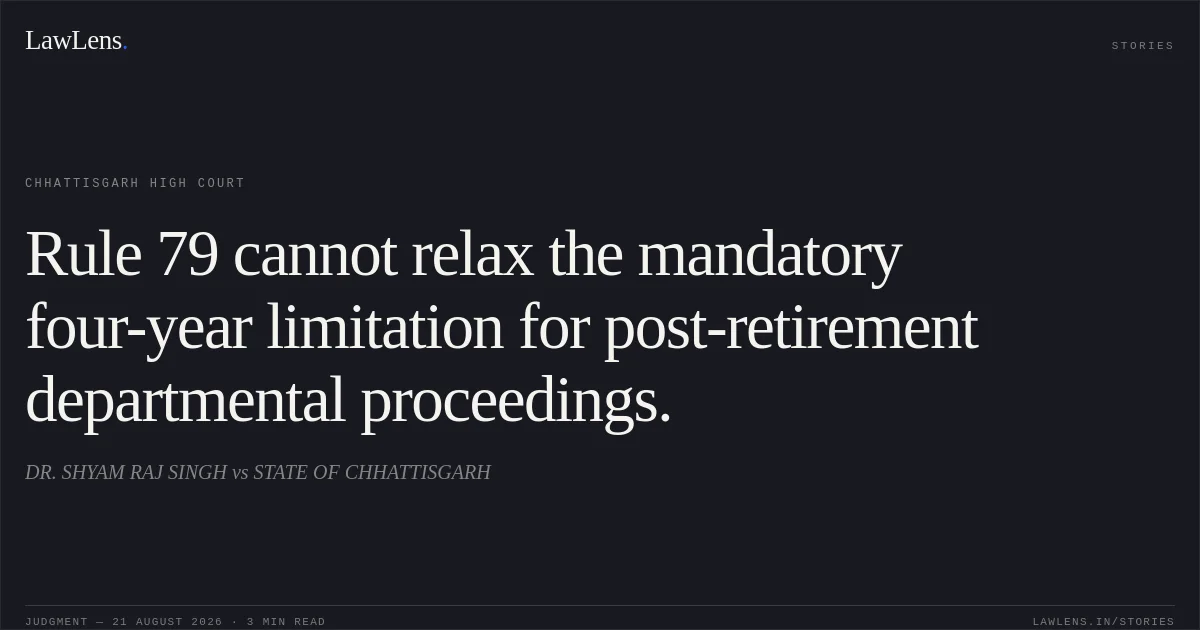
The Court answered the issues against the State and held that Rule 79 could not lawfully be invoked to relax or override the mandatory four-year bar under Rule 9(2)(b)(ii).
The post-retirement departmental proceedings concerning events of 2004–05 and 2005–06 were barred by limitation, and the absence of recorded reasons independently invalidated the purported relaxation.
Source reference: para. 35Accordingly, the order dated 18 October 2019 directing recovery of ₹1,09,975 from the petitioner was quashed, the writ petition was allowed, and no order as to costs was made.
Source reference: para. 37Acts & Sections Cited
1 provisions across 1 statute referred to in this judgment. Linked provisions open on LawLens.
Rules of 19761
Original Court PDF
DR. SHYAM RAJ SINGHvsSTATE OF CHHATTISGARH
Click to open original judgment
Original judgment, available to read, download and summarize on LawLens.in