Facts
The petitioners, a mother and her two sons, challenged the cancellation of a patta issued in respect of 4.90 acres of Government land assigned to the petitioners’ predecessor under an Assignment Order dated 15 April 1965 and evidenced by Patta dated 31 January 1970.
Source reference: paras. 1–2; pp. 3–4The original assignee transferred the property to his daughter, the first petitioner, through a settlement deed dated 23 June 1967, during the ten-year period of non-alienation stipulated in the Assignment Order.
Source reference: paras. 2, 6, 9; pp. 4, 8, 16–18The first petitioner subsequently settled the property in favour of petitioners 2 and 3 in 1978.
Source reference: para. 2; p. 4On an application submitted by the sixth respondent on 20 February 2017—approximately 52 years after the assignment and 50 years after the alleged violation—the District Collector cancelled the patta under Rule 8(3) of the Kerala Land Assignment Rules, 1964.
Source reference: paras. 2, 13, 16; pp. 4, 23–28The Land Revenue Commissioner dismissed the petitioners’ appeal and confirmed the cancellation.
Source reference: paras. 2, 13, 16; pp. 4, 23–28Issues
Whether the transfer of the assigned property by the original assignee to his adult, married and employed daughter within the prescribed period constituted a prohibited alienation under Rule 8 of the Kerala Land Assignment Rules, 1964.
Source reference: paras. 6–9; pp. 8–19Whether the Government could initiate proceedings under Rule 8(3) to cancel the assignment after approximately 50 years from the alleged breach of the non-alienation condition.
Source reference: paras. 12–16; pp. 23–28Whether the alleged presence of quarryable rock or the petitioners’ attempt to obtain quarrying permissions independently justified cancellation of the assignment.
Source reference: paras. 10–11; pp. 19–22Law Applied
The Court applied Rule 8 of the Kerala Land Assignment Rules, 1964, under which the assignment could be resumed or cancelled for breach of the conditions of assignment, including the applicable condition of non-alienation; for the 1965 assignment, that period was ten years.
Source reference: paras. 9, 15; pp. 16–18, 27–28Under Rule 2(d), only children living with or dependent on the assignee fall within the relevant definition of “family”; therefore, a daughter who was an adult, married and employed was not protected from the non-alienation restriction.
Source reference: para. 9; pp. 17–19Section 8 of the Kerala Government Land Assignment Act, 1960, gives effect to the conditions and restrictions contained in the assignment document or patta, notwithstanding contrary law or custom.
Source reference: para. 7; pp. 10–11Relying on Chandy Chandy v. District Collector, 2025 KLT OnLine 2260, the Court held that Rule 8 does not prescribe an express limitation period, but the power of cancellation must be exercised within a reasonable period; the period of non-alienation under Rule 8(1) provides guidance for determining that period.
Source reference: paras. 14–15; pp. 24–28The Court also applied Article 112 of the Limitation Act, 1963, under which a suit by the Government for recovery of possession is subject to a thirty-year limitation period.
Source reference: para. 15; p. 28The Court further considered the principles in Mathew John v. Land Revenue Commissioner, Varkey Abraham v. Secretary to Government, and related precedents concerning the primacy of the assignment order, exclusion of quarry lands, and use of assigned land for its assigned purpose.
Source reference: paras. 7, 9–11; pp. 10–22Reasoning
The Court held that the transfer to the first petitioner did violate the ten-year non-alienation condition.
Source reference: para. 9; pp. 16–19The restriction in the Assignment Order prevailed over the allegedly struck-off condition in the patta, particularly because the deletion was unauthenticated; moreover, the first petitioner was not a dependent or co-residing child within Rule 2(d).
Source reference: para. 9; pp. 16–19However, the breach occurred in 1967, whereas cancellation proceedings were initiated only in 2017.
Source reference: paras. 13–16; pp. 23–28Applying Chandy Chandy, the Court rejected the argument that the reasonable-time principle applied only to defects in the original grant and not to breaches of assignment conditions.
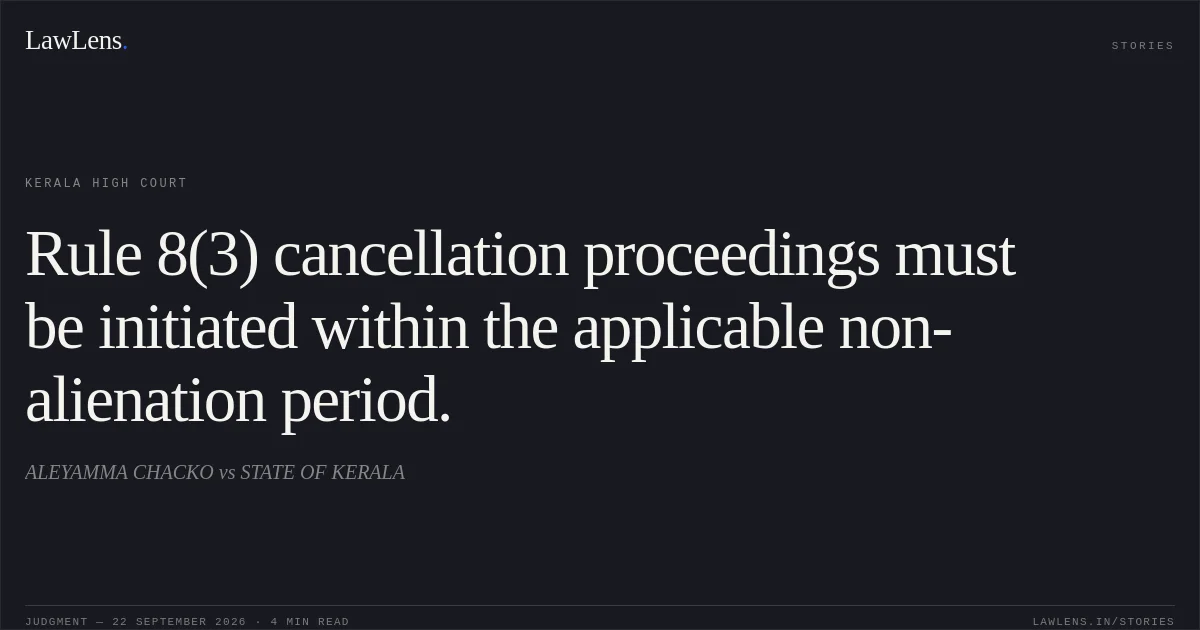
Source reference: paras. 13–16; pp. 23–28It held that the power under Rule 8(3) could not be exercised indefinitely and that, in this case, proceedings initiated nearly 50 years after the breach were beyond the permissible period.
Source reference: paras. 13–16; pp. 23–28The delay was particularly unjustified because the Government itself had not initiated action and had allowed the assignees’ rights to remain undisturbed for decades.
Source reference: paras. 13–16; pp. 23–28The Court also rejected the quarry-related grounds: the record did not establish that the land contained rock to an extent making it an unassignable quarry, and no quarrying had actually been undertaken.
Source reference: paras. 10–11; pp. 19–22The questions concerning future quarrying and compliance with the purpose of assignment were left open.
Source reference: paras. 10–11; pp. 19–22Holding
The Court answered that, although the 1967 transfer technically breached the ten-year non-alienation condition, the cancellation proceedings initiated approximately five decades later were time-barred and legally unsustainable.
The writ petition was allowed, and the Court issued a writ of certiorari quashing the proceedings culminating in the District Collector’s cancellation order dated 11 April 2019 and the Land Revenue Commissioner’s appellate order dated 4 October 2019.
Source reference: para. 17; p. 29The Court left open the separate questions concerning the legality of any future quarrying activity and the use of the assigned land for purposes other than those authorised by the assignment.
Source reference: paras. 10–11; pp. 21–22Acts & Sections Cited
1 provisions across 1 statute referred to in this judgment. Each provision opens on LawLens.
Limitation Act, 19631
Original Court PDF
ALEYAMMA CHACKOvsSTATE OF KERALA
Click to open original judgment
Original judgment, available to read, download and summarize on LawLens.in