Facts
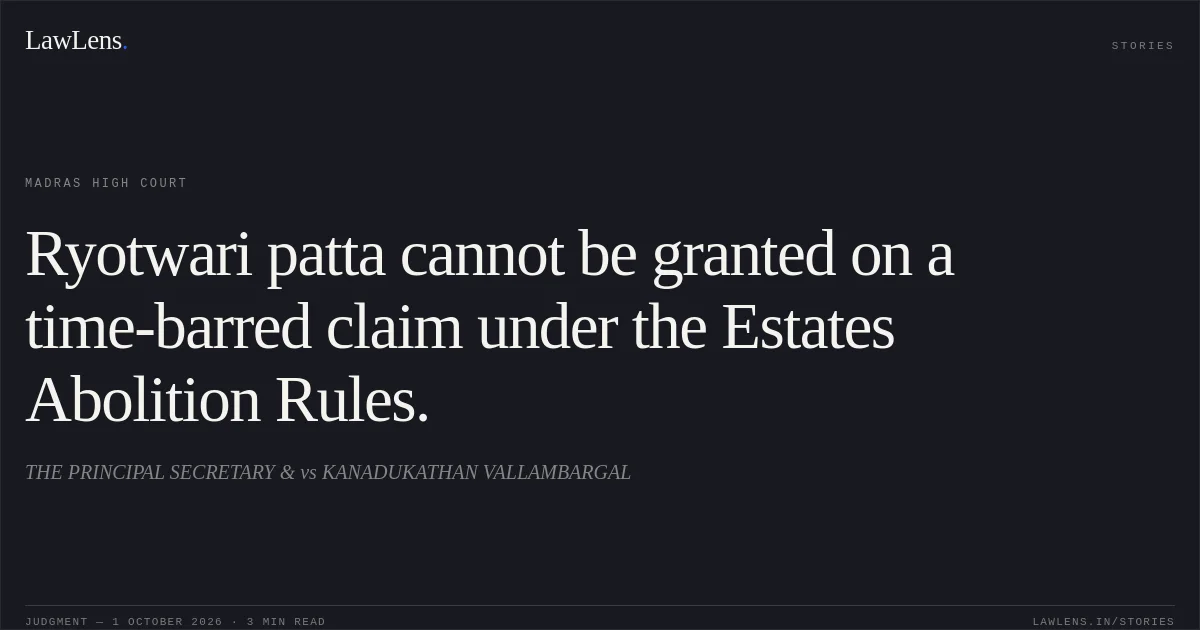
The dispute concerned lands in Survey Nos. 485/1, 490, 492 and 118 at Kanadukathan, part of an estate taken over by the Government under the Tamil Nadu Estates (Abolition and Conversion into Ryotwari) Act, 1948, on 7 September 1949.
Source reference: para. 41–42The Vallambars sought ryotwari patta.
Source reference: para. 52–56After an initial rejection on limitation grounds in 1964, the Director of Settlements remanded the matter for fresh enquiry; the Assistant Settlement Officer granted patta in 1967, relying substantially on findings concerning other nearby lands.
Source reference: para. 52–56A 1969 notice seeking to reopen the grant was quashed by the High Court in W.P. No. 3652 of 1969; the Animal Husbandry Department, to which the lands had been transferred under G.O. Ms. No. 1533 dated 23 April 1959, was not a party to that writ proceeding.
Source reference: para. 65–68Following later review and appellate proceedings, the patta was cancelled by the Settlement Officer, whose decision was affirmed by the higher authorities.
Source reference: para. 12–13, 80–82The learned Single Judge set aside those cancellation orders, holding that the authorities could not reopen an issue concluded by the 1971 writ order.
Source reference: para. 12–13, 80–82The State appealed.
Source reference: para. 12–13, 80–82Issues
1. Whether the patta claim was barred because it was not made within the prescribed period and the relevant lands were not shown to have been included in the Vallambars’ holdings immediately before the notified date.
Source reference: para. 58–64, 822. Whether the 1971 order in W.P. No. 3652 of 1969 finally determined the Vallambars’ entitlement to patta so as to prevent subsequent statutory authorities from examining or cancelling it.
Source reference: para. 68–72, 81–833. Whether the learned Single Judge’s order restoring the patta should be set aside in light of the limitation issue and the Animal Husbandry Department’s absence from the earlier writ proceeding.
Source reference: para. 72, 82–89Law Applied
Section 11(a) of the Tamil Nadu Estates (Abolition and Conversion into Ryotwari) Act, 1948 entitles a ryot to patta only for qualifying ryoti lands that, immediately before the notified date, were included or ought properly to have been included in the ryot’s holding.
Source reference: para. 57–61The Court considered the definitions of “ryot” and “ryoti land” in Sections 3(15) and 3(16) of the Tamil Nadu Estates Land Act, 1908, requiring, respectively, a qualifying agricultural holding and cultivable land.
Source reference: para. 49–50It applied Rule 2(a) of the 1948 Rules as prescribing the period for applications for patta and providing that a late application must be dismissed, even where sufficient cause is shown.
Source reference: para. 62–64The Court also affirmed the principle that a statutory authority cannot sit in appeal over a High Court order, while distinguishing that principle where the earlier order had not adjudicated the substantive limitation issue or the entitlement to patta.
Source reference: para. 82, 84, 88Reasoning
The Court held that the original patta claim had been rejected as time-barred, but neither the Director’s remand nor the subsequent patta orders addressed that threshold issue.
Source reference: para. 54–59, 69–71, 75–78The Assistant Settlement Officer relied on decisions concerning other lands and did not establish that these lands were ryoti lands included in the Vallambars’ holdings before the notified date.
Source reference: para. 54–59, 69–71, 75–78The 1971 writ order quashed the reopening notice but did not decide the limitation question; moreover, the Animal Husbandry Department, which claimed the lands under the 1959 Government Order, was not a party to that proceeding.
Source reference: para. 68–72, 82–88The Court therefore held that the earlier order did not sustain the patta against the unresolved statutory requirements.
Source reference: para. 68–72, 82–88Holding
The writ appeal was allowed and the learned Single Judge’s order was set aside.
The pattas granted on 31 March 1967 and 22 April 1994 were cancelled, and the lands in Survey Nos. 485/1, 490, 492 and 118 were confirmed as transferred to and vesting with the Animal Husbandry Department under G.O. Ms. No. 1533 dated 23 April 1959.
Source reference: para. 89The connected miscellaneous petitions were closed, with no order as to costs.
Source reference: para. 89Acts & Sections Cited
10 provisions across 2 statutes referred to in this judgment. Linked provisions open on LawLens.
Tamil Nadu Estates (Abolition and Conversion Into Ryotwari) Act, 1948
Tamil Nadu Estates Land Act, 19081
Original Court PDF
THE PRINCIPAL SECRETARY &vsKANADUKATHAN VALLAMBARGAL
Click to open original judgment
Original judgment, available to read, download and summarize on LawLens.in