Facts
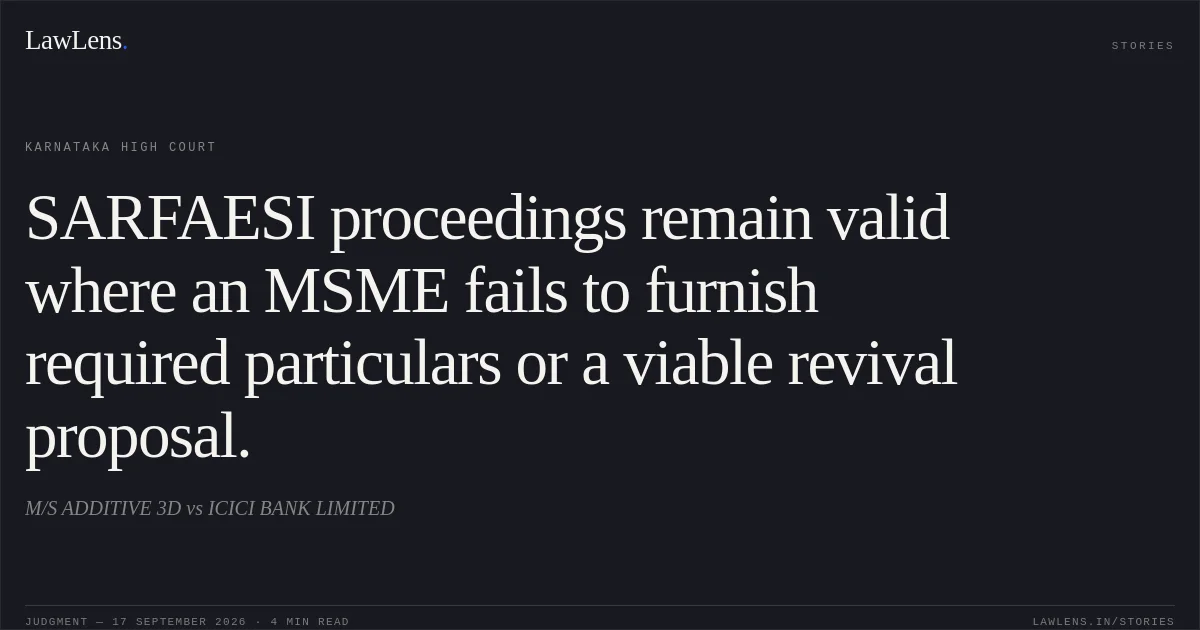
The first petitioner, M/s Additive 3D, claimed to be a registered micro enterprise holding a valid Udyam Registration dated 30 June 2021. It alleged that, pursuant to the Government of India Notification dated 29 May 2015 issued under Section 9 of the Micro, Small and Medium Enterprises Development Act, 2006 (“MSMED Act”), it submitted a representation to ICICI Bank on 10 July 2025 seeking constitution of a Stressed MSME Committee and consideration of revival or restructuring measures.
Source reference: paras. 2–3, pp. 3–5The Bank had extended an overdraft facility of approximately Rs. 530 lakhs under Account No. 317005000922. According to the Bank, the remaining credit facilities were personal or otherwise unrelated to the MSME business. The account was classified as a non-performing asset on 15 July 2025, following which the Bank issued a demand notice under Section 13(2) of the SARFAESI Act on 15 September 2025.
Source reference: paras. 12–14, pp. 14–17The petitioners submitted objections under Section 13(3A) of the SARFAESI Act, contending that the Bank could not initiate coercive recovery without first complying with the MSME revival and rehabilitation framework. The Bank maintained that it had convened a meeting on 14 July 2025 and had sought financial particulars, liabilities, business projections, GST records, details of other borrowings and a revival roadmap, but that the petitioners had failed to furnish the required material.
Source reference: paras. 4–5, 13–16, pp. 6–8, 15–19The Bank further asserted that the unit had not been operational since April 2025 and that the petitioners had not demonstrated a viable proposal for restarting the business. After rejecting the petitioners’ objections, the Bank issued a symbolic possession notice under Section 13(4) of the SARFAESI Act on 6 January 2026. The petitioners invoked Article 227 of the Constitution seeking quashing of the SARFAESI proceedings and a direction to constitute the stressed MSME committee.
Source reference: paras. 14–15, p. 3, pp. 16–18Issues
Whether the Bank’s failure to constitute a Stressed MSME Committee before initiating proceedings under Sections 13(2) and 13(4) of the SARFAESI Act rendered the recovery proceedings illegal or without jurisdiction
Source reference: paras. 6–11, 19–24, pp. 8–14, 20–26Whether the petitioners were entitled to invoke the MSME revival and rehabilitation framework when they had not furnished the information sought by the Bank and had not placed a concrete, viable proposal for revival of the allegedly non-operational unit
Source reference: paras. 19–23, pp. 21–25Whether the writ petition was maintainable in view of the alternative statutory remedy under Section 17 of the SARFAESI Act
Source reference: paras. 12, 18, pp. 14, 20Whether the MSME framework could be invoked in respect of all the petitioners’ liabilities, including personal or non-MSME loan facilities, merely because one borrower maintained an MSME account
Source reference: paras. 12–13, 22, pp. 14–16, 24–25Law Applied
The Court considered Section 9 of the MSMED Act, the Government of India Notification dated 29 May 2015 and the RBI Framework for Revival and Rehabilitation of MSMEs dated 17 March 2016, which require banks to identify financial stress in eligible MSME accounts and consider appropriate corrective, restructuring or revival measures. It also applied Sections 13(2), 13(3A) and 13(4) of the SARFAESI Act concerning demand notices, consideration of borrower objections and enforcement of security interests.
Source reference: para. 7, pp. 9–10Relying on Pro Knits v. Board of Directors of Canara Bank, (2024) 10 SCC 292, the Court recognised that an MSME seeking protection must produce authenticated and verifiable material before or at the stage when its account is classified as an NPA; once the account is classified as an NPA without such substantiation, the secured creditor may proceed under Chapter III of the SARFAESI Act.
Source reference: para. 7, pp. 9–10The Court also considered M/s Metro Steel Section v. Deputy General Manager, State Bank of India, W.P. No. 10305 of 2024, decided on 29 April 2025, for the principle that revival protection cannot ordinarily assist a unit that has ceased operations and has no credible revival proposal.
Source reference: para. 17, pp. 19–20The Court held that the MSME framework is not an automatic moratorium on recovery proceedings: the bank must consider an eligible and substantiated request fairly, but the borrower must cooperate and provide the information necessary to assess viability.
Source reference: paras. 19–23, pp. 21–25Reasoning
The Court accepted that the MSME revival framework is intended to prevent the premature closure of viable enterprises and cannot be disregarded by banks merely because recovery proceedings are available.
Source reference: para. 19, pp. 21–22However, registration as an MSME alone did not automatically invalidate SARFAESI action. The Bank had not rejected the petitioners’ request outright; it had convened a meeting and sought material necessary to evaluate the unit’s financial position, liabilities, business prospects and revival plan.
Source reference: paras. 13, 16 and 20, pp. 15–19, 22–23The petitioners did not furnish the requested particulars, did not file a rejoinder disputing the Bank’s factual assertions and did not place before the Court any concrete proposal identifying when operations would resume, what funds would be available or how the outstanding liability would be addressed.
Source reference: paras. 20–21, pp. 22–24Since the unit was admittedly not functioning and no commercially viable revival proposal was demonstrated, directing constitution of a committee would have been a mere formality.
Source reference: paras. 20–21, pp. 22–24The Court further held that personal and other non-MSME borrowings could not be brought within the MSME framework merely because the borrowers were associated with an MSME enterprise.
Source reference: para. 22, pp. 24–25Accordingly, the alleged non-constitution of the committee did not, on the facts, vitiate the SARFAESI proceedings.
Source reference: para. 24, p. 26Holding
The Court dismissed the writ petition and declined to quash the Bank’s actions under Sections 13(2) and 13(4) of the SARFAESI Act.
It held that the petitioners could not challenge the recovery proceedings solely on the ground that a Stressed MSME Committee had not been constituted, particularly when they had failed to provide the information sought by the Bank and had not established a viable possibility of revival.
Source reference: paras. 20–24, pp. 22–26No order was made as to costs, and all pending interlocutory applications were closed.
Source reference: final order, p. 26Acts & Sections Cited
5 provisions across 3 statutes referred to in this judgment. Each provision opens on LawLens.
Securitisation and Reconstruction of Financial Assets and Enforcement of Security Interest Act, 20022
Banking Regulation Act, 19491
Original Court PDF
M/S ADDITIVE 3DvsICICI BANK LIMITED
Click to open original judgment
Original judgment, available to read, download and summarize on LawLens.in