Facts
The petitioner, claiming membership of the Ramdasia Scheduled Caste, was born in Chandigarh and had completed her schooling there.
Source reference: para. 3; pp. 5–6She qualified NEET (UG) 2026 as an SC candidate and applied for admission to the MBBS course under the U.T. Chandigarh Pool.
Source reference: para. 3; pp. 5–6Although she produced an SC certificate issued by the Chandigarh authorities, the certificate described her as a “migrant” Scheduled Caste certificate.
Source reference: para. 3; pp. 5–6In the provisional revised combined merit list dated 20/21 August 2026, her SC candidature was rejected and she was shifted to the General Category on the ground that an SC migrant certificate was not eligible for an SC-reserved seat.
Source reference: para. 3; pp. 5–6The respondents defended the decision by relying upon Government of India instructions dated 22 February 2018 and 22 March 1977, and contended that Scheduled Caste status is territorial and cannot be carried by a migrant to another State or Union Territory.
Source reference: para. 4; pp. 6–7The writ petitions challenged the exclusion of the petitioners from the SC category under the U.T. Chandigarh Pool.
Source reference: no citationIssues
Whether the respondents could impose, after commencement of the admission process, an additional eligibility condition distinguishing between an “SC-bona fide resident” and an “SC-migrant” when no such distinction was contained in the admission prospectus.
Source reference: para. 6; p. 7Whether candidates satisfying the U.T. Pool eligibility conditions and possessing the prescribed SC certificate could be excluded from SC-reserved seats merely because their certificate described them as “migrant” Scheduled Caste certificates.
Source reference: paras. 12–14; pp. 11–13Law Applied
The Court applied the settled principle that an admission prospectus has the force of law and binds both the candidates and the admitting authority; eligibility conditions cannot be altered after the selection process has commenced.
Source reference: paras. 7–9; pp. 7–9It relied on Amandeep Singh Sahota v. State of Punjab, 1993 (2) PLR 212 (FB), Raj Singh v. Maharishi Dayanand University, 1994 (4) R.S.J. 289 (FB), and Rahul Prabhakar v. Punjab Technical University, 1997 (3) SCT 526, which prohibit departure from or alteration of notified admission conditions.
Source reference: paras. 7–8; pp. 7–9It also relied on Indu Gupta v. Director, Sports Punjab, 1999 (4) SCT 113 (FB), and Adarsh Dinkar Sontakke (Minor) v. Navodaya Vidyalaya Samiti, which establish that a new eligibility condition may be prescribed for future admissions but cannot retrospectively govern an ongoing admission process.
Source reference: para. 8; pp. 8–9The Court considered Article 341 of the Constitution and the Supreme Court decisions in Marri Chandra Shekhar Rao v. Dean, Seth G.S. Medical College, (1990) 3 SCC 130, and Action Committee v. Union of India, (1994) 5 SCC 244, relied upon by the respondents regarding the territorial operation of SC benefits, but held that those principles could not be introduced retrospectively contrary to the governing prospectus.
Source reference: para. 4; p. 6; para. 13; pp. 12–13Reasoning
The prospectus required an SC candidate to satisfy the general U.T. Pool eligibility conditions under Clause A-3, claim SC status in NEET (UG) 2026, and submit an SC certificate issued by the competent Chandigarh authority under Clause A-4.
Source reference: para. 10; pp. 9–10It did not require proof that the candidate’s ancestors had resided in Chandigarh before 1 November 1966, did not restrict SC reservation to persons of Chandigarh origin, and did not declare a certificate bearing the word “migrant” to be invalid or sufficient to shift the candidate to the General Category.
Source reference: para. 12; pp. 11–12Reading the Government of India instructions into the prospectus would effectively modify the notified eligibility criteria and render candidates ineligible after they had applied and participated in the process.
Source reference: para. 13; pp. 12–13This would impermissibly alter the “rules of the game” after commencement of selection.
Source reference: para. 13; pp. 12–13Accordingly, whatever may be the validity or applicability of such instructions in a future admission process, they could not be retrospectively applied to the 2026–27 admissions.
Source reference: paras. 13–14; pp. 12–13Holding
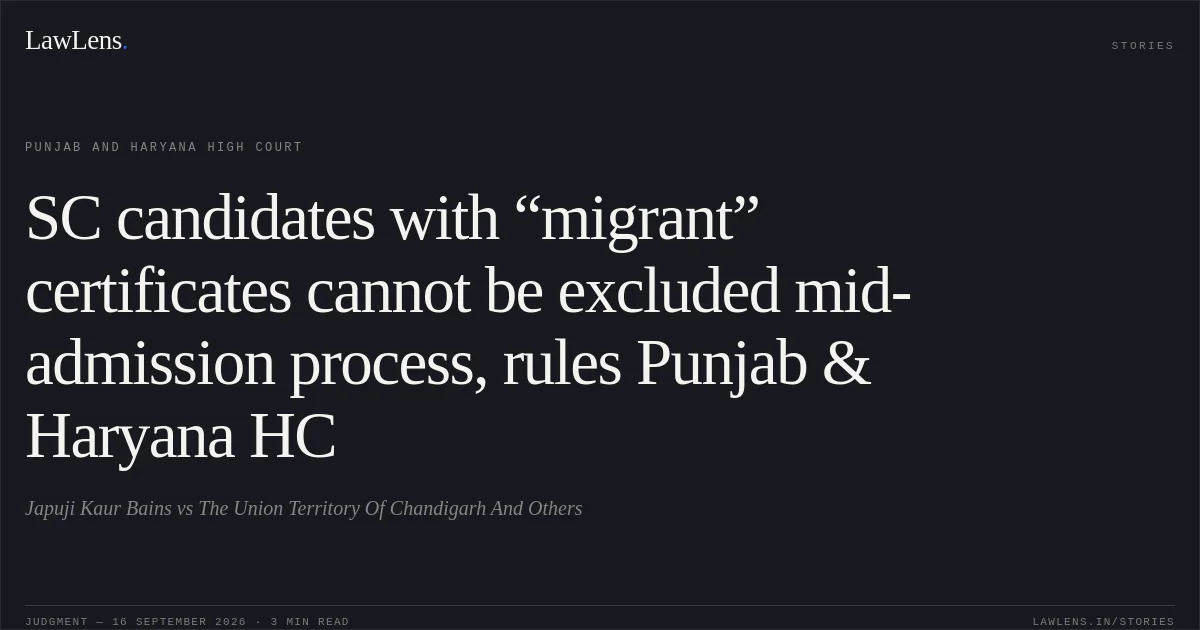
The Court answered the framed issue in the negative and held that, for the 2026–27 MBBS admission process, the respondents could not exclude an otherwise eligible SC candidate from the U.T. Chandigarh Pool merely by labelling the candidate as an “SC-migrant”.
The revised provisional merit list dated 20/21 August 2026 was quashed.
Source reference: para. 15; p. 13The respondents were directed to prepare a fresh merit list of SC candidates strictly in accordance with Clauses A-3 and A-4 of the prospectus and to complete the exercise, preferably within ten days of uploading the judgment.
Source reference: para. 15; p. 13All connected writ petitions were disposed of.
Source reference: no citationThe Court clarified that the respondents remained free to prescribe a legally valid admission criterion based on the Government of India instructions for subsequent academic sessions.
Source reference: paras. 16–17; p. 14Original Court PDF
Japuji Kaur BainsvsThe Union Territory Of Chandigarh And Others
Click to open original judgment
Original judgment, available to read, download and summarize on LawLens.in