Facts
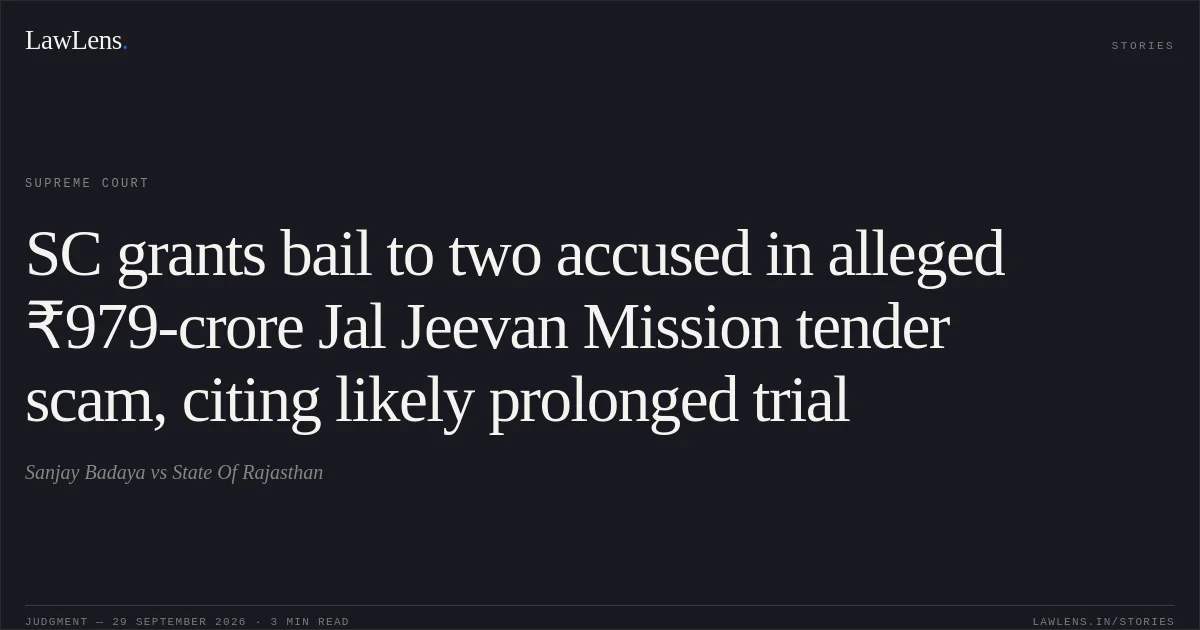
The appeals challenged the Rajasthan High Court’s dismissal of the appellants’ applications for regular bail: Shubhanshu Dixit’s application was dismissed on 1 June 2026, and Sanjay Badaya’s on 13 August 2026.
Source reference: para. 2–3The prosecution arose from an Anti-Corruption Bureau case alleging forged work-experience certificates, irregular tender awards under the Jal Jeevan Mission, and a conspiracy involving public servants, contractors and intermediaries. Dixit, a public servant, was alleged to have suppressed complaints and facilitated approval of tenders; Badaya, a private individual, was alleged to have acted as an intermediary and routed bribe proceeds.
Source reference: para. 4–7Chargesheets had been filed, but the prosecution proposed to call 124 witnesses and rely on extensive documentary evidence. Charges had not been framed, and the trial was not ready to commence, in part because investigation concerning other accused remained pending, two accused were absconding, and sanction for prosecution of six other public servants had only recently been granted.
Source reference: para. 6, 11Issues
Whether the appellants should be released on regular bail despite the seriousness of the alleged economic offences and their alleged roles in the conspiracy.
Source reference: para. 8–10Whether continued pre-trial detention was justified where the investigation against the appellants was complete but the trial was unlikely to commence or conclude in the near future.
Source reference: para. 10–12Law Applied
Article 21 of the Constitution protects personal liberty; pre-trial incarceration must not operate as punitive detention, particularly where the commencement or conclusion of trial is not reasonably foreseeable.
Source reference: para. 12In assessing bail, the Court considered the seriousness of the alleged economic offences alongside the completion of the investigation, the nature and custody of the evidence, the likely duration of trial, and the treatment of co-accused.
Source reference: para. 10–13The judgment identifies no specific precedent as the basis for these principles.
Source reference: no citationThe charges were brought under provisions of the Prevention of Corruption Act, 1988, and the Indian Penal Code, 1860; Section 19 of the Prevention of Corruption Act was also relevant to the procedural status of other accused.
Source reference: para. 4, 11Reasoning
The Court accepted that economic offences involving deep-rooted conspiracies warranted serious consideration and that the State was justified in opposing bail.
Source reference: para. 10However, the investigation against these appellants was complete and chargesheets had been filed; the case depended predominantly on documentary and electronic material already seized and held by the investigating agency, substantially reducing the risk of evidence tampering.
Source reference: para. 10Given the volume of evidence, the unframed charges, the pending investigation and other procedural obstacles, the trial was likely to be protracted.
Source reference: para. 11–12The Court also took account of bail or protection granted to certain co-accused, while making clear that it expressed no view on the merits of the allegations or evidence.
Source reference: para. 13, 18In these circumstances, continued custody was not warranted.
Source reference: para. 14Holding
The Supreme Court allowed both appeals and set aside the High Court’s orders. It directed that Badaya and Dixit be released on bail in the present case, unless required in another case, on bonds and conditions fixed by the Trial Court.
They were directed to join the investigation if called upon and to attend trial as required; the Trial Court may cancel bail for unjustified non-appearance or breach of conditions.
Source reference: para. 16–17The Court clarified that its observations were confined to the bail appeals and would not affect the trial on the merits.
Source reference: para. 18Acts & Sections Cited
11 provisions across 2 statutes referred to in this judgment. Each provision opens on LawLens.
Prevention of Corruption Act, 19886
Indian Penal Code, 18605
Original Court PDF
Sanjay BadayavsState Of Rajasthan
Click to open original judgment
Original judgment, available to read, download and summarize on LawLens.in