Facts
The complainant alleged that on 2 December 2017, the petitioner, the warden of his hostel, assaulted him with a stick after noticing that he had spat inside the hostel.
Source reference: pp. 2–4, paras. 2–3The complainant reported the incident to hostel mates and his mother, but lodged a complaint only on 8 December 2017, after being taken to hospital by the head of the DSS Union. The police registered a case under Section 324 of the Indian Penal Code (IPC) and Section 3(2)(v-a) of the Scheduled Castes and Scheduled Tribes (Prevention of Atrocities) Act, 1989 (SC/ST Act), investigated it, and filed a charge-sheet. The petitioner sought to quash the proceedings in S.C. No. 87/2018 under Section 482 of the Code of Criminal Procedure (Cr.P.C.).
Source reference: pp. 2–4, paras. 2–3Issues
Whether the allegations, as stated in the complaint, disclosed offences under Section 324 IPC and Section 3(2)(v-a) of the SC/ST Act
Source reference: pp. 6–8, paras. 6–7Whether the High Court should exercise its inherent power under Section 482 Cr.P.C. to quash the proceedings
Source reference: pp. 4–5, para. 4; p. 8, para. 7Law Applied
Section 482 Cr.P.C. preserves the High Court’s inherent power to quash criminal proceedings where the circumstances justify that intervention.
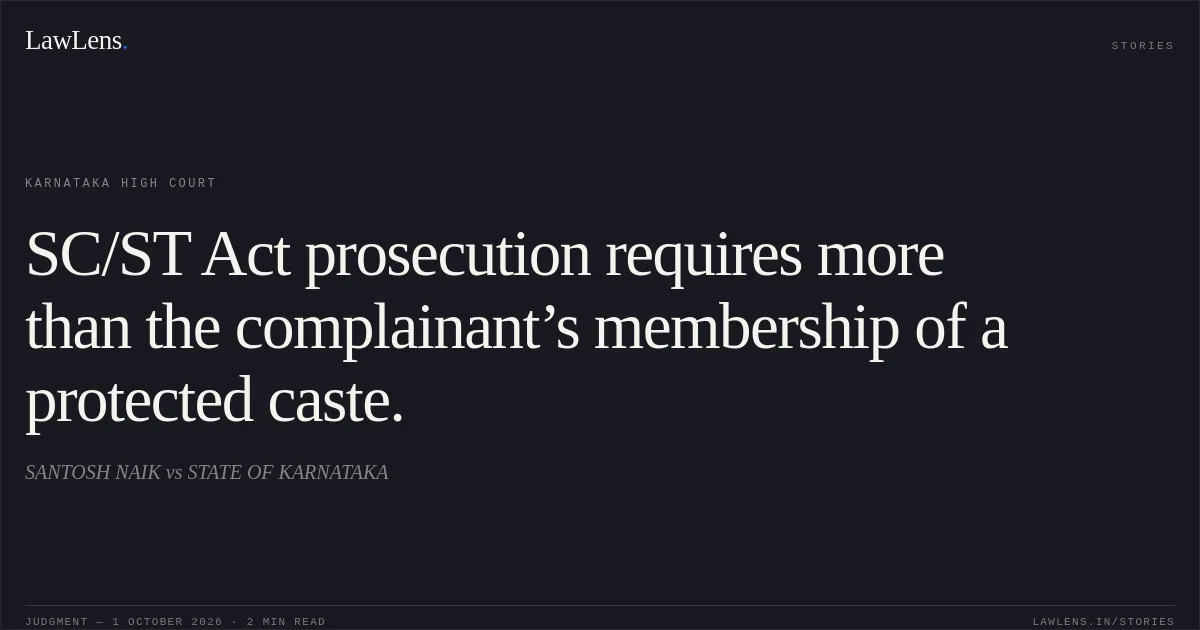
Source reference: pp. 4–5, para. 4; p. 8, para. 7It reasoned that the complainant’s membership of a particular community, without an allegation of caste-based abuse, was not by itself sufficient to invoke the special enactment.
Source reference: pp. 7–8, para. 7Reasoning
The Court considered the six-day delay in lodging the complaint, the simple nature of the injury—an abrasion—and the absence of any allegation that the complainant was abused by reference to his caste.
Source reference: pp. 6–8, paras. 6–7In the Court’s view, the complaint did not disclose the ingredients of the offences charged, and the circumstances did not warrant continuation of the prosecution. It therefore found the case appropriate for exercise of its inherent power under Section 482 Cr.P.C.
Source reference: pp. 6–8, paras. 6–7Holding
The High Court allowed the petition and quashed the proceedings initiated against the petitioner in S.C. No. 87/2018.
The High Court allowed the petition and quashed the proceedings initiated against the petitioner in S.C. No. 87/2018.
Source reference: p. 8, para. 8Acts & Sections Cited
3 provisions across 3 statutes referred to in this judgment. Each provision opens on LawLens.
Code of Criminal Procedure, 19731
Scheduled Castes and the Scheduled Tribes (Prevention of Atrocities) Act, 19891
Indian Penal Code, 18601
Original Court PDF
SANTOSH NAIKvsSTATE OF KARNATAKA
Click to open original judgment
Original judgment, available to read, download and summarize on LawLens.in