Facts
The parties married on 12 February 2010 according to Hindu rites and had two daughters, born in 2010 and 2014.
Source reference: paras. 2–3The respondent-husband alleged that the appellant-wife subjected him and his family to mental cruelty through verbal abuse, refusal of cohabitation, public humiliation, family disputes, alienation of the children from his family, and refusal to live with him after his transfer to Deoghar. He asserted that there had been no cohabitation since November 2018.
Source reference: paras. 4–5The wife denied the allegations and made counter-allegations of physical assault, alcohol abuse, verbal abuse, and neglect by the husband.
Source reference: para. 6The husband instituted Matrimonial Suit No. 68 of 2021 before the Family Court, Lakhisarai, seeking divorce under Section 13(1)(ia) of the Hindu Marriage Act, 1955, on the ground of cruelty, along with custody of the daughters.
Source reference: para. 9He examined himself, his sister, and a village friend, and relied on WhatsApp messages and call records marked as Exhibit-1.
Source reference: paras. 12–13The wife did not lead evidence despite opportunities, and her evidence was closed.
Source reference: para. 14A counselling-related arrangement resulted in temporary cohabitation from 04 June 2022, but it subsequently failed.
Source reference: para. 15The Family Court accepted the husband’s case, held that cruelty had been proved, and granted a decree of divorce on 20 March 2023, with the husband remaining liable to maintain the wife and children.
Source reference: paras. 7, 16The wife challenged that decree under Section 19(1) of the Family Courts Act, 1984.
Source reference: para. 1Issues
1. Whether the husband proved mental cruelty of the degree, gravity, and continuity required under Section 13(1)(ia) of the Hindu Marriage Act, 1955, so as to justify dissolution of marriage?
Source reference: paras. 1, 24(B)–(C)2. Whether the scattered and allegedly historic incidents of verbal abuse, family discord, refusal of intimacy, and separate residence constituted a subsisting and continuous cause of action for divorce?
Source reference: paras. 24(B)(ii)–(v), 24(C)3. Whether the WhatsApp messages relied upon by the husband were admissible in the absence of a certificate under Section 65B(4) of the Indian Evidence Act, 1872?
Source reference: paras. 24(B)(vi)–(vii)4. Whether the Family Court had territorial jurisdiction and whether the trial proceedings suffered from any material procedural irregularity?
Source reference: para. 24(D)Law Applied
The Court applied Section 13(1)(ia) of the Hindu Marriage Act, 1955, under which divorce may be granted where one spouse has treated the other with cruelty.
Source reference: para. 1It treated an appeal under Section 19(1) of the Family Courts Act, 1984 as a first appeal on facts and law, permitting complete reappraisal of the evidence.
Source reference: para. 24(A)Relying on Suman Singh v. Sanjay Singh, (2017) 4 SCC 85, the Court held that isolated incidents occurring many years before institution of the divorce petition, particularly where they have been condoned by subsequent cohabitation or compromise, ordinarily do not furnish a subsisting cause of action; cruelty must generally be recurring or continuing and proximate to the proceedings.
Source reference: paras. 24(B)(iv), 24(B)(v)Under Samar Ghosh v. Jaya Ghosh, (2007) 4 SCC 511, mental cruelty requires conduct causing such grave and sustained mental pain or suffering that the parties cannot reasonably be expected to live together; ordinary quarrels, trivial irritations, and normal wear and tear of married life are insufficient.
Source reference: paras. 24(C)(i)–(ii)Applying Arjun Panditrao Khotkar v. Kailash Kushanrao Gorantyal, (2020) 7 SCC 1, the Court held that a certificate under Section 65B(4) of the Evidence Act is a mandatory condition for admissibility of electronic records, and oral evidence cannot substitute for it.
Source reference: paras. 24(B)(vi)–(vii)Reasoning
The Court independently reappreciated the evidence because the appeal was a first appeal on facts and law.
Source reference: para. 24(A)It found that the husband’s evidence consisted primarily of general assertions concerning intermittent incidents spread over nearly twelve years, without precise dates, particulars, exact words, independent corroboration, or contemporaneous complaints.
Source reference: paras. 24(B)(i)–(iii)The 2012 Chhath incident and the 2015 Shraddha incident, even if accepted, were isolated events and were not shown to form part of a sustained course of conduct.
Source reference: para. 24(B)(iii)The parties had cohabited for substantial periods, had two children, and had occasional physical relations before 2018; the temporary cohabitation following counselling in 2022 also weakened the claim of an unbroken course of cruelty.
Source reference: paras. 24(B)(iii), 24(B)(v), 24(C)(iii)The Court further held that the wife’s failure to lead evidence did not relieve the husband of his burden to prove cruelty. Since the husband’s evidence was vague and insufficiently corroborated, the statutory threshold under Section 13(1)(ia) was not met.
Source reference: para. 24(B)(viii)The WhatsApp messages and call records were excluded because no Section 65B(4) certificate had been produced.
Source reference: paras. 24(B)(vi)–(vii)Although the Family Court had territorial jurisdiction and no independent procedural irregularity was established, those findings could not cure the deficiency in proof on the merits.
Source reference: para. 24(D)Holding
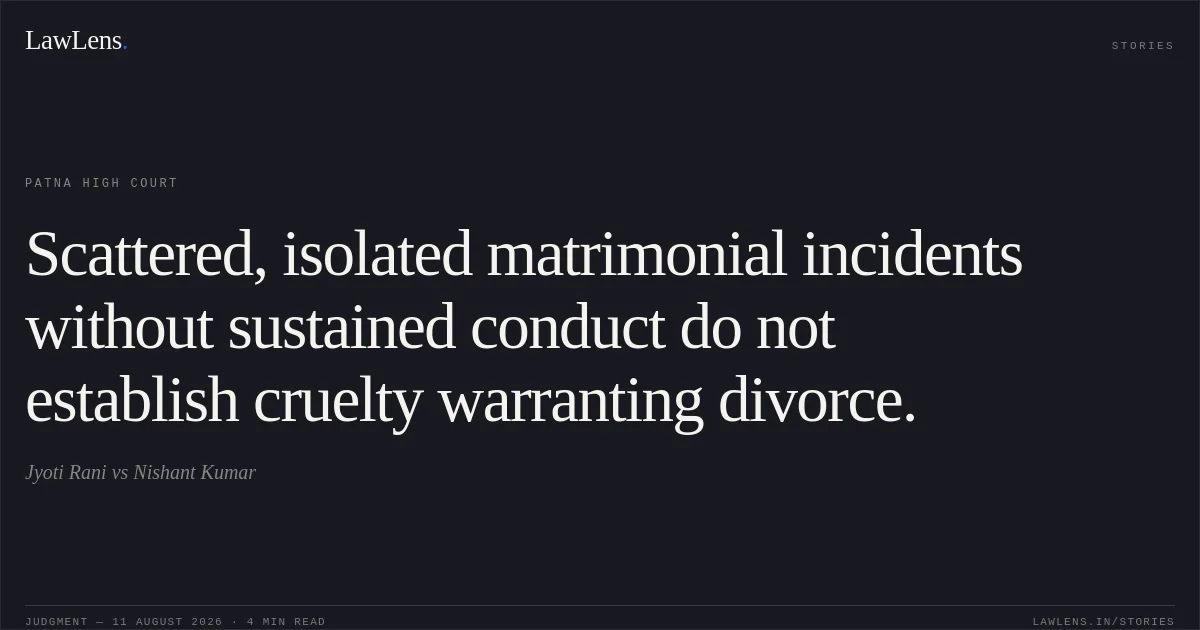
The High Court held that the respondent-husband failed to establish mental cruelty of the requisite gravity, continuity, and degree under Section 13(1)(ia) of the Hindu Marriage Act, 1955.
The appeal was allowed, and the Family Court’s judgment and decree dated 20 March 2023/01 April 2023 were set aside.
Source reference: Operative Order (i)–(ii)The husband’s matrimonial suit for divorce was dismissed.
Source reference: Operative Order (iii)Both parties were directed to continue discharging their parental obligations towards their two daughters; issues concerning custody, visitation, and maintenance were left open for determination by the competent court upon an appropriate application.
Source reference: Operative Order (iv)Acts & Sections Cited
3 provisions across 3 statutes referred to in this judgment. Each provision opens on LawLens.
Family Courts Act, 19841
Hindu Marriage Act, 19551
Code of Civil Procedure, 19081
Original Court PDF
Jyoti RanivsNishant Kumar
Click to open original judgment
Original judgment, available to read, download and summarize on LawLens.in