Facts
The appellant was convicted by the Trial Court under Section 376(1) IPC and Section 6 of the POCSO Act for the alleged kidnapping and sexual assault of PW1, whom the prosecution claimed was below 13 years of age at the time of the incident in October 2014
Source reference: p. 2-3The prosecution relied on school records (Ext. PW2/A) stating the victim's date of birth as 04.03.2002
Source reference: p. 18the appellant contended that he married PW1 voluntarily with family consent
Source reference: p. 4During the trial, both the victim (PW1) and her father (PW3) turned hostile, deposing that the victim was approximately 19 years old at the time of the marriage and that the age in school records had been intentionally reduced to secure admission
Source reference: p. 10-12, 16It was further revealed that PW3 had previously filed a similar kidnapping case against others which resulted in acquittal
Source reference: p. 21-22Issues
1. Whether the prosecution proved beyond reasonable doubt that the victim was a minor at the time of the incident to attract the provisions of the POCSO Act
Source reference: p. 82. Whether the sexual relationship between the appellant and the victim was consensual, thereby vitiating the charge of rape under Section 375 IPC in the event the victim was a major
Source reference: p. 21Law Applied
The Court applied Section 376(1) of the Indian Penal Code (IPC) and Section 6 of the POCSO Act regarding aggravated penetrative sexual assault on a minor
Source reference: p. 2It placed reliance on Section 35 of the Indian Evidence Act, 1872, regarding the relevancy of entries in public records, noting that school register entries are not conclusive proof of age if the source of information is shown to be unreliable
Source reference: p. 7The Court also followed the principle from Moidu K. vs. State of Kerala (2009), holding that non-compliance with Section 232 Cr.P.C. does not vitiate proceedings unless substantial prejudice is shown
Source reference: p. 5Reasoning
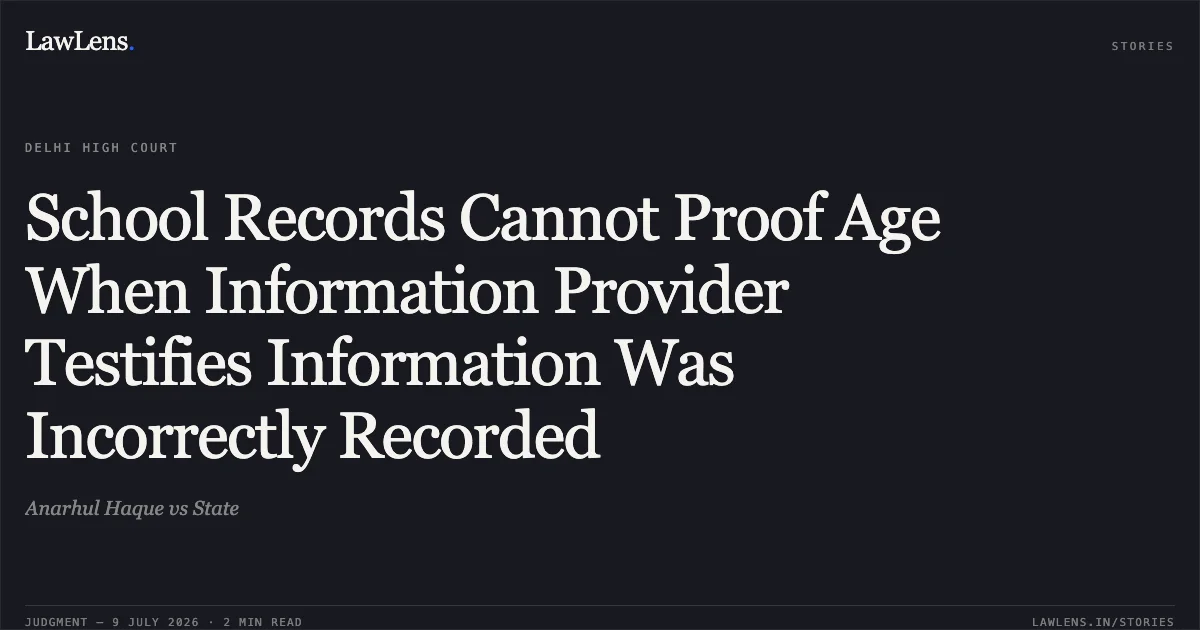
The Court observed that the primary evidence for the victim's age—the school admission register—was based solely on an affidavit by the father (PW3), who later admitted in court that he provided a false, lesser age to the school
Source reference: p. 18-19The Court noted the absence of a birth certificate from municipal authorities or an ossification test to scientifically determine age
Source reference: p. 20Since the person who supplied the information for the school record (PW3) discredited his own statement, the prosecution failed to establish the victim's minority beyond reasonable doubt
Source reference: p. 20-21Furthermore, PW1's testimony confirmed she left home voluntarily, married the appellant, and had consensual relations
Source reference: p. 10The Court also highlighted the complainant's (PW3) suspicious modus operandi of filing similar criminal cases previously, suggesting a motive of extortion
Source reference: p. 24Holding
The Court held that the prosecution failed to prove that the victim was a minor or that the act was non-consensual
Consequently, the appeal was allowed, and the conviction under Section 376(1) IPC and Section 6 of the POCSO Act was set aside. The appellant was acquitted of all charges and ordered to be set at liberty
Source reference: p. 25Acts & Sections Cited
7 provisions across 3 statutes referred to in this judgment. Each provision opens on LawLens.
Indian Penal Code, 18604
Prohibition of Child Marriage Act, 20061
Original Court PDF
Anarhul HaquevsState
Click to open original judgment
Original judgment, available to read, download and summarize on LawLens.in