Facts
The applicant, Jaganath, filed a private complaint under Section 200 Cr.P.C. against his brother (Respondent No. 1), his nephew (Respondent No. 2), and a Revenue Inspector (Respondent No. 3).
Source reference: para 2-3The applicant alleged that the respondents conspired to grab his land by forging a demarcation Panchnama and signatures of witnesses—including a witness, Rama Patel, who had died before the proceedings—without conducting an actual spot demarcation.
Source reference: para 2-3The Judicial Magistrate First Class (JMFC), Hanumana, dismissed the complaint on 10.10.2018, citing a lack of locus standi, the revenue nature of the dispute, and the absence of sanction under Section 197 Cr.P.C. for the public servant.
Source reference: para 2This dismissal was affirmed by the First Additional Sessions Judge, Mauganj, on 28.04.2023 in criminal revision.
Source reference: para 1-2The applicant subsequently moved the High Court under Section 482 Cr.P.C. to challenge these concurrent findings.
Source reference: no citationIssues
1. Whether the lower courts committed a patent illegality or perversity in refusing to take cognizance of the offences under Sections 218, 219, 418, 420, 465, and 468 of the IPC.
Source reference: para 1, 52. Whether the High Court, in exercise of its inherent jurisdiction under Section 482 Cr.P.C., should re-appreciate the evidentiary material presented during the enquiry under Sections 200 and 202 Cr.P.C.
Source reference: para 5-6Law Applied
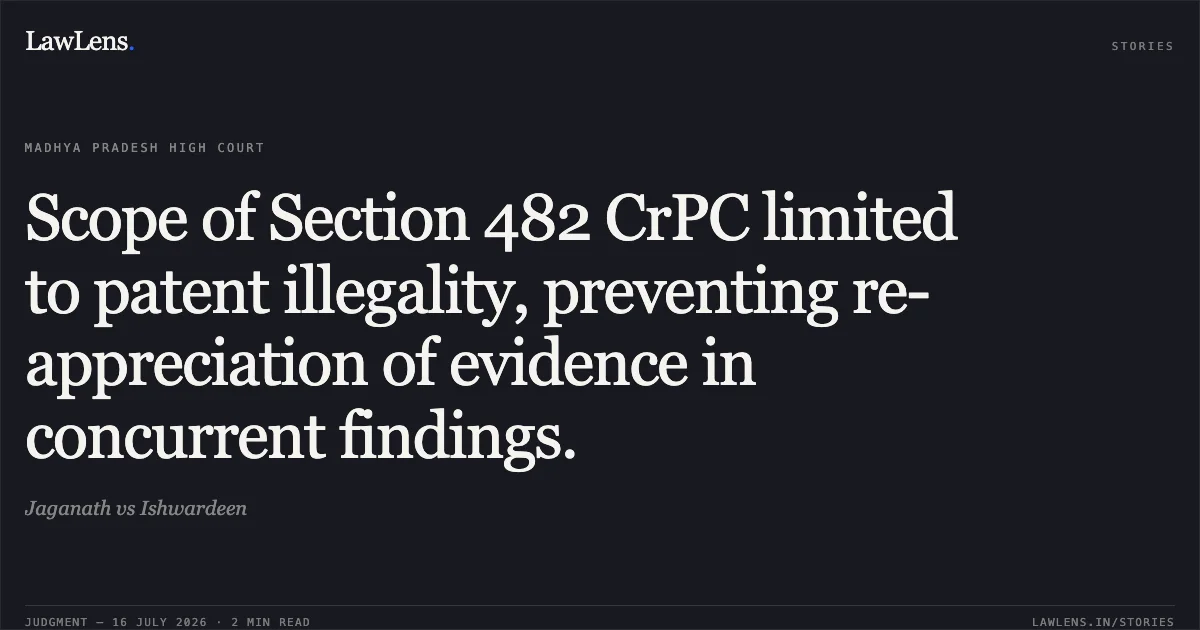
Section 482 of the Code of Criminal Procedure (Cr.P.C.) regarding the inherent powers of the High Court, emphasizing that such power is not an appellate jurisdiction and should only be exercised to prevent manifest miscarriage of justice or patent illegality.
Source reference: para 5Section 197 Cr.P.C. regarding the requirement of prior government sanction for prosecuting public servants for acts done in the discharge of official duties.
Source reference: para 2, 6The standards for taking cognizance under Section 200 Cr.P.C. based on whether "sufficient grounds" exist.
Source reference: para 4, 6Reasoning
The High Court observed that the inherent jurisdiction under Section 482 Cr.P.C. is narrow and cannot be used to re-evaluate evidence as if it were a second appeal.
Source reference: para 5The Court found that both the Magistrate and the Revisional Court had duly considered the applicant’s allegations of forgery and the testimonies of witnesses (including Patwari Ram Shiromani Mishra) before concluding that no sufficient grounds for cognizance existed.
Source reference: para 6The High Court reasoned that the specific claims regarding forged signatures and the validity of the demarcation were matters of evidentiary appreciation that had already been handled by the lower courts.
Source reference: para 6Furthermore, the court held that even if the applicant challenged the applicability of Section 197 Cr.P.C. (sanction), the complaint’s dismissal remained valid because it was substantiated by other independent grounds beyond just the lack of sanction.
Source reference: para 6Holding
The High Court dismissed the petition, holding that there was no patent illegality, perversity, or jurisdictional error in the concurrent findings of the lower courts.
The court affirmed the orders dated 10.10.2018 and 28.04.2023, thereby upholding the refusal to take cognizance of the criminal complaint.
Source reference: para 8Acts & Sections Cited
10 provisions across 2 statutes referred to in this judgment. Each provision opens on LawLens.
Indian Penal Code, 18606
Code of Criminal Procedure, 19734
Original Court PDF
JaganathvsIshwardeen
Click to open original judgment
Original judgment, available to read, download and summarize on LawLens.in