Facts
The applicant, a Postal Assistant, was initially issued a charge sheet on December 3, 2020, involving three articles of charge. Following an inquiry, the Disciplinary Authority imposed a penalty of stoppage of increment and recovery of funds on September 24, 2021
Source reference: p. 2Upon appeal, the Appellate Authority quashed the punishment order on January 12, 2022, and the Disciplinary Authority subsequently dropped the original charge sheet on January 31, 2022
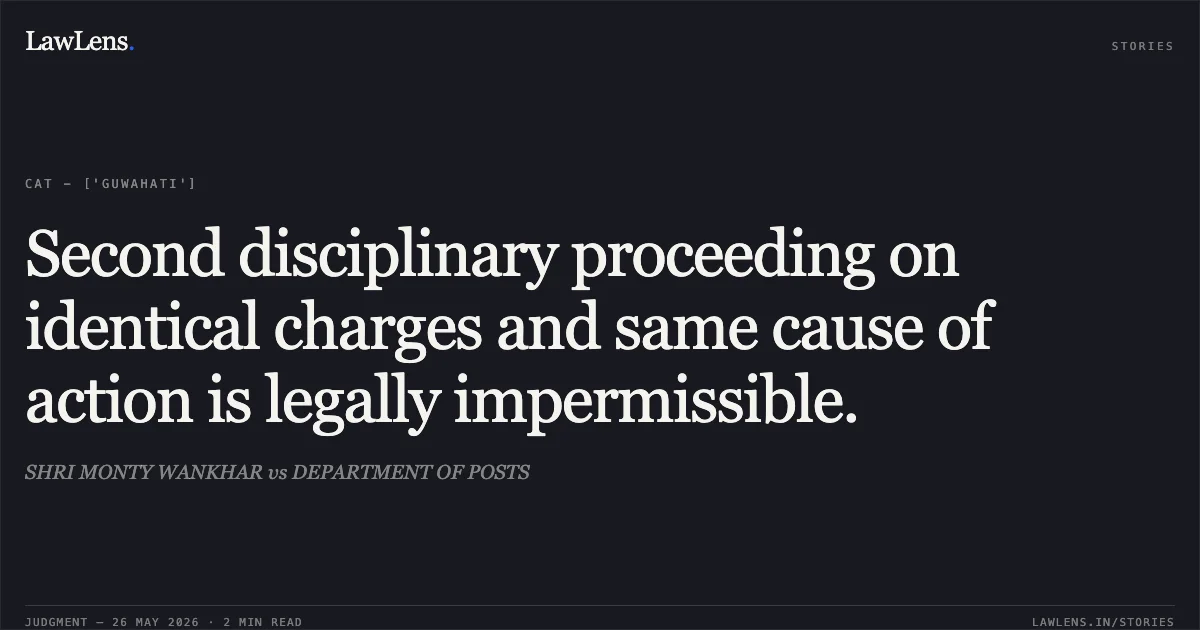
Source reference: p. 3However, the respondents issued a fresh charge sheet on February 24, 2022, based on the exact same cause of action and identical charges
Source reference: p. 3The respondents contended the fresh issuance was necessary because the previous proceedings incorrectly cited the "CCS (Conduct) Rules 1965" instead of the "CCS (Conduct) Rules 1964"
Source reference: p. 4Issues
1. Whether the respondent authorities are legally permitted to issue a second/fresh charge sheet on the same cause of action and identical set of charges after the original proceedings were quashed and dropped
Source reference: p. 3-42. Whether the issuance of a fresh charge sheet to correct a clerical error regarding the nomenclature of the Conduct Rules is permissible under the CCS (CCA) Rules, 1965 and the Constitution of India
Source reference: p. 4-6Law Applied
The Tribunal applied the principle of Nemo debet bis vexari pro uno delicto, which dictates that no person should be vexed twice for the same offense
Source reference: p. 6-7It relied on the precedent set by the Supreme Court in Lt. Governor, Delhi and Others v. HC Narinder Singh (2004) 13 SCC 342, which prohibits fresh proceedings on identical charges
Source reference: p. 3, 6Further reliance was placed on Canara Bank v. Swapan Kumar Pani (2006) 3 SCC 251 and Nand Kumar Verma v. State of Jharkhand (2012) 3 SCC 580 regarding the limitations of disciplinary proceedings
Source reference: p. 3-4The court also referenced its own consistent rulings in Ratan Debnath v. Union of India (O.A. No. 122/2021) and Sri Remigious Syiem v. Union of India (O.A. No. 043/00243/2022)
Source reference: p. 5-6Reasoning
The Tribunal observed that both parties admitted the fresh charge sheet dated February 24, 2022, was based on the same cause of action and identical charges as the earlier one from December 3, 2020
Source reference: p. 6While the respondents argued the second charge sheet was merely to correct a clerical error in the citation of the Conduct Rules (1964 vs. 1965), the Tribunal found this insufficient to bypass the settled position of law
Source reference: p. 4, 6Applying the ratio from HC Narinder Singh, the Tribunal reasoned that initiating a second inquiry on the same facts after the first had been concluded/dropped constitutes a violation of the principles of natural justice and Constitutional protections under Articles 14, 16, and 21
Source reference: p. 4, 6The Tribunal emphasized that justice must not only be done but must be seen to be done, and subjecting an employee to repetitive proceedings for the same act is a legal overreach
Source reference: p. 6Holding
The Tribunal allowed the Original Application, answering that a fresh charge sheet cannot be issued on identical grounds
It held that the impugned action was dehors the established procedure for disciplinary proceedings. Consequently, the Tribunal quashed and set aside the impugned Charge Sheet dated February 24, 2022
Source reference: p. 7Original Court PDF
SHRI MONTY WANKHARvsDEPARTMENT OF POSTS
Click to open original judgment
Original judgment, available to read, download and summarize on LawLens.in