Facts
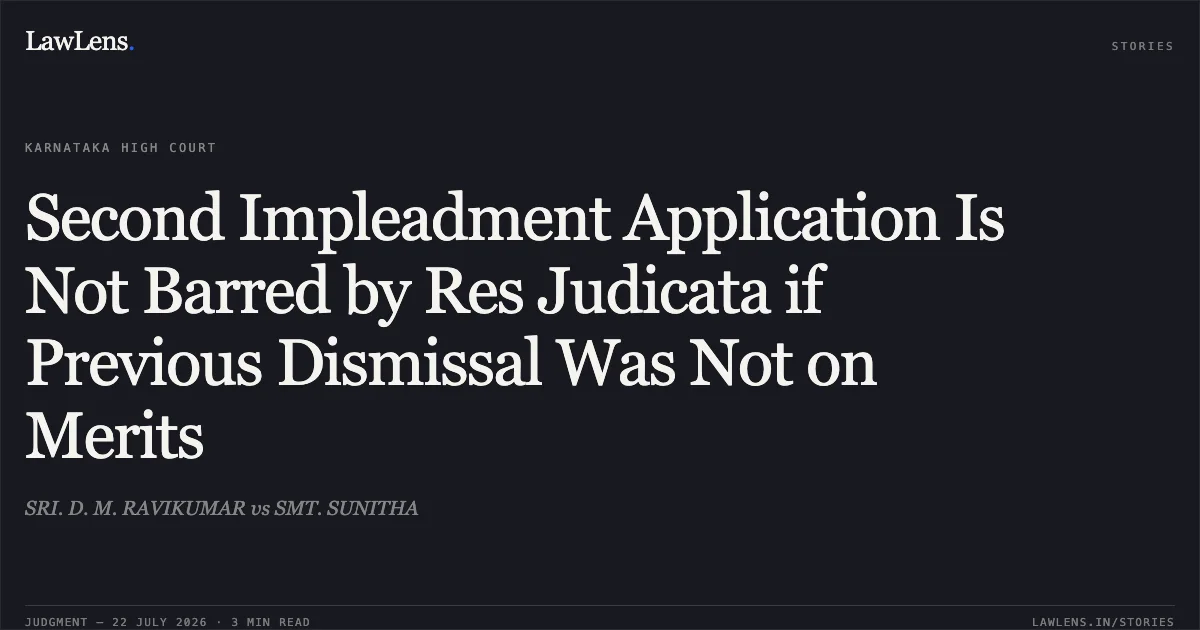
The Petitioner/Applicant sought to implead himself as a defendant in a suit for declaration of ownership and recovery of possession filed by Respondent No. 1 regarding property in Srigandhadakaval Village
Source reference: paras 1, 4The Petitioner first filed I.A. No. 26 of 2019 under Order I Rule 10(2) CPC, which the Trial Court dismissed on 20.11.2019, terming it "bald and vague" because no supporting documents were produced
Source reference: paras 2, 5, 9Subsequently, the Petitioner filed I.A. No. 35 of 2023 for the same relief, this time attaching title documents, including registered gift deeds
Source reference: paras 6, 10The Trial Court dismissed this second application on 10.01.2024, holding that it was barred by the principles of res judicata since the previous dismissal was not challenged
Source reference: paras 1, 8, 17The Petitioner challenged this dismissal via a Writ Petition under Article 227 of the Constitution
Source reference: p. 3Issues
1. Whether a second application for impleadment under Order I Rule 10(2) CPC is barred by the principle of res judicata if the first application was dismissed for lack of evidence rather than on merits
Source reference: para 13, 162. Whether the Petitioner qualified as a 'necessary' or 'proper' party based on his claim of title through registered gift deeds
Source reference: para 12, 17Law Applied
Order I Rule 10(2) of the CPC, which grants the court wide discretion to implead any person whose presence is necessary for effective adjudication
Source reference: para 11, 11.1In Mumbai International Airport (P) Ltd. v. Regency Convention Centre & Hotels (P) Ltd., the court distinguished between "necessary parties" (without whom no decree can be passed) and "proper parties" (whose presence enables complete adjudication)
Source reference: para 12Section 11 of the CPC regarding res judicata, noting that the doctrine applies to different stages of the same proceeding only when an issue is heard and finally decided on merits [Sulthan Said Ibrahim v. Prakasan]
Source reference: paras 13-14In Pankajbhai Rameshbhai Zalavadiya v. Jethabhai Kalabhai Zalavadiya, it was held that a dismissal based on maintainability or technical defaults does not operate as res judicata for subsequent maintainable applications
Source reference: para 15Reasoning
The High Court found that the Trial Court’s dismissal of the first application (I.A. No. 26) was not an adjudication on merits but was based solely on the Petitioner’s failure to provide details or documents
Source reference: para 9, 16The second application (I.A. No. 35) was distinct as it provided a clear title chain and eleven supporting documents, including registered gift deeds
Source reference: para 10The High Court reasoned that since the first order did not examine the Petitioner’s status as a necessary or proper party relative to the property’s title, it did not constitute a "final decision" on the issue
Source reference: para 18Under Order I Rule 10(2), the court’s primary duty is to ensure all parties necessary for the settlement of questions involved in the suit are before it, regardless of the plaintiff’s wishes
Source reference: para 11.2, 12.1Holding
The High Court allowed the Writ Petition and set aside the Impugned Order dated 10.01.2024
It held that the principle of res judicata did not apply because there was no prior adjudication on the merits of the Petitioner’s claim to the property
Source reference: para 18The Court directed the Trial Court to examine I.A. No. 35 of 2023 afresh after hearing both parties, without prejudice to the merits of the underlying title dispute
Source reference: para 20, 21Acts & Sections Cited
2 provisions across 1 statute referred to in this judgment. Each provision opens on LawLens.
Code of Civil Procedure, 19082
Original Court PDF
SRI. D. M. RAVIKUMARvsSMT. SUNITHA
Click to open original judgment
Original judgment, available to read, download and summarize on LawLens.in