Facts
The appellant was the then Chief Executive Officer of respondent No. 8, Jamnagar Vistar Vikas Satta Mandal, and acted in that capacity under the Gujarat Town Planning and Urban Development Act, 1976 (“the 1976 Act”).
Source reference: para. 6; p. 3The original plaintiffs instituted Special Civil Suit No. 10 of 1998, which was dismissed by the Trial Court on 31 March 2018.
Source reference: para. 9.1; p. 6In Regular Civil Appeal No. 59 of 2018, the First Appellate Court reversed the dismissal and directed original defendant Nos. 1, 3 and 5 to pay Rs. 8,28,300 with 6% simple interest, jointly and severally.
Source reference: para. 9.1; p. 7It further provided that if defendant Nos. 1 or 5 paid the decretal amount, they could recover it personally from defendant No. 3, the present appellant.
Source reference: para. 9.1; p. 7Respondent No. 8 subsequently paid Rs. 22,21,501 to the plaintiff and sought reimbursement from the appellant.
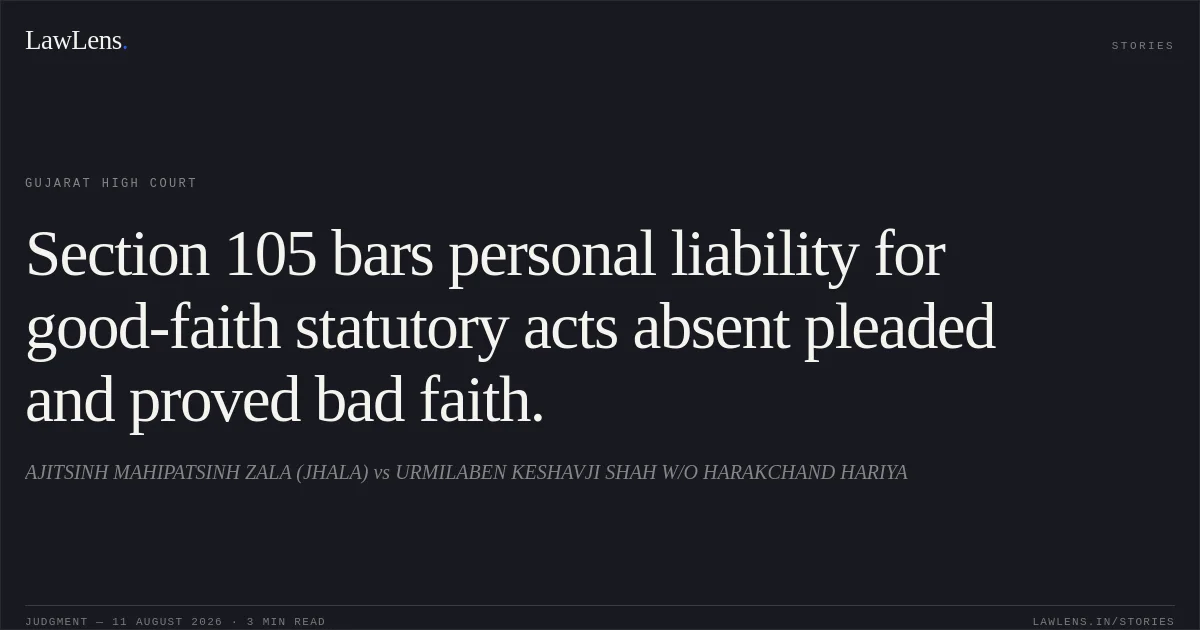
Source reference: paras. 6.1–6.2, 9.2; pp. 4, 7–8The appellant challenged the decree in the present Second Appeal, principally relying on the bar contained in Section 105 of the 1976 Act and contending that no personal liability could be imposed upon him for acts performed in his official capacity.
Source reference: paras. 6, 10; pp. 3, 8Issues
1. Whether the First Appellate Court could rely upon the statement of respondent No. 9, allegedly recorded in the appellant’s absence and behind his back, while deciding the appeal.
Source reference: para. 4(A); p. 22. Whether the plaintiffs’ suit was maintainable against the appellant in view of Section 105 of the Gujarat Town Planning and Urban Development Act, 1976.
Source reference: para. 4(B); p. 23. Whether personal liability could be imposed upon a public officer acting in his official capacity without pleadings, an issue, or a finding of mala fides, misfeasance, lack of good faith, or want of jurisdiction.
Source reference: para. 4(C); p. 24. Whether, in the absence of a specific issue regarding personal liability, the First Appellate Court could direct recovery of the decretal amount from the appellant personally.
Source reference: para. 4(D); p. 2Law Applied
The Court primarily applied Section 105 of the Gujarat Town Planning and Urban Development Act, 1976, which provides that no suit, prosecution, or other legal proceeding shall lie against the State Government, the appropriate authority, or any public servant or person appointed or authorised under the Act for anything done or purportedly done in good faith under the Act or the rules and regulations made thereunder.
Source reference: para. 10; p. 8The provision protects public officers from proceedings concerning acts performed in good faith in the discharge of statutory functions.
Source reference: para. 10; p. 8However, such protection would not extend to conduct proved to be outside statutory authority, mala fide, misfeasant, or lacking in good faith.
Source reference: para. 10; p. 8The Court further applied the procedural principle that personal liability cannot ordinarily be imposed without adequate pleadings, a specific issue, notice, and evidence establishing the factual basis for such liability.
Source reference: paras. 12–13.1; pp. 9–10Reasoning
The Court found that the appellant had acted as the Chief Executive Officer of respondent No. 8 while discharging statutory duties under the 1976 Act.
Source reference: para. 6; p. 3The plaintiffs neither pleaded nor proved that he had acted mala fide, beyond jurisdiction, in bad faith, or otherwise outside the scope of his official functions.
Source reference: paras. 12–13; pp. 9–10No specific issue regarding the appellant’s personal liability had been framed, and he had not been put on notice that such liability would be adjudicated.
Source reference: para. 13; p. 10Consequently, the First Appellate Court overlooked the statutory protection under Section 105 and committed an error of law in fastening personal liability upon the appellant.
Source reference: paras. 11, 13–14; pp. 9–10Although respondent No. 8 had already paid the decretal amount to the plaintiff, that payment did not justify permitting respondent Nos. 8 or 11 to recover the amount from the appellant personally.
Source reference: paras. 13.2–13.3; p. 10Holding
The Second Appeal was partly allowed.
The High Court modified the judgment and decree dated 29 November 2025 passed in Regular Civil Appeal No. 59 of 2018 by exonerating the appellant, original defendant No. 3, from liability to pay the compensation or reimburse respondent Nos. 8 and 11.
Source reference: paras. 14–17; pp. 10–12Original defendant Nos. 1 and 5 alone remained jointly or severally liable to pay Rs. 8,28,300 with 6% simple interest from the date of filing of the suit until realization.
Source reference: para. 16; p. 11The remaining portion of the First Appellate Court’s judgment and decree was left undisturbed.
Source reference: para. 17; p. 12The connected Civil Application for interim relief was disposed of as infructuous, with no order as to costs.
Source reference: para. 17; p. 12Acts & Sections Cited
1 provisions across 1 statute referred to in this judgment. Each provision opens on LawLens.
Gujarat Town Planning And Urban Development Act, 19761
Original Court PDF
AJITSINH MAHIPATSINH ZALA (JHALA)vsURMILABEN KESHAVJI SHAH W/O HARAKCHAND HARIYA
Click to open original judgment
Original judgment, available to read, download and summarize on LawLens.in