Facts
Indian Oil Corporation Ltd. booked BTPN tank wagons containing superior kerosene oil from Baholi to Raxaul under Railway Receipt No. 262000724 dated 18 October 2009.
Source reference: p. 2, para. 2The Railway Receipt reflected a distance of 1,069 km in the CRIS-generated entry, but the distance was manually altered to 1,139 km, resulting in allegedly excessive freight being charged.
Source reference: p. 2, para. 2IOC notified the Railway Administration regarding excess freight in respect of 14 Railway Receipts. The Railway Administration settled claims concerning 12 receipts but rejected the claim concerning the present receipt, treating it as barred by limitation.
Source reference: p. 2, para. 2IOC filed a claim before the Railway Claims Tribunal seeking refund, contending that the freight had been illegally charged.
Source reference: p. 2–3, para. 3The Tribunal dismissed the claim on 29 January 2016, finding, inter alia, that the manual correction by the booking clerk was a bona fide mistake and that the claim was barred for want of timely statutory notice.
Source reference: p. 4, para. 9Issues
Whether the claim for refund arose from an “illegal charge” or merely an “overcharge” so as to attract Section 106(3) of the Railways Act, 1989.
Source reference: p. 3–4, paras. 7–9.1Whether the Tribunal was justified in finding that the manual alteration of the distance and consequential freight recovery resulted from a bona fide mistake by the booking clerk.
Source reference: p. 4–5, para. 9.1Whether the Tribunal’s dismissal of the claim on the ground of limitation was sustainable.
Source reference: p. 3–5, paras. 3, 7–9.1Law Applied
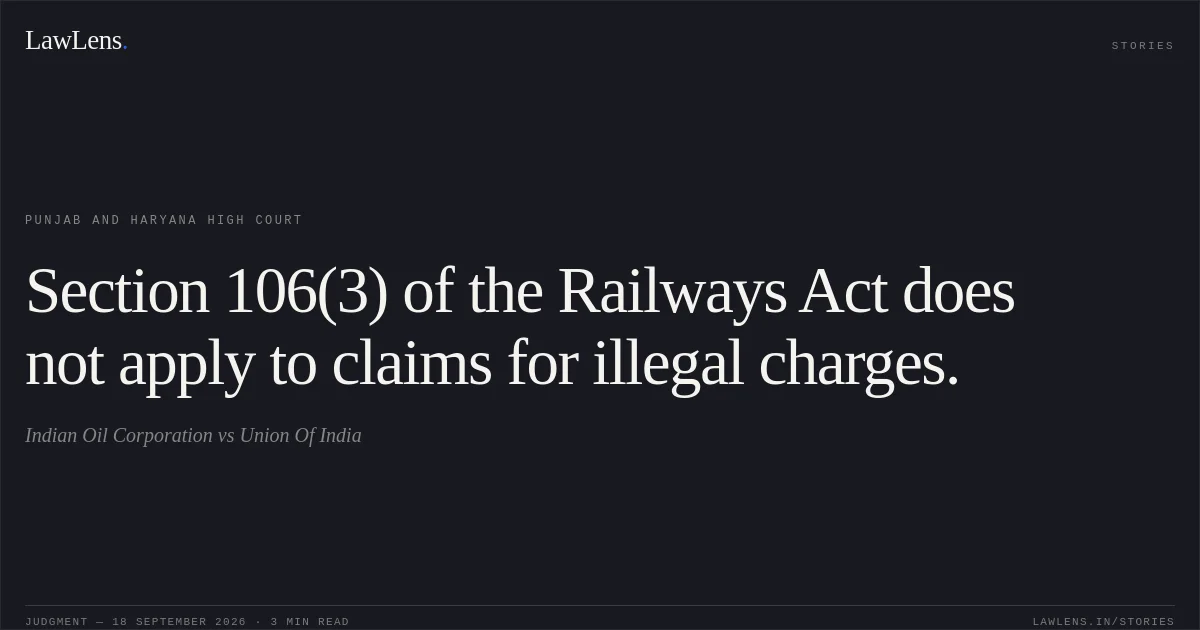
The Court applied Section 106 of the Railways Act, 1989, particularly Section 106(3), which governs claims for refund arising from an “overcharge.”
Source reference: p. 5, para. 9.1The Court distinguished an illegal or unauthorised charge from an overcharge, holding that the statutory limitation requirement applicable to refund claims for overcharge does not govern a claim alleging that the Railway Administration had no lawful basis to levy the charge.
Source reference: p. 5, para. 9.1The Court relied on United Bank of India v. Naresh Kumar, 1997 AIR Supreme Court 3, which distinguished an illegal charge from an overcharge and held that an illegal charge would not attract Section 78-B of the Indian Railways Act, 1890, a provision materially corresponding to Section 106 of the 1989 Act.
Source reference: p. 5, para. 9.1It also followed the subsequent decision of the Punjab and Haryana High Court in FAO-3398-2017, Indian Oil Corporation Ltd. v. Union of India, decided on 8 October 2021.
Source reference: p. 5, para. 9.1Further, factual findings must be supported by pleadings and evidence; a finding based on an unpleaded defence and unsupported testimony or documentary material cannot be sustained.
Source reference: p. 4–5, para. 9.1Reasoning
The High Court found that IOC’s pleaded case was not that the Railway had merely miscalculated a lawful freight charge, but that freight had been levied on a distance that was not chargeable, thereby constituting an illegal charge.
Source reference: p. 4–5, para. 9.1Consequently, Section 106(3), which concerns refund of an overcharge, was held inapplicable.
Source reference: p. 4–5, para. 9.1The Tribunal had additionally concluded that the manual correction was made bona fide by the booking clerk, but the Railway Administration had neither pleaded this explanation in its written statement nor examined the booking clerk to establish it.
Source reference: p. 4–5, para. 9.1The Tribunal’s finding was therefore unsupported and legally unsustainable.
Source reference: p. 4–5, para. 9.1Since the claim was one concerning an illegal charge, the Tribunal could not dismiss it by applying the limitation requirement applicable to overcharge claims.
Source reference: p. 5, para. 10Holding
The High Court allowed the appeal, set aside the Railway Claims Tribunal’s order dated 29 January 2016, and remanded the matter for fresh adjudication on the merits of IOC’s claim that the freight constituted an illegal charge.
The Court held that Section 106(3) of the Railways Act, 1989, was not applicable to such a claim.
Source reference: p. 5, para. 10The parties were directed to appear before the Tribunal on 1 October 2026, and the Tribunal was requested to conclude the proceedings within six months from that date.
Source reference: p. 5–6, para. 10Pending miscellaneous applications were also disposed of.
Source reference: p. 6, para. 11Acts & Sections Cited
1 provisions across 1 statute referred to in this judgment. Each provision opens on LawLens.
Railways Act, 19891
Original Court PDF
Indian Oil CorporationvsUnion Of India
Click to open original judgment
Original judgment, available to read, download and summarize on LawLens.in