Facts
The respondent was charged under Section 302 IPC with murdering his father, Narayan Verma.
Source reference: no citationThe prosecution relied on circumstantial evidence, including the alleged recovery of a kutela (cutlass) following the respondent’s memorandum statement and a bloodstained shirt.
Source reference: no citationThe trial court acquitted him, finding the charge unproved; the State appealed.
Source reference: no citationThe High Court noted that the death was homicidal, caused by a fatal head injury.
Source reference: para. 1–3, 7The prosecution’s witnesses did not establish that the respondent and the deceased were together in the house on the night of the incident; the recovery evidence was not independently corroborated, and the FSL report did not connect the weapon to the deceased’s blood.
Source reference: para. 9–12Issues
1. Whether the evidence established a complete and sufficient circumstantial case to sustain the respondent’s conviction under Section 302 IPC
Source reference: para. 8, 11–132. Whether Section 106 of the Indian Evidence Act applied when the prosecution had not proved that the respondent and the deceased were together in the house on the night of the incident
Source reference: para. 9–103. Whether the trial court’s acquittal warranted interference in appeal
Source reference: para. 13Law Applied
Section 302 IPC governs the offence of murder.
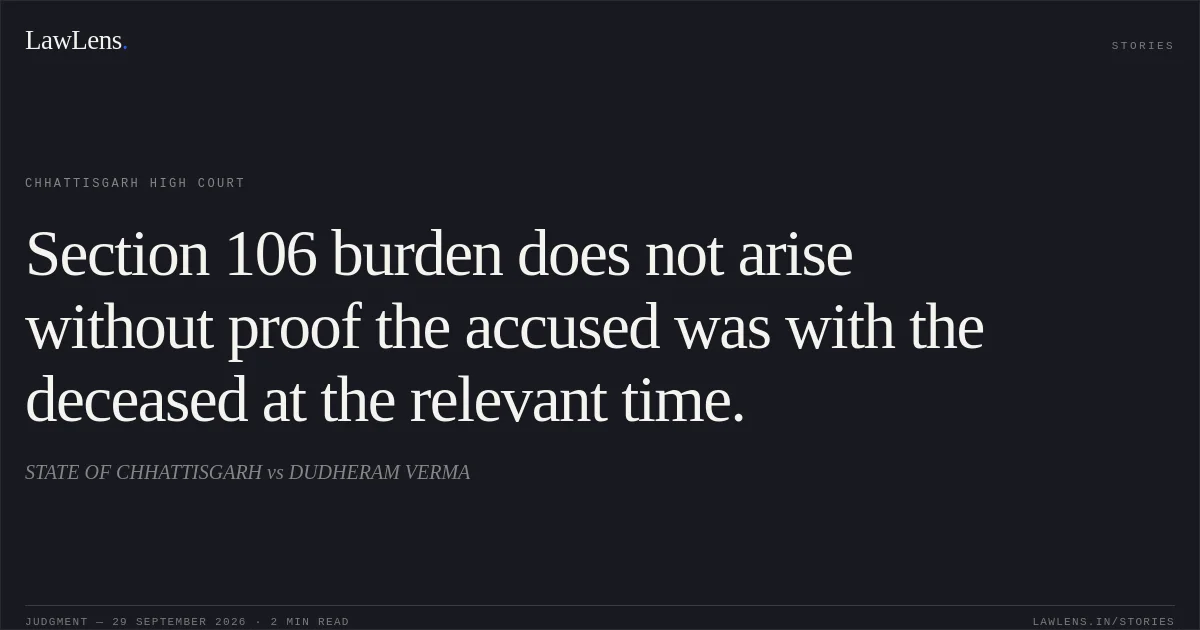
Source reference: no citationSection 106 of the Indian Evidence Act places on an accused the burden of explaining facts especially within his knowledge; as applied here, that burden could arise only if the prosecution first established that the respondent and the deceased were together in the house on the night of the incident.
Source reference: para. 10The Court assessed the circumstantial evidence, including the alleged recovery and forensic evidence, but cited no separate precedent or broader test for appellate interference with acquittals.
Source reference: para. 11–13Reasoning
The witnesses did not establish that the respondent was with the deceased in the house during the night, so the Court held that Section 106 did not require him to explain the death.
Source reference: para. 9–10The alleged weapon recovery was not proved through an independent witness, and the FSL report did not establish that blood on the weapon matched the deceased’s blood. The motive was also not proved.
Source reference: para. 8, 11–12These deficiencies left the circumstantial evidence insufficient to displace the acquittal, which the Court found had been reached after proper analysis.
Source reference: para. 13Holding
The High Court dismissed the State’s appeal and declined to interfere with the acquittal under Section 302 IPC.
It directed that the trial court’s original records be returned with a copy of the judgment.
Source reference: para. 15Acts & Sections Cited
1 provisions across 1 statute referred to in this judgment. Each provision opens on LawLens.
Indian Penal Code, 18601
Original Court PDF
STATE OF CHHATTISGARHvsDUDHERAM VERMA
Click to open original judgment
Original judgment, available to read, download and summarize on LawLens.in