Facts
The appellant was convicted under Section 302 of the Indian Penal Code (IPC) for the murder of his wife and sentenced to life imprisonment.
Source reference: p.1The prosecution case was that, after an altercation, the appellant assaulted the deceased with a bamboo stick; she was found dead in their house the next morning, while the appellant had left the scene.
Source reference: p.2There was no eyewitness to the assault.
Source reference: p.5The post-mortem evidence established death from head injuries caused by a hard and blunt object, which the doctor said were sufficient in the ordinary course of nature to cause death.
Source reference: p.4The trial court convicted the appellant, and he appealed.
Source reference: pp.1, 4Issues
1. Whether the prosecution evidence established beyond reasonable doubt that the deceased died a homicidal death.
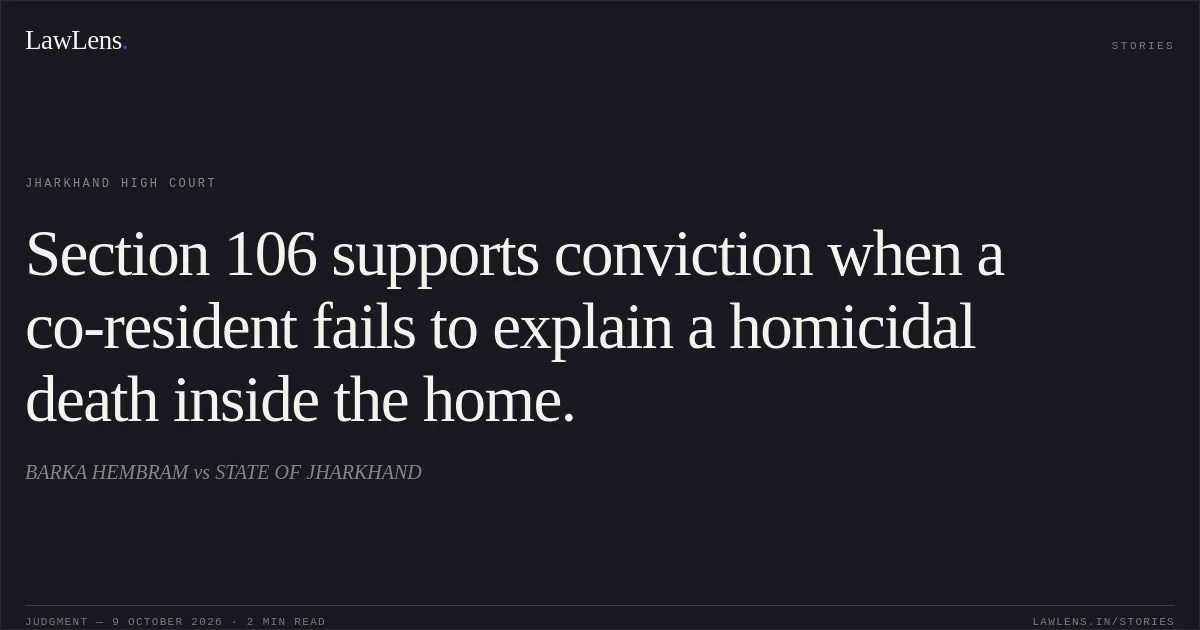
Source reference: p.52. Whether the circumstances, including the death in the couple’s house and the appellant’s failure to explain the occurrence, established his guilt under Section 302 IPC, with recourse to Section 106 of the Indian Evidence Act, 1872.
Source reference: pp.5–6Law Applied
Section 302 IPC criminalises murder.
Source reference: p.1Section 106 of the Indian Evidence Act, 1872 places the burden of proving a fact especially within a person’s knowledge on that person; it does not relieve the prosecution of its obligation to prove its case beyond reasonable doubt.
Source reference: p.6The Court relied on State of Madhya Pradesh v. Balveer Singh, (2025) 8 SCC 545, referring to its discussion of the governing principles for Section 106 and the establishment of a prima facie case.
Source reference: p.6Reasoning
The Court treated the medical evidence as proving homicidal death and found that the body was discovered in the appellant’s house, where the appellant and deceased were the only residents; it also noted evidence of quarrels and that the appellant had left the scene.
Source reference: pp.5–6On those circumstances, the Court held that the prosecution had established the foundational facts for invoking Section 106.
Source reference: pp.5–6The appellant’s denial and assertion of no knowledge in his Section 313 CrPC examination did not explain the occurrence, and the Court considered that failure alongside the prosecution evidence in finding the case proved beyond reasonable doubt.
Source reference: pp.6–7Holding
The High Court answered the issues against the appellant, held that the prosecution had proved his guilt under Section 302 IPC beyond reasonable doubt, and dismissed the appeal.
It upheld the conviction and life sentence, and directed that the trial court record be sent back to the court concerned.
Source reference: p.7Acts & Sections Cited
3 provisions across 2 statutes referred to in this judgment. Each provision opens on LawLens.
Indian Penal Code, 18602
Code of Criminal Procedure, 19731
Original Court PDF
BARKA HEMBRAMvsSTATE OF JHARKHAND
Click to open original judgment
Original judgment, available to read, download and summarize on LawLens.in