Facts
The Applicant claimed through the estate of late Chandrakant T. Mirani, who had entered into a Development Agreement with Respondent No. 1 on 4 October 2002.
Source reference: para. 3–4The Applicant alleged that the developer and the relevant housing society had failed to execute a Lease Deed and pay lease rent, and sought arbitration after notices in 2022 and 2025.
Source reference: para. 3–4, 14Respondent No. 1 challenged the Applicant’s authority and raised non-joinder and limitation objections.
Source reference: para. 6–15Respondent No. 2 contended that it was not party to the arbitration agreement and that the dispute was time-barred and affected the rights of other societies.
Source reference: para. 6–15The applications concerned two related developments and were decided together.
Source reference: para. 1Issues
Whether the disputes between the Applicant and Respondent No. 1 should be referred to arbitration despite objections concerning the Applicant’s authority, non-joinder, and limitation of the substantive claims.
Source reference: para. 16–30, 42–45Whether Respondent No. 2, a housing society that was not shown to have signed the Development Agreement, could be compelled to arbitrate under its arbitration clause.
Source reference: para. 31–35, 43–45Whether the disputes were non-arbitrable because their determination could affect the rights of other societies or third parties.
Source reference: para. 35–37Law Applied
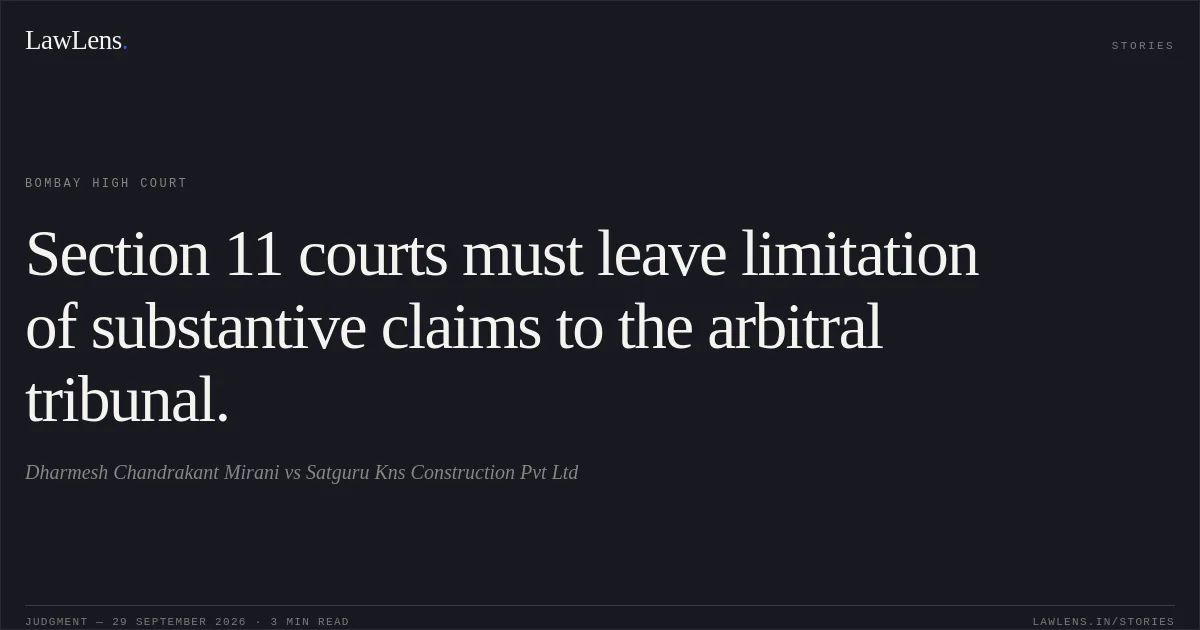
Under Section 11 of the Arbitration and Conciliation Act, 1996, the referral court’s inquiry is limited, ordinarily, to a prima facie examination of the existence of an arbitration agreement; it should not conduct a mini-trial or an intricate evidentiary inquiry into disputed questions. The Tribunal may decide jurisdictional objections under Section 16, including issues requiring detailed evidence.
Source reference: para. 17–18The Court relied on *A.P. Power Generation Corpn. Ltd. v. Tecpro Systems Ltd.*, *In re: Interplay Between Arbitration Agreements under the Arbitration Act, 1996 and the Indian Stamp Act, 1899*, *SBI General Insurance Co. Ltd. v. Krish Spg.*, and *Aslam Ismail Khan Deshmukh v. ASAP Fluids (P) Ltd.* for the limited referral inquiry and the treatment of limitation: the court examines whether the Section 11 application itself is within time, leaving disputed limitation issues concerning the substantive claims to the Tribunal.
Source reference: para. 17–18, 27–30Under *Cox & Kings Ltd. v. SAP India (P) Ltd.*, a non-signatory may be referred only where there is prima facie material that it is a “veritable party” to the arbitration agreement; the Tribunal may determine that issue on evidence.
Source reference: para. 31–33*Vidya Drolia v. Durga Trading Corporation* provides that disputes requiring centralized adjudication or affecting third-party rights may be non-arbitrable, but the character of the particular dispute must be assessed.
Source reference: para. 13, 36Reasoning
Clause 33 of the Development Agreement provided for arbitration of disputes arising from the agreement, and Respondent No. 1’s status as the developer and the Applicant’s claim through the original contracting party supplied a sufficient prima facie basis for referring their dispute.
Source reference: para. 20, 42–43Questions about the Applicant’s authority, other heirs, non-joinder, and the substantive claims’ limitation required further examination and were left to the Tribunal; the Section 11 applications themselves were not shown to be out of time.
Source reference: para. 20–30, 44By contrast, the record did not show that Respondent No. 2 had signed or otherwise become a party to Clause 33. Its status as a society or potential beneficiary of a lease did not, without more, establish consent to arbitrate.
Source reference: para. 31–35Nor did the possible effect of the dispute on other societies make the entire contractual dispute non-arbitrable: the Tribunal could determine the limits of any relief affecting non-parties.
Source reference: para. 36–38Holding
The Court allowed the applications to the limited extent of referring disputes between the Applicant and Respondent No. 1 arising from or connected with the Development Agreement to a sole arbitrator, Mr. Tushad Kakalia.
It declined to refer Respondent No. 2 because there was insufficient prima facie material that the society was bound by the arbitration agreement.
Source reference: para. 43–45The Tribunal was left to decide the outstanding objections and questions of merits in accordance with law.
Source reference: para. 44, 48The order also stated that the applications originally filed under Section 9 were treated and converted as applications under Section 17 of the Act.
Source reference: para. 47Acts & Sections Cited
5 provisions across 1 statute referred to in this judgment. Each provision opens on LawLens.
Arbitration and Conciliation Act, 19965
Original Court PDF
Dharmesh Chandrakant MiranivsSatguru Kns Construction Pvt Ltd
Click to open original judgment
Original judgment, available to read, download and summarize on LawLens.in