Facts
Respondent No. 2, Sahanaz Choudhury, filed an application under Section 12 of the Protection of Women from Domestic Violence Act, 2005 (“DV Act”) before the Chief Judicial Magistrate, Sribhumi, alleging mental torture and other acts of domestic violence by her husband, Sadikul Haque, and his family members.
Source reference: p.4, para. 3–4The proceedings were registered as Misc. (DV) Case No. 37/2025 and assigned to the Judicial Magistrate First Class-II, Sribhumi. By order dated 06.09.2025, the Magistrate issued notices to the respondents and fixed the matter for service report, written statement, Domestic Incident Report, and disclosure of assets and liabilities.
Source reference: p.4, para. 3; p.5, para. 5The husband and his family members challenged the proceedings and the notice order under Section 528 of the Bharatiya Nagarik Suraksha Sanhita, 2023 (“BNSS”).
Source reference: p.5, para. 6Issues
Whether the first proviso to Section 223(1) BNSS, requiring an opportunity of hearing to the accused before cognizance of an offence is taken, applies to an application under Section 12 of the DV Act?
Source reference: pp.13–16, paras. 27–31Whether an application under Section 12 of the DV Act is maintainable against persons with whom the aggrieved woman was not residing at the time of the alleged domestic violence?
Source reference: pp.6–7, paras. 7–8; p.17, para. 32Whether the High Court should exercise its inherent jurisdiction under Section 528 BNSS to quash the DV proceedings on the grounds that the allegations were vague, false, or unsupported by the petitioners’ documents?
Source reference: pp.7–8, paras. 10–12; pp.17–18, para. 33Law Applied
Section 12 of the DV Act enables an aggrieved person to seek protective, residence, monetary, compensation, and other reliefs from the Magistrate; such proceedings are essentially quasi-civil and are not instituted for punishment for an offence.
Source reference: pp.15–16, paras. 30–31Section 223(1) BNSS applies when a Magistrate takes cognizance of an offence on a complaint; the definitions of “complaint” under Section 2(h) and “offence” under Section 2(q) BNSS presuppose an allegation of a legally punishable act.
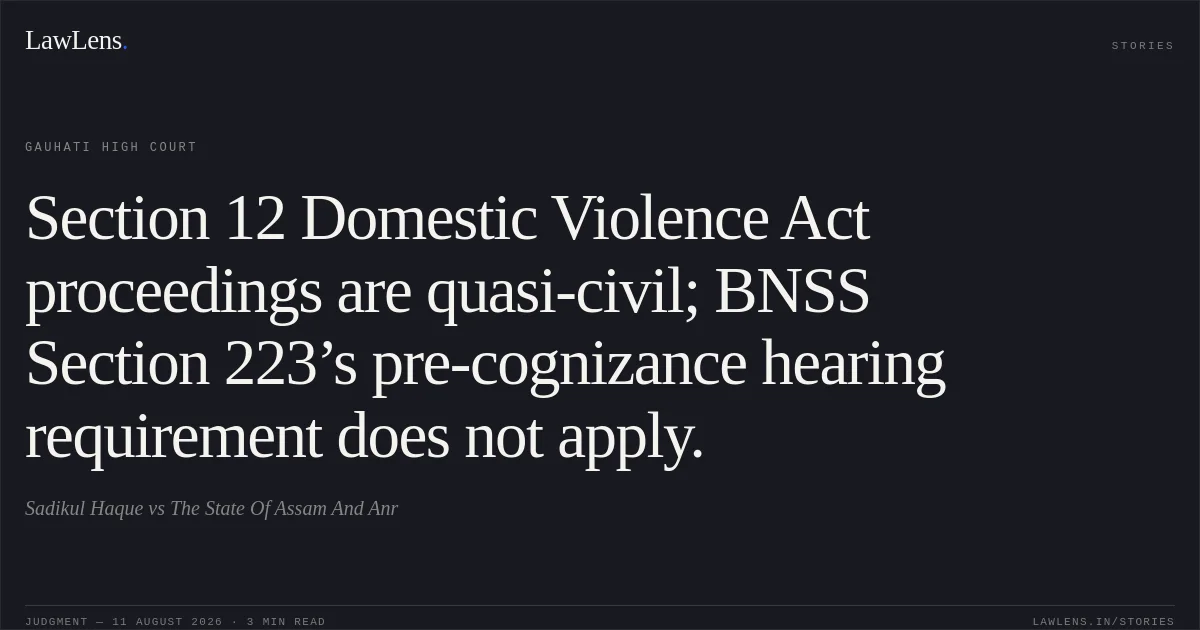
Source reference: p.14, para. 29Consequently, the first proviso to Section 223(1) BNSS does not govern a Section 12 DV Act application.
Source reference: p.16, para. 31Relying on Prabha Tyagi v. Kamlesh Devi, (2022) 8 SCC 90, the Court held that actual residence with the persons proceeded against at the time of the alleged violence is not mandatory where the relationship falls within the DV Act and the woman has lived in the shared household or has a right to reside there.
Source reference: p.17, para. 32The Court also applied the settled principle, including State of Haryana v. Bhajan Lal, 1992 Supp (1) SCC 335, that inherent powers to quash proceedings must be exercised sparingly and with circumspection.
Source reference: p.13, para. 26Reasoning
The Court held that the petitioners’ reliance on Section 223(1) BNSS was misplaced because the respondent’s application sought reliefs under the DV Act rather than punishment for an offence.
Source reference: pp.13–16, paras. 27–31Since the Magistrate was not taking cognizance of an offence on a complaint within the meaning of the BNSS, the statutory requirement of hearing the accused before such cognizance did not arise.
Source reference: pp.13–16, paras. 27–31The objection that some petitioners had not continuously resided with the respondent was also rejected at the threshold stage.
Source reference: p.17, para. 32Applying Prabha Tyagi, the Court held that actual co-residence at the time of the alleged incident is not an indispensable condition for seeking relief under the DV Act.
Source reference: p.17, para. 32The competing assertions regarding the parties’ residence, the nature of their domestic relationship, and the truth or falsity of the allegations involved factual issues that could not appropriately be adjudicated in a Section 528 BNSS proceeding.
Source reference: pp.11–12, paras. 20–23; p.18, para. 33The petitioners’ documents and allegations of falsity therefore did not disclose a ground for quashing the proceedings.
Source reference: p.18, para. 33The Court further observed that the parties remained free to pursue mediation before the Trial Court.
Source reference: p.18, para. 34Holding
The Court answered the principal issues against the petitioners.
It held that the first proviso to Section 223(1) BNSS does not apply to proceedings initiated under Section 12 of the DV Act, as such proceedings are quasi-civil and do not involve cognizance of an offence.
Source reference: p.16, para. 31It further held that actual residence with the respondents at the time of the alleged domestic violence is not mandatory for maintainability of the application.
Source reference: p.17, para. 32Finding no sufficient ground to invoke its inherent jurisdiction under Section 528 BNSS, the Court dismissed Criminal Petition No. 1381/2025 and Criminal Petition No. 334/2026, and directed that a copy of the judgment be forwarded to the concerned Magistrate.
Source reference: p.18, paras. 35–36Acts & Sections Cited
10 provisions across 3 statutes referred to in this judgment. Each provision opens on LawLens.
Protection of Women from Domestic Violence Act, 20055
Bharatiya Nagarik Suraksha Sanhita, 20234
Cattle-Trespass Act, 18711
Original Court PDF
Sadikul HaquevsThe State Of Assam And Anr
Click to open original judgment
Original judgment, available to read, download and summarize on LawLens.in