Facts
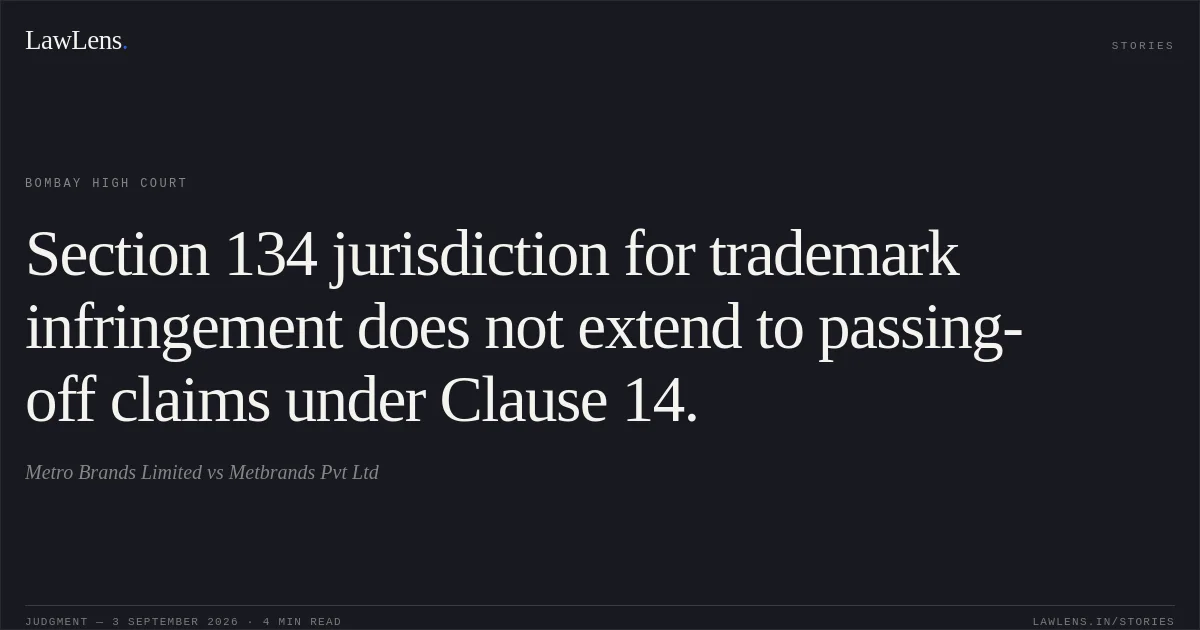
Metro Brands Limited filed a commercial IPR suit seeking an injunction restraining Met Brands Private Limited from infringing its registered trade mark “METRO” by using “METBRANDS”/“METBRANDS SHOES & BAGS”, along with claims for damages for trademark infringement, passing off and unfair competition.
Source reference: paras. 1–2; pp. 2–3The defendant carried on business in Kerala, while the plaintiff’s registered office was in Mumbai and it operated 18 Metro stores in Kerala.
Source reference: para. 2; p. 3The suit was instituted in the Bombay High Court under Section 134 of the Trade Marks Act, 1999.
Source reference: para. 3; p. 4Since the alleged passing-off cause of action arose in Kerala, the plaintiff sought leave under Clause 14 of the Letters Patent to join the passing-off cause of action with the trademark-infringement claim.
Source reference: para. 3; p. 4The defendant opposed the application on the grounds of forum shopping, hardship, lack of territorial nexus with Mumbai, and the availability of Kerala as the appropriate forum.
Source reference: paras. 9–10; pp. 8–9Issues
Whether the plaintiff was entitled to leave under Clause 14 of the Bombay Letters Patent to join the cause of action for passing off, arising in Kerala, with the claim for trademark infringement maintainable in Mumbai under Section 134 of the Trade Marks Act, 1999.
Source reference: paras. 3–8; pp. 4–8Whether the plaintiff’s registered office in Mumbai, without a specific pleading that Mumbai was its principal place of business or the centre from which it controlled its business, justified exercising Clause 14 discretion in its favour.
Source reference: paras. 16–18; pp. 16–18Whether avoidance of multiplicity of proceedings and the plaintiff’s operation of 18 stores in Kerala justified retaining the composite suit in Mumbai despite the cause of action and the defendant’s business being located in Kerala.
Source reference: paras. 19–20; pp. 19–20Law Applied
The Court applied Section 120 of the Code of Civil Procedure, 1908, under which Sections 16, 17 and 20 do not govern the Bombay High Court’s ordinary original civil jurisdiction; territorial jurisdiction is determined principally by Clause 12 of the Letters Patent.
Source reference: para. 11; p. 10Under Clause 12, jurisdiction exists where the defendant carries on business or where the cause of action wholly or partly arises.
Source reference: para. 11; p. 10Section 134(2) of the Trade Marks Act provides an additional forum for suits concerning infringement under Section 134(1)(a) and (b), enabling the plaintiff to sue where it resides, carries on business or works for gain; however, claims for passing off under Section 134(1)(c) remain governed by Section 20 of the CPC and the applicable Letters Patent jurisdictional rules.
Source reference: para. 13; pp. 11–12Relying on Food Corporation of India v. Evdom en Corporation, (1999) 2 SCC 446, Indian Performing Rights Society Ltd. v. Sanjay Dalia, (2015) 10 SCC 161, Jagdish Gopal Kamath v. Lime and Chilli Hospitality Services Pvt. Ltd., 2013 (4) Mah LJ, and Manugraph India Ltd. v. Simarq Technologies Pvt. Ltd., 2016 SCC OnLine Bom 5334, the Court held that leave under Clause 14 is discretionary, principally intended to avoid multiplicity of proceedings, but may be refused where the chosen forum lacks a sufficient nexus, causes undue hardship, is inconvenient, or amounts to an abuse of process.
Source reference: paras. 12–15; pp. 10–15The Court also relied on Shree Sai Plast Pvt. Ltd. in Prince Pipes & Fittings Ltd. v. Shree Sai Plast Pvt. Ltd., 2024:BHC-OS:4767, for the principle that a registered office is not invariably the principal place of business; the latter depends on where the company controls its business activities.
Source reference: para. 15; p. 15Reasoning
The Court found that the plaintiff had pleaded only that its registered office was in Mumbai and had not pleaded that Mumbai was its exclusive principal place of business or the centre from which it controlled all business activities.
Source reference: para. 17; p. 17The plaintiff’s own pleadings established that the passing-off cause of action arose in Kerala, where the defendant carried on business and where the plaintiff also operated 18 stores.
Source reference: paras. 16–18; pp. 16–18Consequently, the passing-off claim was governed by Clause 12 of the Letters Patent and had a clear territorial connection with Kerala, not Mumbai.
Source reference: para. 17; p. 17The Court held that there was no genuine risk of multiplicity because the plaintiff could institute both claims in Kerala, where the defendant and cause of action were located.
Source reference: para. 20; p. 20Trial convenience, availability of witnesses and evidence, balance of convenience, and the asserted hardship to the Kerala-based defendant also favoured Kerala.
Source reference: paras. 19–20; pp. 19–20The discretionary power under Clause 14 therefore could not be exercised merely because Section 134(2) independently enabled the plaintiff to sue for trademark infringement in Mumbai.
Source reference: paras. 18–20; pp. 18–20Holding
The Bombay High Court dismissed the Leave Petition and refused leave under Clause 14 to join the passing-off cause of action with the trademark-infringement claim in the Mumbai suit.
The Court held that the appropriate forum for the composite claims was Kerala, where the defendant carried on business and where the passing-off cause of action arose.
Source reference: para. 21; p. 21The plaintiff was granted liberty to take appropriate steps in accordance with law.
Source reference: para. 21; p. 21Acts & Sections Cited
8 provisions across 4 statutes referred to in this judgment. Each provision opens on LawLens.
Bombay High Court (Letters Patent) Act, 1866.2
Trade Marks Act, 19991
Copyright Act, 19571
Code of Civil Procedure, 19084
Original Court PDF
Metro Brands LimitedvsMetbrands Pvt Ltd
Click to open original judgment
Original judgment, available to read, download and summarize on LawLens.in