Facts
The complainant, a private chit-fund company, alleged that Ashok Gupta had purchased two chits of ₹1,00,000 each in 1996 and had failed to pay the instalments and agreed interest.
Source reference: para. 2Gupta allegedly issued cheque No. 595510 dated 20 December 1998 for ₹1,03,901 towards the outstanding liability.
Source reference: para. 2The cheque was dishonoured on 23 February 1999 with the remark “account closed”; a statutory notice was issued on 4 March 1999, but payment was not made.
Source reference: para. 2The Judicial Magistrate convicted the accused under Section 138 of the Negotiable Instruments Act, 1881, sentencing him to six months’ rigorous imprisonment, a fine of ₹1,000, and compensation of ₹1,25,000.
Source reference: para. 5The Additional Sessions Judge allowed the appeal and acquitted him on 30 September 2009.
Source reference: para. 6The complainant challenged the acquittal through the present revision petition.
Source reference: no citationThe High Court left the question of maintainability open and proceeded to decide the matter on merits.
Source reference: paras. 10–10.2Issues
Whether the complainant proved the existence of a legally enforceable debt or liability corresponding to the dishonoured cheque so as to attract Sections 138 and 139 of the NI Act?
Source reference: paras. 11.1–12.2Whether the presumption under Sections 118 and 139 of the NI Act was sufficient to sustain the conviction despite the complainant’s failure to produce the chit agreements, account statements, records of instalments, and income-tax returns?
Source reference: paras. 11.1–13.2Whether dishonour of a cheque on the ground “account closed” constituted an offence under Section 138 where the account had been closed before issuance of the cheque?
Source reference: paras. 7.2, 14–15Whether the High Court could interfere with the appellate acquittal in revisional jurisdiction in the absence of manifest illegality, perversity, or gross miscarriage of justice?
Source reference: paras. 13.3–13.6Whether the complaint was properly instituted by an authorised representative of the complainant company?
Source reference: para. 16Law Applied
Section 138 of the NI Act applies only where a cheque is issued for discharge, wholly or partly, of a legally enforceable debt or other liability, and the statutory requirements concerning presentation, notice, and non-payment are satisfied.
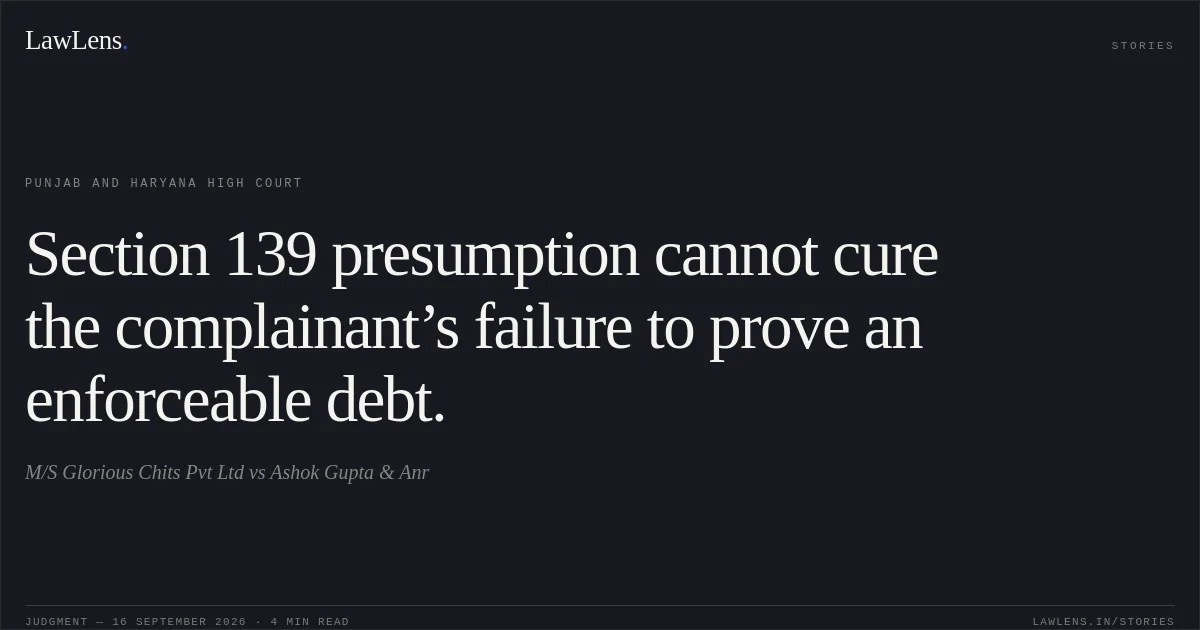
Source reference: para. 11Section 139 creates a rebuttable presumption that the cheque was received for discharge of such debt or liability, while Sections 118 and 139 do not dispense with the requirement that the foundational facts and legally enforceable liability be established.
Source reference: paras. 11.1–11.2The accused may rebut the statutory presumption on a preponderance of probabilities, including through the complainant’s evidence and surrounding circumstances, as explained in M.S. Narayana Menon alias Mani v. State of Kerala.
Source reference: para. 13.1Under Section 401 CrPC, revisional interference with an acquittal is extremely limited and is ordinarily permissible only in exceptional cases involving manifest illegality, perversity, or gross miscarriage of justice; the revisional court cannot indirectly convert an acquittal into a conviction, as held in Bindeshwari Prasad Singh v. State of Bihar and Mahendra Pratap Singh v. Sarju Singh.
Source reference: paras. 13.5–13.6The principle that dishonour due to closure of an account may attract Section 138 where the account is closed after issuance of the cheque, but not where it was already closed before issuance, was applied with reference to NEPC Micon Ltd. v. Magma Leasing Ltd. and Urban Co-op. Credit Society, Borsad v. State of Gujarat.
Source reference: para. 14Reasoning
The Court held that the complainant failed to establish the foundational fact of an existing and legally enforceable liability.
Source reference: paras. 12–12.2Although it alleged unpaid chit instalments and interest, it produced neither the chit agreements nor any account statement, books of account, instalment records, income-tax returns, or other material explaining how the precise amount of ₹1,03,901 had been calculated.
Source reference: paras. 12–12.2The complainant’s own witness admitted that these records existed and that the accused had asserted that blank signed cheques had been taken as security when the chits were raised.
Source reference: para. 12.2These omissions justified an adverse inference and rendered the presumption under Section 139 insufficient to sustain the conviction.
Source reference: no citationThe fact that the cheque bore the accused’s signature or was dishonoured with the endorsement “account closed” could not cure the failure to prove the underlying debt.
Source reference: paras. 13.2, 15Moreover, the account had allegedly been closed before the cheque was issued, making the factual basis distinguishable from cases where the account was closed after issuance.
Source reference: para. 14The appellate court’s view was therefore a legally possible and evidence-based view, and no exceptional ground existed for revisional interference.
Source reference: paras. 13.3–13.6The Court also found no valid proof that the complaint had been instituted pursuant to a duly passed Board resolution, though this issue became secondary in view of the failure to prove the substantive liability.
Source reference: para. 16Holding
The High Court dismissed the revision petition and upheld the Additional Sessions Judge’s order acquitting the accused.
It held that the complainant had failed to prove a legally enforceable debt or liability underlying the cheque, and that the appellate acquittal did not suffer from perversity, manifest illegality, or gross miscarriage of justice.
Source reference: paras. 15, 18The accused was acquitted of the notice of accusation, his bail bonds were discharged, and pending applications, if any, were disposed of.
Source reference: para. 18Acts & Sections Cited
10 provisions across 3 statutes referred to in this judgment. Each provision opens on LawLens.
Negotiable Instruments Act, 18815
Code of Criminal Procedure, 19734
Indian Penal Code, 18601
Original Court PDF
M/S Glorious Chits Pvt LtdvsAshok Gupta & Anr
Click to open original judgment
Original judgment, available to read, download and summarize on LawLens.in