Facts
FCI appointed Shri Chimanlal as an ad-hoc road transport contractor in 1999, but cancelled the contract after he failed to commence work.
Source reference: pp. 1–3, 5–6An arbitral award dated 9 March 2004, made in his absence, awarded FCI Rs. 4,82,795.
Source reference: pp. 1–3, 5–6Chimanlal filed objections under Section 34 of the Arbitration and Conciliation Act, 1996 before the Bikaner Court; after his death, his legal representatives were substituted.
Source reference: pp. 1–3, 5–6The Bikaner Court returned the objections on 26 November 2018 for lack of territorial jurisdiction, and the legal representatives filed objections in the Commercial Court on 15 January 2019.
Source reference: pp. 1–3, 5–6The Commercial Court excluded the time spent before the Bikaner Court under Section 14 of the Limitation Act and set aside the award for breach of natural justice.
Source reference: pp. 1–3, 5–6FCI appealed.
Source reference: pp. 1–3, 5–6Issues
1. Whether the objections before the Commercial Court were time-barred, including whether the time spent pursuing them before the Bikaner Court could be excluded under Section 14 of the Limitation Act
Source reference: pp. 5–8, 12–142. Whether the award was liable to be set aside for lack of proper notice and resulting breach of natural justice
Source reference: pp. 8–9, 15, 173. Whether the Commercial Court’s order warranted interference under Section 37 of the Arbitration and Conciliation Act, 1996
Source reference: pp. 4, 10–11, 16, 20–21Law Applied
Section 34(3) of the Arbitration and Conciliation Act, 1996 prescribes the limitation period for challenging an award, and Section 5 of the Limitation Act cannot extend that period beyond the statutory limit; however, Section 14 of the Limitation Act permits exclusion of time spent diligently and in good faith pursuing a remedy before a court unable to entertain it for lack of jurisdiction
Source reference: pp. 12–14Limitation to challenge an award runs from receipt of the award (State of Maharashtra v. ARK Builders Pvt. Ltd.)
Source reference: p. 7Under Section 27 of the General Clauses Act, 1897, deemed service by registered post requires proof that the document was properly addressed, postage prepaid, and sent by registered post; Section 3(1)(b) of the Arbitration Act similarly requires mailing by registered letter or other means
Source reference: pp. 6–7Section 25 of the Arbitration Act permits proceedings in a party’s absence only where that party has failed to appear; non-appearance cannot support an ex parte proceeding where service is unestablished
Source reference: p. 11Section 37 review is narrower than Section 34 review and does not permit an independent reassessment of the award’s merits (MMTC Ltd. v. Vedanta Ltd.; UHL Power Co. Ltd. v. State of H.P.)
Source reference: pp. 9–11An award must give reasons as required by Section 31(3) of the Arbitration Act
Source reference: p. 11Reasoning
The Court found no postal receipt proving that the award had been sent by registered post; accordingly, FCI could not rely on deemed service, and the limitation period could not be shown to have commenced on the asserted date.
Source reference: pp. 6–7The legal representatives had pursued the objections before a court that lacked territorial jurisdiction and approached the competent court within 46 days after the objections were returned.
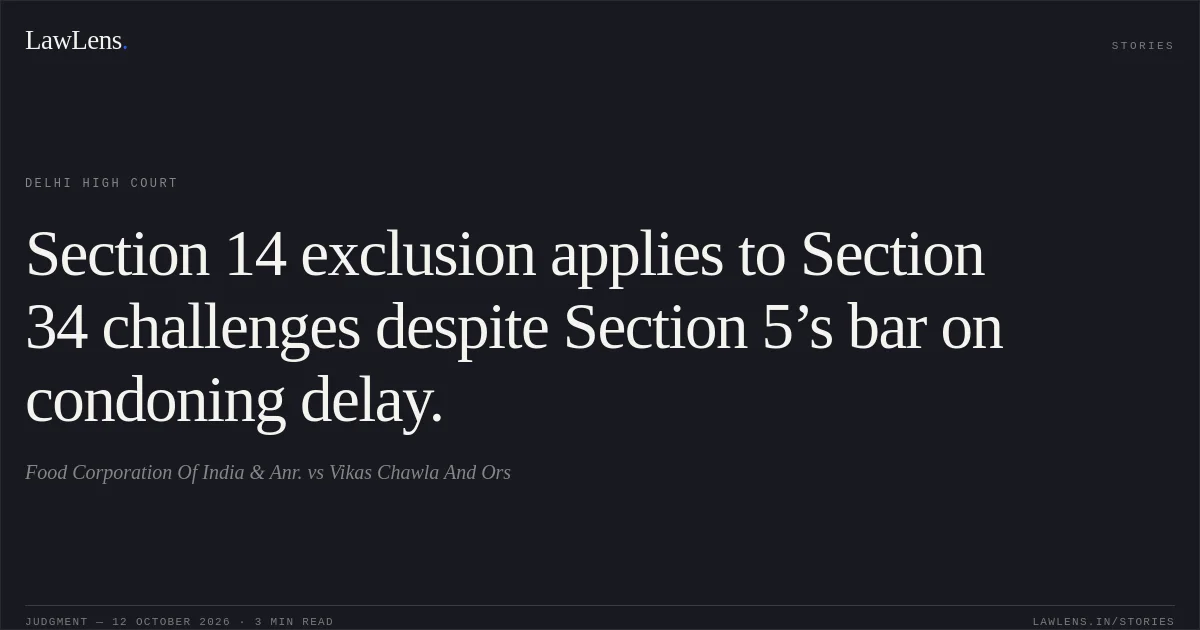
Source reference: pp. 5–8, 12–14The Commercial Court therefore properly excluded the time under Section 14; the bar on condonation under Section 5 did not prevent that exclusion.
Source reference: pp. 5–8, 12–14On the merits, the record did not establish service of the fresh notice issued after amendment of FCI’s claim.
Source reference: p. 8–9, 15, 17The refusal endorsement relied on by the arbitrator bore a date preceding the first hearing, and the relevant notice and postal records were unavailable.
Source reference: p. 8–9, 15, 17The arbitrator therefore lacked a sufficient basis to proceed ex parte, and the resulting natural-justice finding was within the Section 34 grounds.
Source reference: p. 8–9, 15, 17The Commercial Court’s findings, including its conclusion that the award did not state reasons for allowing the claims, disclosed no error warranting interference under the limited Section 37 jurisdiction.
Source reference: pp. 10–11, 18–20Holding
The High Court dismissed FCI’s appeal, holding that the Commercial Court had correctly applied Section 14 of the Limitation Act and set aside the award on grounds including lack of established service and breach of natural justice.
The impugned order disclosed no factual or legal error, much less perversity, warranting interference under Section 37.
Source reference: p. 12Acts & Sections Cited
9 provisions across 4 statutes referred to in this judgment. Each provision opens on LawLens.
Arbitration and Conciliation Act, 19965
Limitation Act, 19632
General Clauses Act, 18971
Negotiable Instruments Act, 18811
Original Court PDF
Food Corporation Of India & Anr.vsVikas Chawla And Ors
Click to open original judgment
Original judgment, available to read, download and summarize on LawLens.in