01Facts
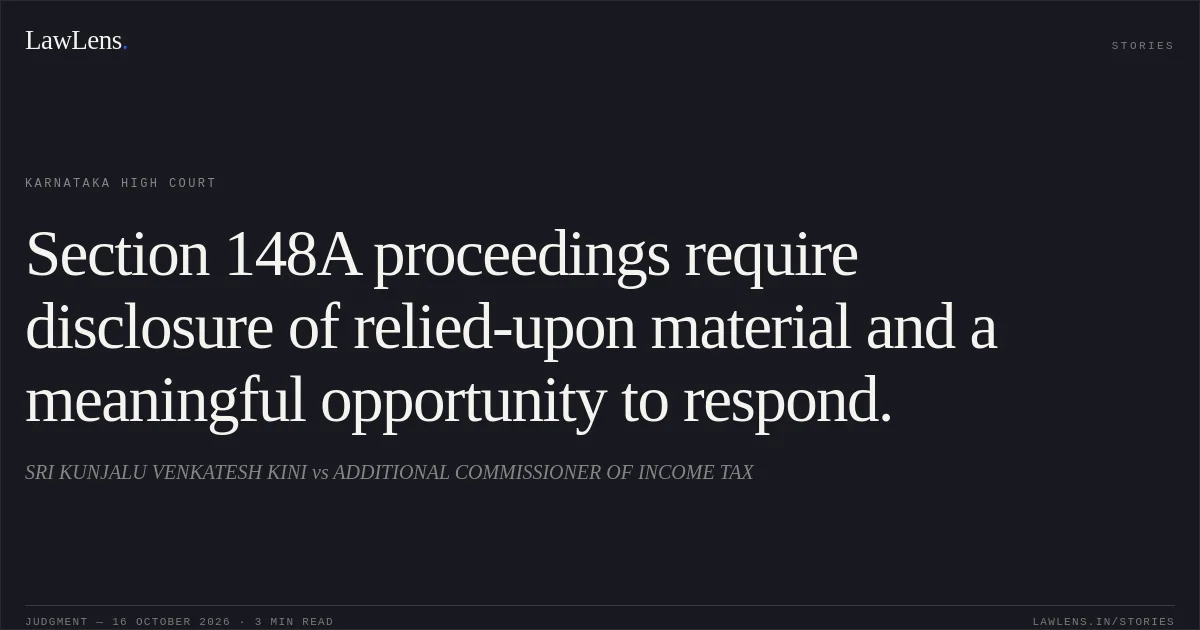
The petitioner challenged proceedings concerning assessment year 2022–23, including an order under Section 148A(3), the prior approval under Sections 148A(3) and 151, and a notice under Section 148.
pp. 2–3, 12The proceedings began with a notice dated 27 March 2026, issued four days before the limitation period under Section 149(1)(b) expired. It alleged that business turnover of ₹14,66,08,364 had not been disclosed in the petitioner’s return.
p. 3The petitioner responded that the amount arose from a difference between bank credits and reported turnover, and that not all bank credits constituted turnover; he also offered to provide further information if required.
p. 4, 10The respondent granted approval on 11 June 2026 and passed the impugned order on 16 June 2026. The Court noted that, although the order recorded the approval date as 11 June, the approval document itself referred to 27 March—before the petitioner’s response.
p. 502Issues
i.1. Whether the order under Section 148A(3) could rely on adverse propositions that were not put to the petitioner in the notice under Section 148A(1).
pp. 5–8, 10–11ii.2. Whether the reassessment proceedings could proceed without disclosing how the alleged unreported turnover of ₹14,66,08,364 was computed and without giving the petitioner an opportunity to respond to the relevant material.
pp. 9–11iii.3. What relief should follow from deficiencies in the Section 148A process, given that the proceedings were commenced within the limitation period.
pp. 8–9, 11–1203Law Applied
The Court applied Sections 148A(1) and 148A(3) of the Income Tax Act, 1961, governing the show-cause and decision-making stages before reassessment, together with Section 151, which requires prior approval, and Section 149(1)(b), which prescribes the relevant limitation period.
p. 3, 5, 8The Court’s reasoning reflects the principle that a taxpayer must receive notice of the material propositions relied on and a meaningful opportunity to respond before an order under Section 148A(3) is made; where the alleged income is based on a computation, the basis and supporting information must be disclosed sufficiently to permit a response.
pp. 9–11No judicial precedents were cited.
Provisions in the judgment · 5
Income Tax Act, 1961 Section 147Section 148ASection 148Section 149Section 151
04Reasoning
Although the original notice identified alleged undisclosed turnover and the petitioner replied that bank credits could not automatically be treated as turnover, the respondents did not provide the requested computation or seek further particulars before proceeding.
pp. 9–10The Section 148A(3) order also introduced matters not raised in the show-cause notice, including allegations concerning the petitioner’s firms, parking and rotation of funds, expenses, and unsecured loans.
pp. 10–11In the Court’s view, deciding the matter on undisclosed propositions and without the computation risked turning reassessment into a roving enquiry rather than an enquiry into defined issues.
p. 11Because the proceedings had commenced within time, the Court accepted that the appropriate course was to restore them for proper consideration rather than terminate them altogether.
pp. 8–905Holding
The petition was allowed in part.
p. 12The Court quashed the Section 148A(3) order, the prior approval, and the consequential notice, and restored the proceedings to the second respondent for reconsideration.
p. 12Upon service of the order, the second respondent was directed to furnish the computation of ₹14,66,08,364 and the information supporting it, and to give the petitioner a reasonable opportunity to respond in light of that material and the observations in the impugned order.
pp. 12–13The Court further observed that the first respondent must examine all materials before granting prior approval, and left all contentions open.
p. 13Original Court PDF
SRI KUNJALU VENKATESH KINIvsADDITIONAL COMMISSIONER OF INCOME TAX
Click to open original judgment
Original judgment, available to read, download and summarize on LawLens.in