Facts
The petitioner claimed that he and his late wife jointly purchased the subject property under a sale deed dated 17 August 1978 and were entered in the khata in 2024.
Source reference: p. 3–4After his wife’s death, he sought mutation of the khata solely in his name, submitting a family tree and no-objection affidavits from family members.
Source reference: p. 3–4He sought an e-khata, but was informed through the portal that his application was rejected because the sale deed had been rejected.
Source reference: p. 3–4The petitioner’s nephew, the fourth respondent, had also filed objections.
Source reference: p. 3–4The petitioner therefore sought a writ directing the authorities to issue the e-khata.
Source reference: p. 3–4Issues
1. Whether the petitioner was entitled to a direction requiring the authorities to issue an e-khata in his name without an inquiry into the objections concerning the existing khata and subsequent mutation
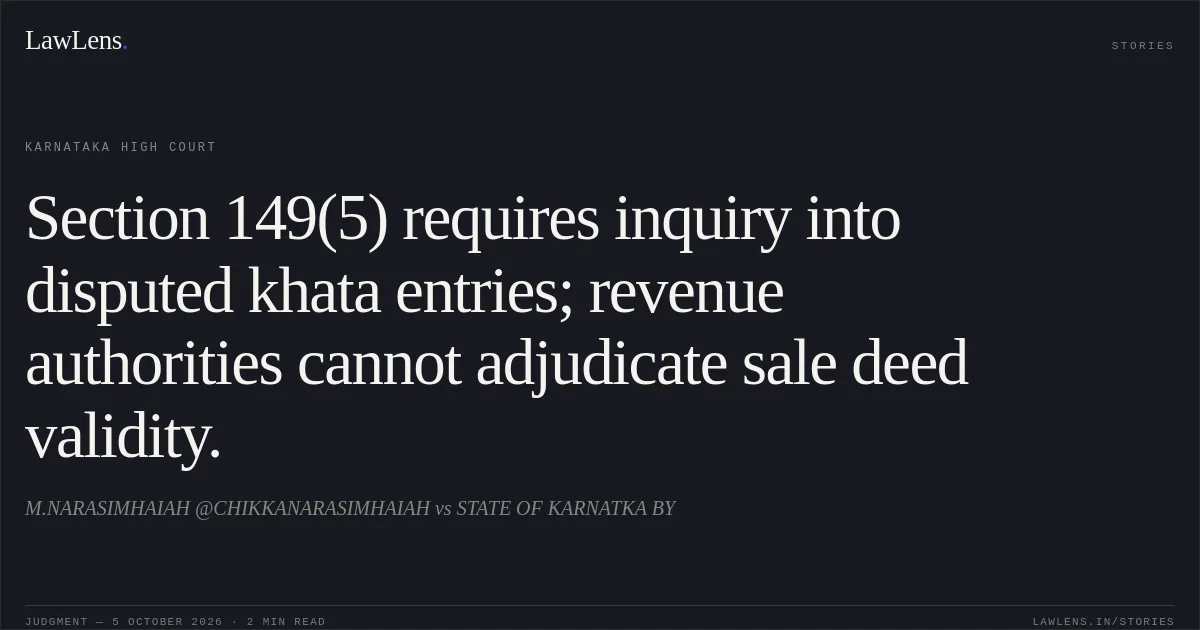
Source reference: p. 4–52. Whether the revenue authorities could reject the application on the basis that the sale deed was rejected, or instead had to conduct an inquiry under Section 149(5) of the Greater Bengaluru Governance Act, 2024
Source reference: p. 4–7Law Applied
Section 149 of the Greater Bengaluru Governance Act, 2024 governs entries in the Property Tax Register.
Source reference: p. 5–7Under the provision described by the Court, upon notice of the devolution of a khatedar’s interest to a legal heir, the Authorized Officer must enter the legal heir’s name in the Register.
Source reference: p. 5–7The Authorized Officer may also initiate action, suo motu or otherwise, to cancel an entry believed to have been wrongly made or made due to fraud, suppression, or incorrect or incomplete material, subject to an inquiry considered necessary and the statutory five-year limit from the date of the entry.
Source reference: p. 5–7Revenue authorities cannot determine the merits or validity of a sale deed.
Source reference: p. 5–7No precedent was cited.
Source reference: p. 5–7Reasoning
The Court considered the petitioner’s account of the joint khata, his wife’s death, his application for mutation, and the fourth respondent’s objections.
Source reference: p. 5–7It held that the application could not properly be rejected merely through a portal notation stating that the sale deed was rejected: the revenue authorities were not competent to decide the sale deed’s merits.
Source reference: p. 5–7Because objections had been raised and the existing and subsequent khata entries were in question, the appropriate course was an inquiry under Section 149(5), with an opportunity for both the petitioner and the fourth respondent to be heard and subject to the statutory time limit.
Source reference: p. 5–7Holding
The Court disposed of the petition without directing immediate issuance of an e-khata.
It gave the petitioner liberty to submit a certified copy of the order to the jurisdictional Assistant Revenue Officer within four weeks of receiving it.
Source reference: p. 7–9The third respondent was called upon to conduct the required inquiry; if not the Authorized Officer, the third respondent must report the matter to that officer for commencement of proceedings.
Source reference: p. 7–9The petitioner and fourth respondent must be notified of the inquiry or informed that a report has been submitted, within the specified four-week period.
Source reference: p. 7–9Acts & Sections Cited
2 provisions across 1 statute referred to in this judgment. Linked provisions open on LawLens.
Greater Bengaluru Governance Act, 20242
Original Court PDF
M.NARASIMHAIAH @CHIKKANARASIMHAIAHvsSTATE OF KARNATKA BY
Click to open original judgment
Original judgment, available to read, download and summarize on LawLens.in