Facts
On 27 December 2017, Dinesh Birajdar and Devidas Ighe were fatally assaulted at Rajiv Nagar, Nashik.
Source reference: p. 5–6The prosecution relied principally on four eyewitnesses, including first informant Ramesh Gaikwad, and on the recovery of a knife at the instance of accused No. 1, Ravi Nikalje
Source reference: p. 7–17The Sessions Court convicted five accused under Sections 302 read with 149, 143 and 148 of the IPC, and acquitted them under Section 135 of the Maharashtra Police Act
Source reference: p. 4The accused appealed their convictions; relatives of the deceased appealed the acquittal under Section 135 and sought capital punishment
Source reference: p. 3–4Issues
1. Whether the evidence proved the participation of accused Nos. 2–5 in the assault, including their liability for murder under Section 149 IPC.
Source reference: p. 27–382. Whether accused No. 1’s conviction under Section 302 read with Section 149 IPC should instead be recorded under Section 302 read with Section 34 IPC.
Source reference: p. 36–393. Whether the acquittal under Section 135 of the Maharashtra Police Act should be reversed, or the sentences enhanced to capital punishment.
Source reference: p. 3–4, 38–39Law Applied
The Court considered Sections 302, 34, 143, 148 and 149 of the IPC and Section 135 of the Maharashtra Police Act.
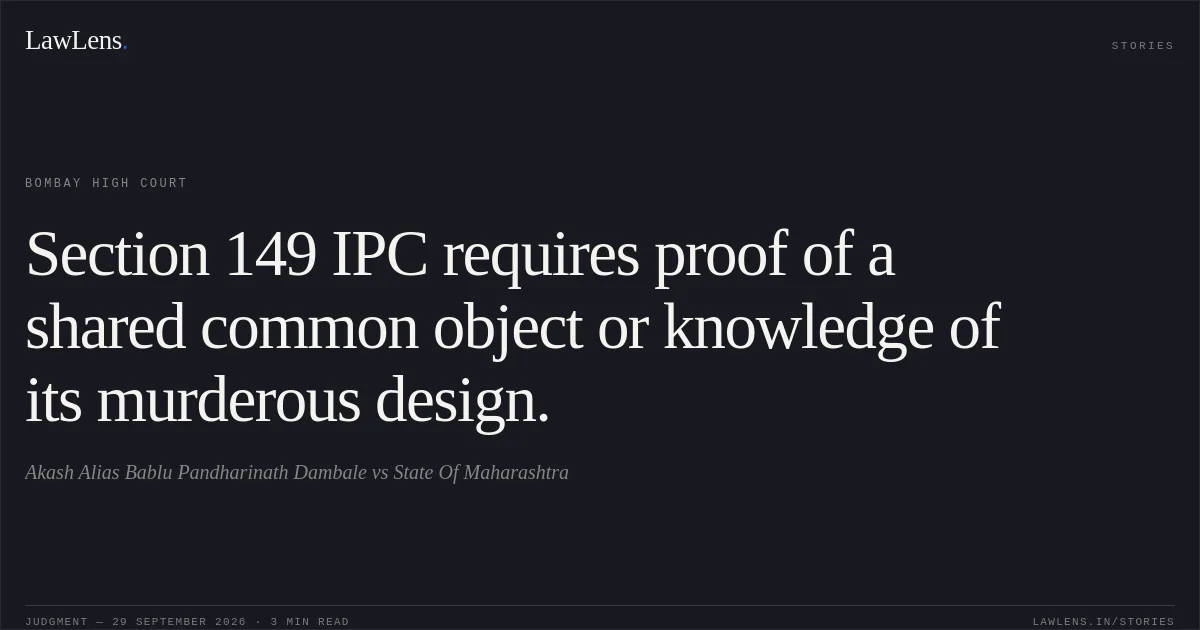
Source reference: no citationIt assessed whether the evidence established each accused’s participation and whether the circumstances proved a shared common object sufficient to impose constructive liability under Section 149 IPC; mere presence with the assailants did not, on the facts, establish such liability.
Source reference: no citationThe Court relied on *Pandurang Kalu Patil v. State of Maharashtra*, (2002) 2 SCC 490, in considering whether the evidence showed that the other accused knew of the assailants’ design or shared their object.
Source reference: p. 34–36It also treated recovery of the weapon as corroborative evidence against accused No. 1.
Source reference: p. 37Reasoning
The Court treated PW-1 as a natural and reliable eyewitness: he was with the deceased before the incident, his presence was supported by his injury, and he had promptly reported the occurrence to police; it therefore found no unexplained delay in the FIR.
Source reference: p. 31–33His specific evidence implicated accused No. 1 and the child in conflict with law, but did not clearly identify acts by accused Nos. 2–5.
Source reference: p. 27–31The other eyewitnesses’ statements were recorded several days later, their conduct in not promptly informing police was unexplained, and their specific allegations against accused Nos. 2–5 were not corroborated by PW-1.
Source reference: p. 27–31The Court consequently found insufficient proof that accused Nos. 2–5 shared the attackers’ common object or knew of the design to kill.
Source reference: p. 33–36In contrast, PW-1’s evidence and the knife recovery supported accused No. 1’s liability; the Court altered his conviction to Section 302 read with Section 34 IPC.
Source reference: p. 36–38Holding
The Court allowed the appeals of accused Nos. 2–5, set aside their convictions and acquitted them of all charges.
It partly allowed accused No. 1’s appeal, altered his conviction from Section 302 read with Section 149 to Section 302 read with Section 34 IPC, and maintained his life sentence and fine.
Source reference: p. 39It acquitted all five accused of the offences under Sections 143 and 148 IPC.
Source reference: p. 40The relatives’ appeal was dismissed: the Court found no basis to convict under Section 135 of the Maharashtra Police Act or to enhance the sentences.
Source reference: p. 38–40Acts & Sections Cited
7 provisions across 2 statutes referred to in this judgment. Each provision opens on LawLens.
Indian Penal Code, 18605
Code of Criminal Procedure, 19732
Original Court PDF
Akash Alias Bablu Pandharinath DambalevsState Of Maharashtra
Click to open original judgment
Original judgment, available to read, download and summarize on LawLens.in