Facts
On 27 April 2010, a cow belonging to Jitendra Chaubey allegedly entered and damaged the maize crop of informant Surendra Chaubey’s family.
Source reference: paras. 4, 15–18Following an altercation over the incident, Jitendra Chaubey, Mugal Ram @ Mangal Ram, Bablu Rajbhar and Mukesh Gond allegedly came armed to the informant’s house on 29 April 2010.
Source reference: paras. 4, 15–18During the ensuing confrontation, Narain Chaubey, who had intervened to pacify the parties, was shot in the chest; the prosecution attributed the fatal firing to Mugal Ram.
Source reference: paras. 4, 15–18The police registered Darauli P.S. Case No. 42 of 2010 on the basis of the informant’s fardbeyan and filed a charge-sheet against all four accused.
Source reference: paras. 5–8The trial court convicted them under Sections 302/149 of the Indian Penal Code, and additionally convicted Mugal Ram and Bablu Rajbhar under Section 27 of the Arms Act.
Source reference: paras. 5–8The accused denied the prosecution case and relied on political rivalry, the dispute concerning distribution of kerosene oil, and the existence of a counter-case.
Source reference: paras. 9–12, 33–35Issues
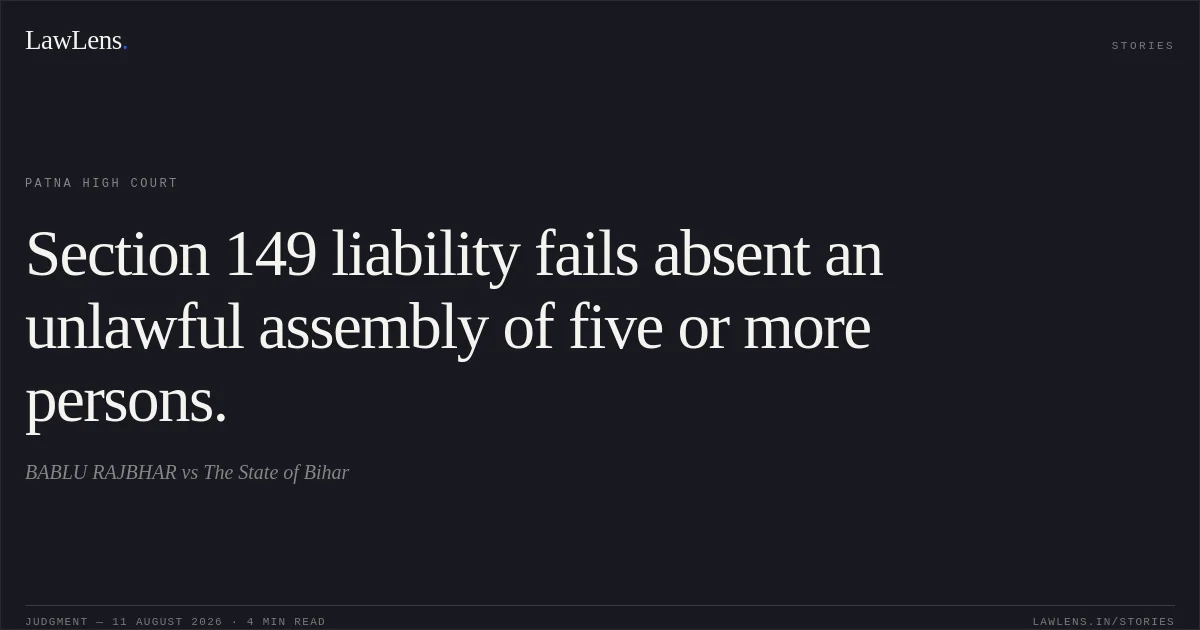
Whether the conviction of all four appellants under Section 302 read with Section 149 IPC was legally sustainable when the prosecution case established the presence of only four accused persons and did not establish an unlawful assembly of five or more persons sharing a common object?
Source reference: paras. 36–40Whether the remaining appellants could nevertheless be held constructively liable under Section 34 IPC when they were not charged under that provision and the evidence did not establish a common intention to cause Narain Chaubey’s death?
Source reference: paras. 41–43, 49Whether Mugal Ram’s act of firing at Narain Chaubey amounted to murder under Section 302 IPC or culpable homicide not amounting to murder under Section 304 Part II IPC, considering the alleged sudden quarrel and absence of premeditation?
Source reference: paras. 44–49Law Applied
The Court applied Section 149 IPC, which creates vicarious liability for an offence committed by a member of an unlawful assembly in prosecution of its common object, and requires an unlawful assembly consisting of at least five persons.
Source reference: paras. 39–40Sections 143, 146 and 148 IPC were considered in defining unlawful assembly and rioting.
Source reference: paras. 39–40Section 34 IPC was recognised as a rule of constructive liability based on a shared common intention, requiring proof of pre-consent, presence and participation; it does not itself create a substantive offence.
Source reference: para. 41The Court relied on Chaitu v. State of Uttar Pradesh, (2014) 11 SCC 218, concerning the application of the sudden-provocation exception in a case arising from a sudden quarrel.
Source reference: para. 47The Court distinguished murder under Section 300 IPC from culpable homicide not amounting to murder, and held that an unpremeditated act committed during a sudden quarrel or grave and sudden provocation may fall within the exception to Section 300 and attract Section 304 Part II IPC where the accused had knowledge that the act was likely to cause death.
Source reference: paras. 45–48Reasoning
The High Court held that Section 149 IPC could not apply because the prosecution’s own case identified four principal accused, while the villagers who followed them were not shown to have formed an unlawful assembly with the accused or shared their alleged criminal object.
Source reference: paras. 36–40The essential requirement of an assembly of at least five persons was therefore absent.
Source reference: paras. 36–40The Court further declined to substitute Section 34 IPC because the accused had not been charged under that provision and the evidence did not show that Jitendra Chaubey, Bablu Rajbhar or Mukesh Gond shared Mugal Ram’s intention to kill Narain.
Source reference: paras. 41–43, 48–49The evidence instead indicated that Narain intervened as a mediator and that Mugal Ram fired during a heated exchange, without prior enmity or established premeditation against the deceased.
Source reference: paras. 41–43, 48–49Although the firearm injury caused death and demonstrated knowledge of the likelihood of death, the Court treated the incident as an unpremeditated act committed in the heat of the moment and consequently reduced Mugal Ram’s liability from murder to culpable homicide not amounting to murder under Section 304 Part II IPC.
Source reference: paras. 44–49Holding
The appeals were allowed in part.
The conviction of Mugal Ram @ Mangal Ram under Sections 302/149 IPC was set aside and modified to conviction under Section 304 Part II IPC.
Source reference: para. 49He was sentenced to 10 years’ rigorous imprisonment and a fine of ₹50,000, with a further one year’s rigorous imprisonment in default; the fine, if realised, was directed to be paid to the widow of Narain Chaubey.
Source reference: paras. 53–54Jitendra Chaubey, Bablu Rajbhar and Mukesh Gond @ Mukesh Kumar Sah were acquitted because Section 149 IPC was inapplicable and the evidence did not establish common intention or individual liability for the homicide.
Source reference: para. 49They were directed to be set at liberty and released from their bail bonds; if in custody pursuant to the trial court’s judgment, they were to be released forthwith.
Source reference: paras. 55–57Acts & Sections Cited
11 provisions across 3 statutes referred to in this judgment. Each provision opens on LawLens.
Indian Penal Code, 18608
Arms Act, 19591
Code of Criminal Procedure, 19732
Original Court PDF
BABLU RAJBHARvsThe State of Bihar
Click to open original judgment
Original judgment, available to read, download and summarize on LawLens.in