Facts
Dogar Singh died on 2 January 1996 after colliding with truck No. HIB-2581, driven by respondent No. 2, Surinder Singh. His mother, Nasibo, and other relatives filed a claim petition under Section 166 of the Motor Vehicles Act, 1988.
Source reference: p.1–2, paras. 1–4The Motor Accident Claims Tribunal, Rupnagar, held that Dogar Singh’s death was not caused by rash or negligent driving of the truck; rather, he had struck a stationary vehicle due to his own fault.
Source reference: p.1–2, paras. 1–4Nevertheless, the Tribunal awarded Nasibo ₹50,000 under the principle of no-fault liability and dismissed the claims of the deceased’s brothers and sisters on the ground that they were not dependants. The Tribunal also held the insurer liable to indemnify the vehicle owner.
Source reference: p.1–2, paras. 1–4In appeal, the appellants did not challenge the finding that the deceased was himself at fault. Counsel sought enhancement of the no-fault compensation to ₹5,00,000 under Section 164 of the Act, relying on Ram Murti v. Punjab State Electricity Board, 2023 ACJ 631. The claim was ultimately pressed only on behalf of Nasibo, the deceased’s mother.
Source reference: p.2–3, paras. 6–7Issues
Whether compensation under the subsequently enacted Section 164 of the Motor Vehicles Act, 1988 could be applied to an accident that occurred on 2 January 1996, notwithstanding the absence of rash or negligent driving?
Source reference: p.2–4, paras. 6–10Whether Nasibo was entitled to enhancement of the no-fault compensation from ₹50,000 to ₹5,00,000, and if so, from what date and against whom?
Source reference: p.4–5, paras. 9–11Whether the Tribunal’s finding that Dogar Singh’s death resulted from his own act of colliding with the stationary truck required interference?
Source reference: p.2–3, paras. 4–6Law Applied
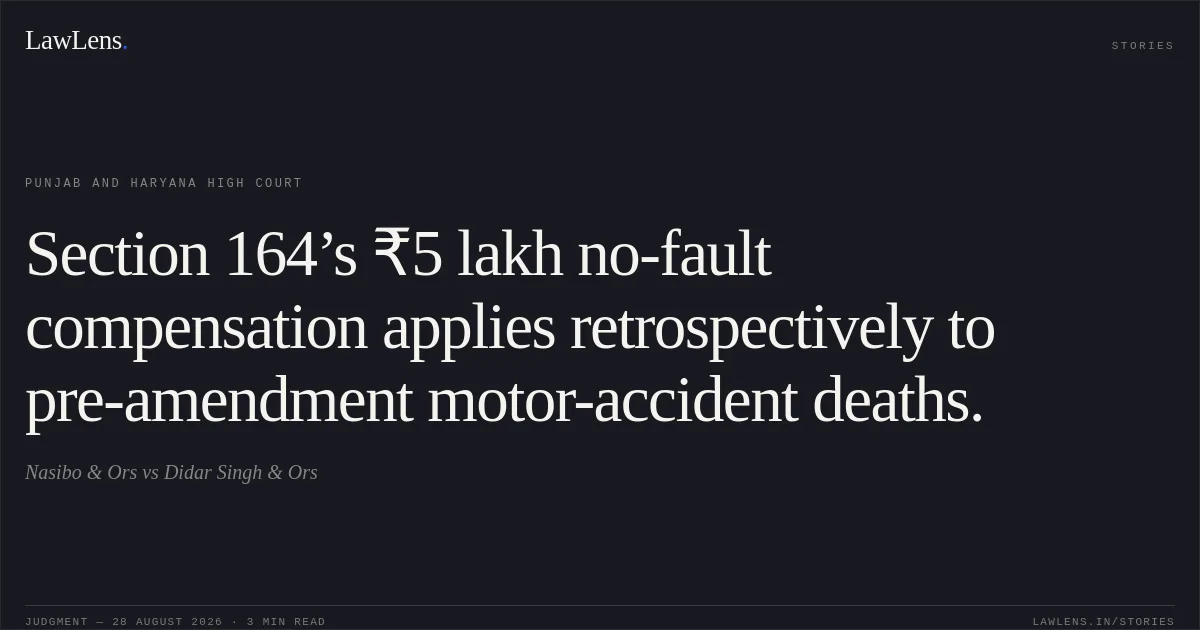
The Court applied the no-fault compensation framework under the Motor Vehicles Act, 1988. It noted that Section 140 had been omitted and Section 163-A had been replaced by Section 164 through the Motor Vehicles (Amendment) Act, 2019, with effect from 1 September 2019; Section 164 provides fixed compensation of ₹5,00,000 for death and ₹2,50,000 for grievous hurt, without proof of negligence.
Source reference: p.3–4, paras. 8–10Relying on the Supreme Court’s decision in Ram Murti v. Punjab State Electricity Board, 2023 ACJ 631, the Court held that the beneficial provisions of Section 164 could be applied retrospectively to pending no-fault claims arising from earlier accidents, including claims in which the accident occurred before Section 164 came into force.
Source reference: p.3–4, paras. 8–9The Court also accepted the principle that compensation under the no-fault regime is payable for death arising out of the use of a motor vehicle, even where negligence is not established.
Source reference: p.2–4, paras. 6, 9–10Reasoning
The High Court did not disturb the Tribunal’s finding that Dogar Singh had himself collided with the stationary truck and that rash or negligent driving by respondent No. 2 was not proved.
Source reference: p.2, para. 4; p.2–3, para. 6However, it held that proof of negligence was unnecessary for entitlement under the no-fault liability regime. Since the death occurred on account of the use of the truck, the case fell within the beneficial scope of Section 164.
Source reference: p.3–4, paras. 8–10Following Ram Murti, where the Supreme Court granted ₹5,00,000 under the corresponding no-fault provision despite the accident having occurred before the statutory amendment, the Court extended the same benefit to Nasibo.
Source reference: p.3–4, paras. 8–10As ₹50,000 had already been awarded by the Tribunal, the Court treated ₹4,50,000 as the enhanced component. It limited interest on the enhanced amount to the period beginning from 1 September 2019, the date on which Section 164 was stated to have come into force.
Source reference: p.4–5, para. 11Holding
The appeal was partly allowed.
Nasibo was held entitled to total compensation of ₹5,00,000 for the death of her son under Section 164 of the Motor Vehicles Act, instead of ₹50,000 awarded by the Tribunal.
Source reference: p.4–5, paras. 10–11The enhanced amount of ₹4,50,000 was directed to carry interest at 9% per annum from 1 September 2019 until realization. The amount was made payable by the insurer and the owner jointly and severally.
Source reference: p.4–5, paras. 10–11The Tribunal’s finding regarding the deceased’s own fault and the dismissal of the claims of the other appellants were not disturbed.
Source reference: p.4–5, paras. 10–11The Registry was also directed to email an authenticated copy of the judgment to the concerned insurance company in accordance with the Supreme Court’s directions in Bajaj Allianz General Insurance Co. v. Union of India, W.P. (C) No. 534 of 2020, decided on 16 March 2021.
Source reference: p.5, para. 12Acts & Sections Cited
4 provisions across 1 statute referred to in this judgment. Each provision opens on LawLens.
Motor Vehicles Act, 19884
Original Court PDF
Nasibo & OrsvsDidar Singh & Ors
Click to open original judgment
Original judgment, available to read, download and summarize on LawLens.in
![Courts will not interfere with transfers absent mala fides or violation of statutory rules.. M Ramya vs EMPLOYEES STATE INSURANCE CORPORATION (ESIC). CAT - ['Chennai']. LawLens](/stories/thumbnails/courts-will-not-interfere-with-transfers-absent-mala-fides-or-violation-of-statutory-rules-a6845e9ca6f548fca284c51c8351957f.webp)
![Courts cannot direct one-time recruitment age relaxation absent authority in the governing rules or advertisement.. UT OF PUDUCHERRY vs M ANDAL. CAT - ['Chennai']. LawLens](/stories/thumbnails/courts-cannot-direct-one-time-recruitment-age-relaxation-absent-authority-in-the-governing-895d78fde47143e2a8ed0207c4b6a44f.webp)
![A review cannot correct an allegedly erroneous decision absent an error apparent on the record.. Ajit Kumar Jha vs RAILWAY BOARD. CAT - ['Delhi']. LawLens](/stories/thumbnails/a-review-cannot-correct-an-allegedly-erroneous-decision-absent-an-error-apparent-on-the-re-8ac952fd4eba470c92f7da20af72a220.webp)