Facts
The petitioner and his family members allegedly advanced loans to Respondent No. 2 through bank transfers between January and April 2024, repayable by 10 September 2024.
Source reference: paras. 2–3Following disputes, the petitioner issued legal notices, lodged a police complaint, and initiated recovery proceedings.
Source reference: paras. 2–3Respondent No. 2 had filed proceedings under Section 138 of the Negotiable Instruments Act based on an allegedly forged promissory note and had also lodged a police complaint concerning the same transaction.
Source reference: paras. 2–3The petitioner thereafter filed a complaint under Sections 223 and 175(3) of the BNSS seeking registration of an FIR.
Source reference: paras. 2–3The learned ACJM allowed the application under Section 175(3) and directed FIR registration on 14 May 2025.
Source reference: paras. 2–3In revision, the learned ASJ set aside that order on 13 November 2025, holding that the dispute was primarily documentary and that police investigation was unnecessary.
Source reference: paras. 2–3The petitioner challenged the revisional order under Section 528 of the BNSS before the High Court.
Source reference: paras. 2–3Issues
Whether the learned Revisional Court erred in setting aside the ACJM’s direction for registration of an FIR under Section 175(3) of the BNSS by allegedly conducting a mini-trial and appreciating the defence evidence?
Source reference: paras. 4–6, 14–15Whether the allegations of forgery and related cognizable offences required police investigation involving custodial interrogation, forensic examination, document recovery, or financial-trail analysis?
Source reference: paras. 5–6, 9–12Whether the ACJM had recorded sufficient reasons and satisfaction demonstrating the necessity of police investigation before directing registration of an FIR under Section 175(3) of the BNSS?
Source reference: paras. 8, 10, 13–15Law Applied
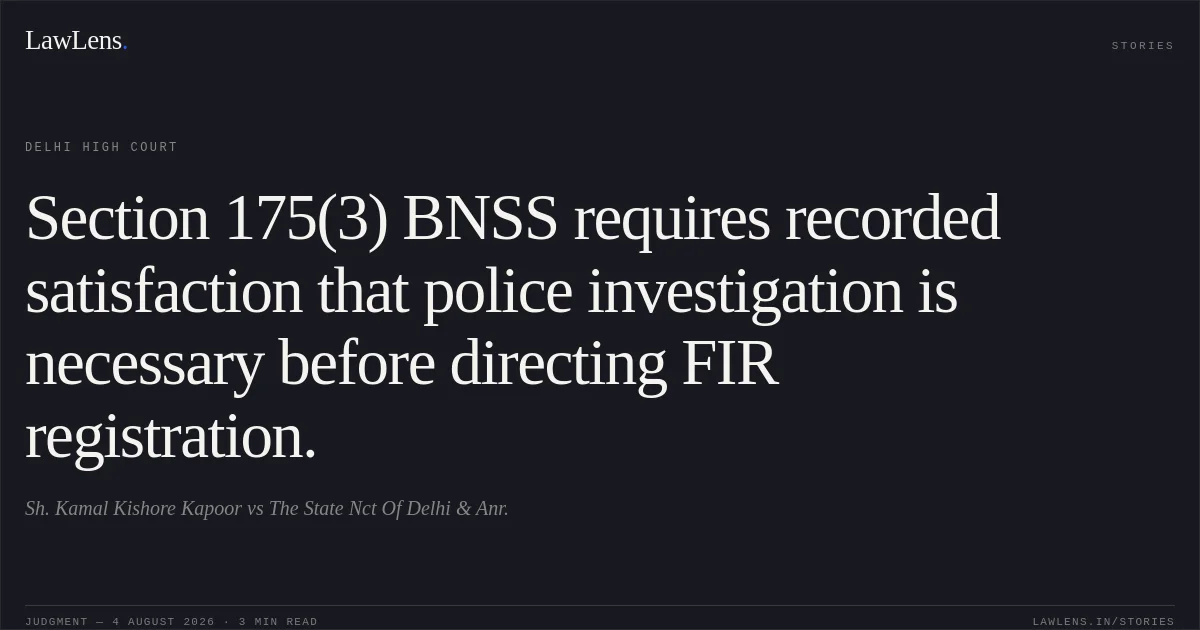
Section 175(3) of the BNSS permits a Magistrate to direct registration of an FIR and investigation, but the discretion must be exercised judicially, with reasons demonstrating why police investigation is necessary.
Source reference: paras. 11–13Where the relevant evidence is documentary and already available to the parties, the Magistrate must assess whether an FIR-based investigation is genuinely required.
Source reference: paras. 11–13The complainant may pursue proceedings under Chapter XVI of the BNSS, including Section 223, and seek police assistance at a later stage under Section 225.
Source reference: paras. 11–13The Court also considered Section 20 of the Negotiable Instruments Act in relation to the disputed promissory note and relied on S. Gopal v. D. Balachandran, Rajendran v. Usha Rani, and Anjuri Kumari v. The State Govt. of NCT of Delhi for the principle that a direction under Section 175(3) requires a reasoned satisfaction regarding the necessity of police investigation.
Source reference: paras. 11–13Interference under Section 528 of the BNSS is warranted only where the subordinate court’s order suffers from manifest error, perversity, irrelevant considerations, illegality, or jurisdictional error.
Source reference: paras. 14–16Reasoning
The High Court found that the Revisional Court had correctly concluded that the ACJM failed to record adequate reasons showing why police investigation was necessary.
Source reference: paras. 8, 10The alleged loan transactions, promissory note, legal notices, WhatsApp communications, and other material were documentary in nature and were already available with the parties; consequently, custodial interrogation, recovery, or police collection of evidence was not shown to be indispensable.
Source reference: para. 9The High Court also accepted that the disputed promissory note was already involved in proceedings under Section 138 of the Negotiable Instruments Act and that the petitioner had an efficacious remedy through a complaint case under Chapter XVI of the BNSS, with the possibility of seeking police assistance subsequently under Section 225.
Source reference: paras. 11–12Since the petitioner failed to establish that the Revisional Court’s findings were manifestly erroneous, perverse, or based on irrelevant considerations, the limited jurisdiction under Section 528 of the BNSS was not attracted.
Source reference: paras. 14–15Holding
The High Court held that the Revisional Court had committed no illegality, jurisdictional error, or perversity in setting aside the ACJM’s order directing registration of an FIR under Section 175(3) of the BNSS.
The petition was dismissed, and the pending applications, if any, were disposed of.
Source reference: para. 16Original Court PDF
Sh. Kamal Kishore KapoorvsThe State Nct Of Delhi & Anr.
Click to open original judgment
Original judgment, available to read, download and summarize on LawLens.in