Facts
The appellant challenged the order dated 11 May 2026 by which the Additional Sessions Judge and Special Judge, Botad rejected his application for regular bail under Section 483 of the Bharatiya Nagarik Suraksha Sanhita, 2023.
Source reference: p.1The prosecution arose from FIR C.R. No. 11190001250459 of 2025 registered at Barwala Police Station, District Botad, for offences under Sections 118(1), 115(2), 351(3) and 54 of the Bharatiya Nyaya Sanhita, 2023, Section 135 of the Gujarat Police Act, and Sections 3(1)(r), 3(1)(s) and 3(2)(va) of the Scheduled Castes and Scheduled Tribes (Prevention of Atrocities) Act, 1989 (“Atrocity Act”).
Source reference: p.1The prosecution alleged that the appellant hurled caste-based insults at the complainant and assaulted the injured victim with an iron pipe and a stick, causing serious injuries.
Source reference: p.2The appellant claimed false implication, denied involvement, and submitted that he had been in custody since 14 April 2026.
Source reference: p.2The investigation was complete and the chargesheet had been filed; the injured victim had been discharged from the hospital and was out of danger.
Source reference: p.2Issues
Whether the appellant was entitled to regular bail under Section 483 of the Bharatiya Nagarik Suraksha Sanhita, 2023, after completion of investigation and filing of the chargesheet?
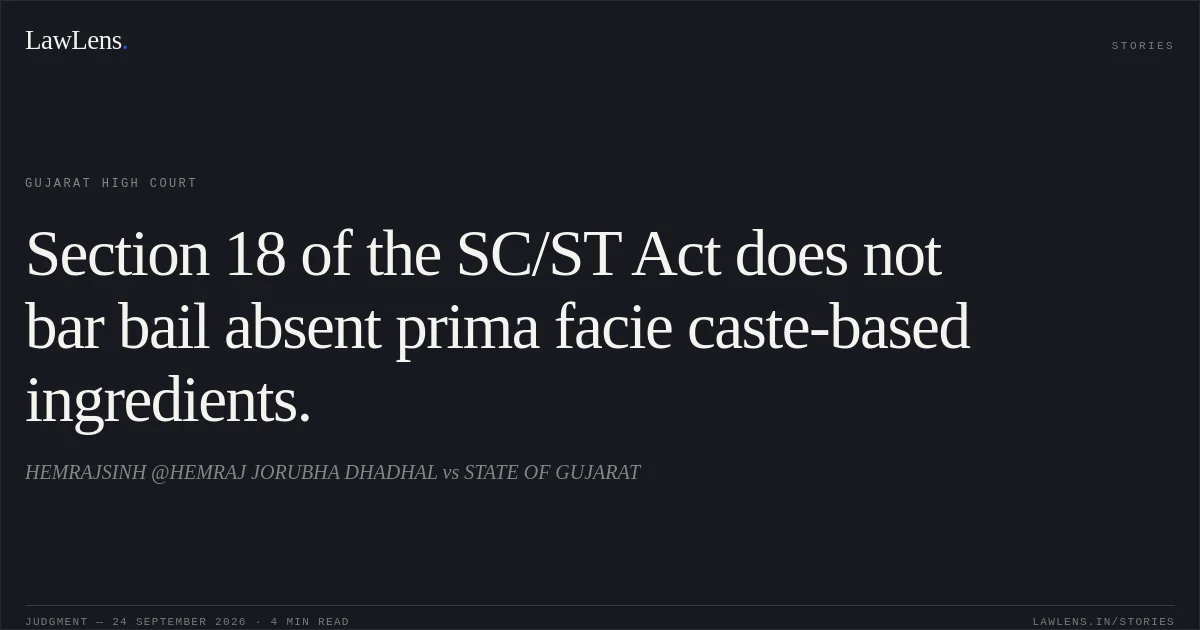
Source reference: pp.1–3Whether the statutory bar under Section 18 of the Atrocity Act operated so as to prevent consideration of the appellant’s bail application?
Source reference: p.3Whether the appellant was entitled to bail on the ground of parity with a co-accused who had been granted bail?
Source reference: p.3Whether appropriate conditions could adequately address the apprehension of witness tampering and ensure the appellant’s presence during trial?
Source reference: pp.2–3Law Applied
The Court exercised appellate jurisdiction under Section 14-A of the Atrocity Act over the order refusing bail and considered the appellant’s application under Section 483 of the Bharatiya Nagarik Suraksha Sanhita, 2023.
Source reference: p.1The Court applied the general principle that bail is the rule and jail is the exception, particularly where investigation is complete and continued detention would effectively amount to pre-trial punishment.
Source reference: p.3Relying on Hitesh Verma v. State of Uttarakhand, (2020) 10 SCC 710, the Court held that the bar under Section 18 of the Atrocity Act would not apply on the facts of the case.
Source reference: p.3It also relied on Sanjay Chandra v. Central Bureau of Investigation, (2012) 1 SCC 40, concerning the purpose of bail and the impermissibility of pre-trial detention functioning as punishment.
Source reference: p.3Further, applying the principle of parity recognised in Ramesh Batubhai Dabhi v. State of Gujarat, 2011 (3) GLR 1150, the Court considered the appellant’s entitlement to similar treatment as the co-accused who had already been granted bail.
Source reference: p.3Reasoning
The Court found that the investigation had concluded and the chargesheet had been filed; therefore, no recovery or discovery remained to be made from the appellant.
Source reference: p.3Although the allegations included caste-based insults and assault with an iron pipe and stick, the injured victim was out of danger and had been discharged from the hospital.
Source reference: p.3The Court held that the complainant’s apprehension that the appellant might influence witnesses could be addressed through stringent bail conditions rather than continued incarceration.
Source reference: p.3In light of Hitesh Verma, the Court concluded that the bar under Section 18 of the Atrocity Act did not prevent consideration of bail.
Source reference: p.3Applying the principles that bail is ordinarily favoured over detention and that detention should not become pre-trial conviction, together with the fact that a co-accused had received bail, the Court found the appellant entitled to relief on merits and parity.
Source reference: p.3Holding
The appeal was allowed.
The Gujarat High Court quashed and set aside the order dated 11 May 2026 and directed that the appellant be released on regular bail in connection with FIR C.R. No. 11190001250459 of 2025, on execution of a personal bond of ₹15,000 with one surety of the like amount.
Source reference: p.3The release was made subject to conditions including surrender of passport, restriction on leaving India, monthly attendance at the concerned police station for six months, furnishing and maintaining the residential address, refraining from influencing the prosecution or delaying the trial, and not entering the vicinity of Botad District Police Station for six months except for marking presence or attending court.
Source reference: pp.3–4The Court clarified that breach of conditions could result in appropriate action, that release would be subject to the appellant not being required in any other case, and that the trial court would not be influenced by the prima facie observations made in the bail order.
Source reference: p.4Acts & Sections Cited
8 provisions across 4 statutes referred to in this judgment. Each provision opens on LawLens.
Scheduled Castes and the Scheduled Tribes (Prevention of Atrocities) Act, 19892
Bharatiya Nagarik Suraksha Sanhita, 20231
Bharatiya Nyaya Sanhita, 20234
Gujarat Police Act, 1951.1
Original Court PDF
HEMRAJSINH @HEMRAJ JORUBHA DHADHALvsSTATE OF GUJARAT
Click to open original judgment
Original judgment, available to read, download and summarize on LawLens.in