Facts
The respondents presented sale deeds for registration in respect of plots carved out of land situated in A. Jettihalli Village, Dharmapuri District. The plots measured approximately 1,744 sq. ft., 2,289 sq. ft. and 2,000 sq. ft., and were conveyed by R.M. Sankar through his power agent, S. Karthikeyan.
Source reference: pp. 4–7The Sub-Registrar refused registration by refusal check slips dated 19 July 2024, principally on the ground that the land had been converted into house sites without the requisite planning approval and that the transactions were hit by Section 22-A(2) of the Registration Act, 1908.
Source reference: pp. 3–7The writ petitioners challenged the refusal. The learned Single Judge allowed the writ petitions, holding that adjoining house sites in the same survey numbers had previously been registered and that the Registration Department had itself assigned a residential guideline value to the properties. The Single Judge consequently directed registration of the sale deeds upon their representation.
Source reference: p. 5The District Registrar and Sub-Registrar preferred the present writ appeals, contending that the properties formed part of an unapproved layout involving the creation of a common way or new road and that the plots had not been regularised.
Source reference: pp. 5–6, 8–9Issues
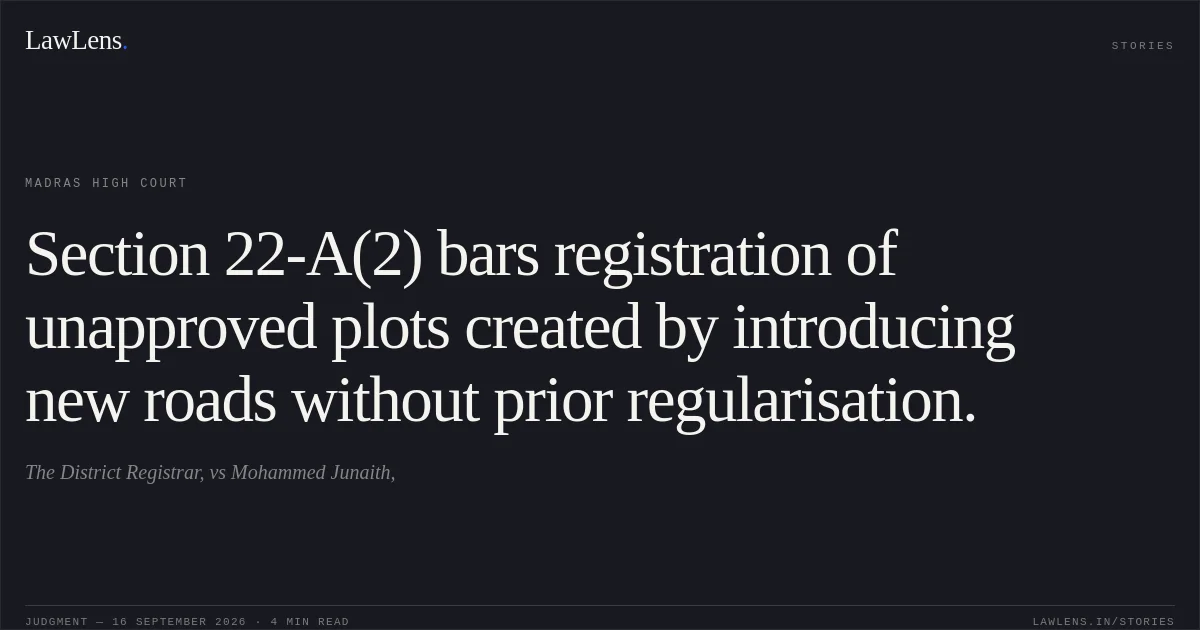
1. Whether the Sub-Registrar was justified in refusing registration of the sale deeds under Section 22-A(2) of the Registration Act, 1908, where the plots had been formed without planning permission and had not been previously registered as house sites before the statutory cut-off date?
Source reference: pp. 9–13; para. 152. Whether the division of the original land by leaving a common way amounted to the introduction of a new road or street, thereby bringing the property within the definition of an unapproved “layout” under Rule 2(8)(ii) of the Tamil Nadu Regularisation of Unapproved Layouts and Plots Rules, 2017?
Source reference: pp. 9–12; paras. 12, 15–163. Whether prior registration of adjoining plots and the assignment of a residential guideline value created a right to registration of the disputed sale deeds notwithstanding the statutory bar under Section 22-A(2)?
Source reference: pp. 5, 12–13; para. 17Law Applied
The Court applied Section 22-A(2) of the Registration Act, 1908, which prohibits registration of instruments transferring ownership of land converted into house sites without planning-authority permission, unless the house site had previously been registered as a house site.
Source reference: p. 9It applied Rule 2(8)(ii) of the Tamil Nadu Regularisation of Unapproved Layouts and Plots Rules, 2017, under which division of land into plots involving the introduction of a new road or street constitutes a “layout” outside the Chennai Metropolitan Planning Area.
Source reference: p. 10Rule 3 of the 2017 Rules prescribes 20 October 2016 as the cut-off date and requires prior registered sale or title deeds for eligibility for regularisation; a general power of attorney or agreement for sale is insufficient proof of sale.
Source reference: p. 10The Court also considered the Inspector General of Registration’s letter dated 18 March 2020 and distinguished the Division Bench decision in W.A.(MD) Nos. 705 and 706 of 2025, because that case involved no newly formed road.
Source reference: pp. 11–12The Court further noted the principle that classification of property for guideline-value purposes is intended for revenue collection and does not override statutory restrictions on registration.
Source reference: p. 13Reasoning
The Court examined the chain of documents and found that the original extent acquired by R.M. Sankar was 35.50 cents, whereas the power of attorney covered only 31.25 cents, without any explanation for the reduction.
Source reference: para. 12This indicated that a portion of the property had been left as a common way. When the plots were subsequently conveyed, the northern boundary was described as a “common way,” whereas the original sale deed described the northern boundary as the properties of third parties.
Source reference: pp. 8–9The Court held that this demonstrated the creation of a new road or street and therefore brought the transaction within Rule 2(8)(ii).
Source reference: paras. 12, 15–16Because the plots had neither received planning permission nor been sold as house sites before 20 October 2016, they did not satisfy the exception in Section 22-A(2) or the eligibility requirements under Rule 3.
Source reference: para. 15The registration of neighbouring plots did not cure the defect in the disputed transactions, particularly where the disputed plots formed part of a subsequently created unapproved layout.
Source reference: para. 17Likewise, the residential classification used for fixing guideline value could not displace the statutory prohibition on registration.
Source reference: para. 17The Court therefore concluded that the Sub-Registrar had correctly issued the refusal check slips.
Source reference: no citationHolding
The Division Bench held that the disputed plots were unapproved house sites forming part of a layout in which a common way or new road had been created.
Since the plots lacked planning approval, had not been regularised, and had not been previously registered as house sites before the cut-off date of 20 October 2016, registration was barred under Section 22-A(2) of the Registration Act, 1908.
Source reference: paras. 15–17The writ appeals were allowed; the Single Judge’s order dated 16 December 2024 was set aside; the refusal check slips dated 19 July 2024 were upheld; and the connected miscellaneous petitions were closed without costs.
Source reference: para. 18Acts & Sections Cited
4 provisions across 3 statutes referred to in this judgment. Linked provisions open on LawLens.
Letters Patent1
Registration Act, 19082
Tamil Nadu Act 28 of 20121
Original Court PDF
The District Registrar,vsMohammed Junaith,
Click to open original judgment
Original judgment, available to read, download and summarize on LawLens.in