01Facts
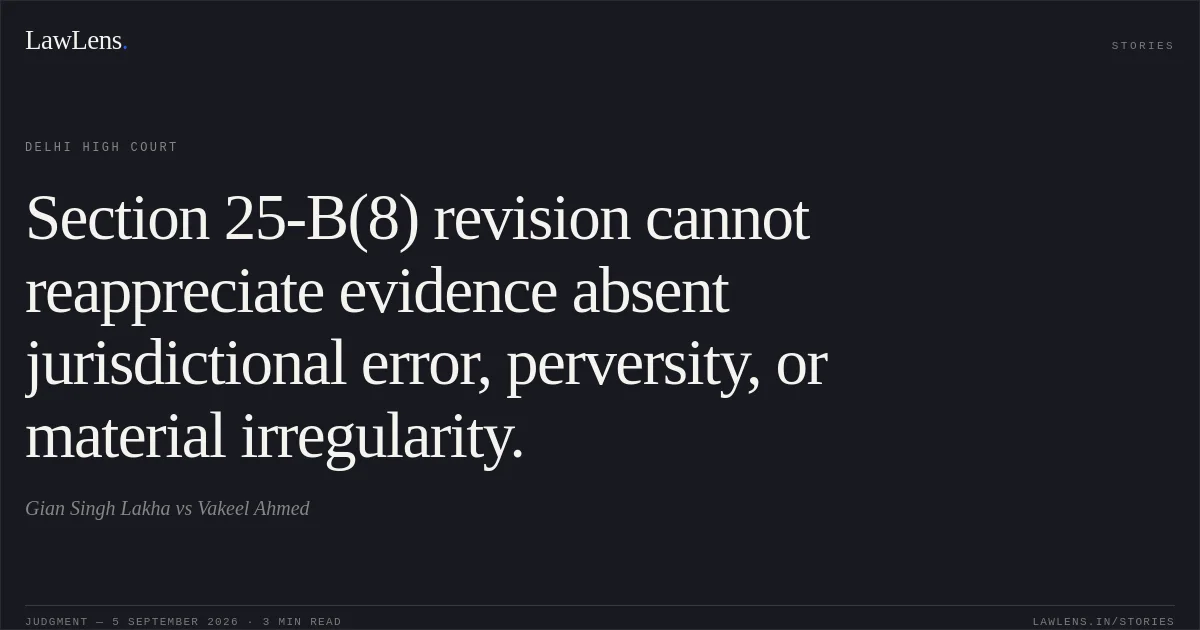
The petitioner-landlord challenged, under the proviso to Section 25-B(8) of the Delhi Rent Control Act, 1958 (“DRC Act”), the judgment dated 31 March 2015 by which the Rent Controller dismissed his eviction petition under Section 14(1)(e) concerning a shop at property No. 1418/13, Govind Puri, New Delhi.
p. 1 · ¶ 1–2The landlord claimed that the shop was bona fide required by him and his son for starting a hardware and paint business.
p. 1 · ¶ 1–2The Rent Controller found that the son, who was residing in the United States, had not demonstrated any intention to return to India or enter the proposed business, and had not appeared as a witness.
pp. 5–7 · ¶ 17, 21–29The Controller also found that the landlord had four vacant rooms in the rear portion of the property, which had not been disclosed in the eviction petition, and that their alleged unsuitability or dilapidated condition was raised only during cross-examination.
pp. 5–7 · ¶ 17, 21–2902Issues
i.Whether the landlord established a bona fide requirement of the tenanted shop for himself and his son under Section 14(1)(e) of the DRC Act
pp. 5–8 · ¶ 17–20ii.Whether the landlord lacked reasonably suitable alternative accommodation for the proposed business
pp. 6–8 · ¶ 17, 21iii.Whether the Rent Controller’s findings disclosed a jurisdictional error, material irregularity, manifest illegality, perversity, or other ground warranting interference under the proviso to Section 25-B(8) of the DRC Act
pp. 3–5, 10–16, 22–2303Law Applied
The Court applied Section 14(1)(e) of the DRC Act, which requires the landlord to establish a bona fide requirement of the premises and the absence of reasonably suitable alternative accommodation.
pp. 5–7 · ¶ 17It also applied the proviso to Section 25-B(8), under which the High Court exercises limited supervisory and revisional jurisdiction rather than appellate jurisdiction.
pp. 3–4 · ¶ 10–15Relying on Sarla Ahuja v. United India Insurance Co. Ltd., (1998) 8 SCC 119, Hindustan Petroleum Corporation Ltd. v. Dilbahar Singh, (2014) 9 SCC 78, and Abid-Ul-Islam v. Inder Sain Dua, (2022) 6 SCC 30, the Court held that it must examine the legality and propriety of the decision-making process and should not substitute its own view merely because another view is possible.
pp. 3–4 · ¶ 10–15Interference is warranted only for jurisdictional error, manifest illegality, material irregularity, perversity, an unreasonable conclusion, or an error apparent on the face of the record.
p. 4 · ¶ 15Provisions in the judgment · 1 · Linked ones open on LawLens
delhi rent control act, 1958 Section 14
04Reasoning
The Court held that the Rent Controller had properly considered the absence of evidence from the petitioner’s son, the son’s prolonged absence from India, and the lack of contemporaneous material showing a concrete intention to return and start the proposed business.
p. 8 · ¶ 19–20Although residence abroad or non-visitation to India could not, by itself, disprove bona fide requirement, those circumstances were relevant when combined with the son’s failure to testify and the absence of supporting evidence.
p. 8 · ¶ 19–20On alternative accommodation, the Court found that the Controller was entitled to rely on the landlord’s admission that four rooms in the rear portion had been vacant since 2006.
pp. 7–8 · ¶ 21The failure to disclose those rooms in the eviction petition, followed by the belated assertion that they were dilapidated or unsuitable, supported the Controller’s conclusion regarding concealment and suitability.
pp. 7–8 · ¶ 21Since the challenge essentially sought a re-appreciation of evidence and the Controller’s findings were neither perverse nor unsupported, the restrictive revisional standard under Section 25-B(8) was not satisfied.
p. 9 · ¶ 22–2305Holding
The High Court answered the issues against the petitioner.
p. 9 · ¶ 23–24It held that the petitioner failed to establish both a bona fide requirement under Section 14(1)(e) and the absence of reasonably suitable alternative accommodation, and that the Rent Controller’s judgment did not suffer from any jurisdictional error, material irregularity, manifest illegality, or perversity.
p. 9 · ¶ 23–24The revision petition was dismissed, and the petition together with any pending applications was disposed of accordingly.
p. 9 · ¶ 24–25Original Court PDF
Gian Singh LakhavsVakeel Ahmed
Click to open original judgment
Original judgment, available to read, download and summarize on LawLens.in