Facts
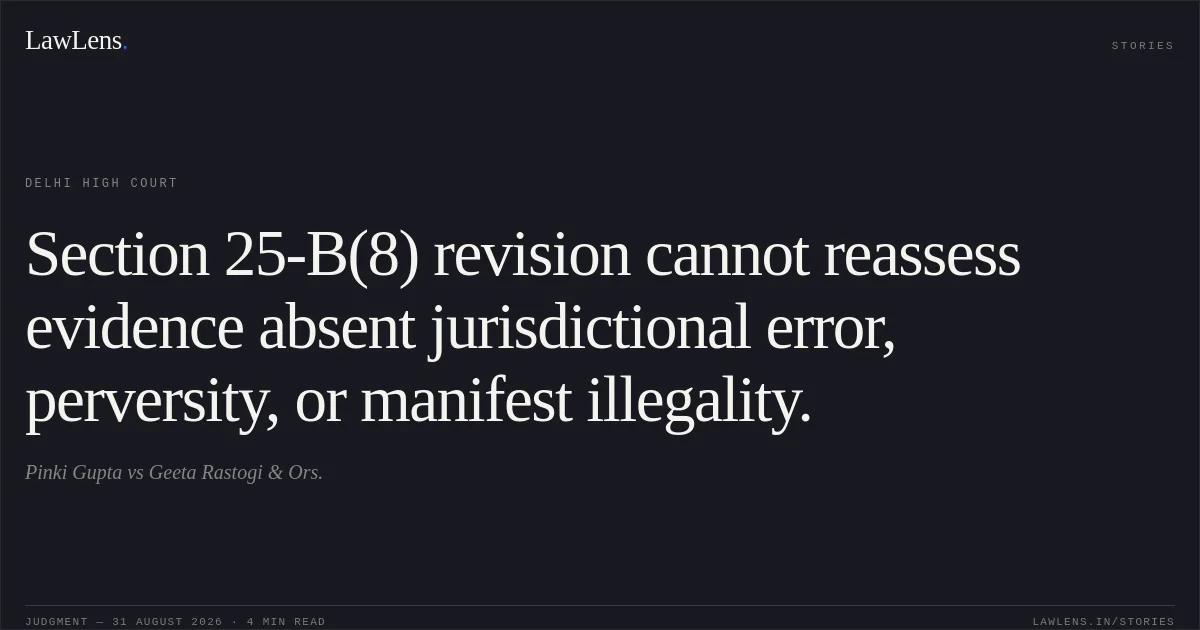
The Petitioner-tenant challenged, under the proviso to Section 25-B(8) of the Delhi Rent Control Act, 1958 (“DRC Act”), the judgment dated 09.06.2026 passed by the Senior Civil Judge-cum-Rent Controller, District Shahdara, Delhi, in RC ARC No. 71/2023. The learned Rent Controller had dismissed the Petitioner’s leave-to-defend application and directed her to vacate the tenanted premises.
Source reference: p.1, para.1The Respondent-landlords sought eviction on the ground of bona fide requirement, asserting that the premises, along with the other shops on the ground floor of property No. E-4/10, were required to establish a Gymnasium-cum-Fitness Centre for certain family members, principally Nikunj, Nimish and Vaibhav Rastogi, along with Nitin and Rachit Rastogi.
Source reference: pp.5–8, para.16The Petitioner contended that the requirement was a pretext for re-letting the premises at a higher rent; that the projected beneficiaries were already employed or engaged in business; that other shops were available; and that the Respondents had previously obtained possession of other shops on similar grounds but failed to use them as represented.
Source reference: pp.1–2, paras.2–5The learned Rent Controller rejected these objections, finding that the alleged existing businesses of the beneficiaries were not established by cogent documentary evidence and that the other shops formed part of the larger premises required for the proposed venture. The Petitioner thereafter approached the High Court in revision.
Source reference: pp.5–8, para.16Issues
Whether the judgment of the learned Rent Controller suffered from a jurisdictional error, perversity, material irregularity, or error apparent on the face of the record warranting interference under the proviso to Section 25-B(8) of the DRC Act?
Source reference: pp.2–5, paras.7–13Whether the Respondents’ pleaded requirement of the premises for establishing a Gymnasium-cum-Fitness Centre constituted a bona fide requirement, notwithstanding that some projected beneficiaries were earning income or associated with existing businesses?
Source reference: pp.9–10, paras.17–20Whether the alleged availability of other shops and the subsequent vacation of shops during the proceedings constituted suitable alternate accommodation negating the Respondents’ requirement?
Source reference: pp.11–12, paras.22–24Whether the allegations that the Respondents intended to re-let the premises at a higher rent, or had misused possession of other shops, raised a triable issue or otherwise invalidated the eviction claim?
Source reference: pp.10–13, paras.21 and 25–27Law Applied
The Court applied the proviso to Section 25-B(8) of the DRC Act, under which the High Court exercises limited supervisory and revisional jurisdiction over the Rent Controller’s decision-making process and does not act as an appellate court.
Source reference: pp.2–5, paras.7–13Relying on Sarla Ahuja v. United India Insurance Co. Ltd., (1998) 8 SCC 119; Hindustan Petroleum Corporation Ltd. v. Dilbahar Singh, (2014) 9 SCC 78; and Abid-Ul-Islam v. Inder Sain Dua, (2022) 6 SCC 30, the Court held that interference is warranted only for jurisdictional error, manifest illegality, material irregularity, perversity, absence of adjudication, or an error apparent on the face of the record; mere possibility of another view or a request for re-appreciation of evidence is insufficient.
Source reference: pp.2–5, paras.8–12The Court also relied on Pankaj Pahwa v. Prem Wati & Ors. and Sanjeev Hiranandani v. Sunny Grover for the restricted scope of Section 25-B(8) revision.
Source reference: pp.3–5, paras.9–12On bona fide requirement, the Court applied the principle that a landlord need not establish that the proposed business is the only means of livelihood, and that an existing source of income or association with a family business does not, by itself, defeat a genuine requirement.
Source reference: pp.9–10, paras.19–20 and p.12, para.26It further applied the principle that alternate accommodation must be reasonably suitable for the projected requirement, not merely physically available.
Source reference: p.11, para.23Reasoning
The High Court held that the Petitioner was substantially seeking re-appreciation of the same evidence and grounds already considered by the Rent Controller, which was impermissible in revision.
Source reference: pp.8–9, paras.14–18The Rent Controller had specifically examined the alleged businesses of “Vaibhav Properties” and “Café Gainz” and found that the Petitioner had produced no documentary material proving that the projected beneficiaries were their proprietors, partners or directors.
Source reference: pp.5–7, para.16; p.13, para.27The allegations regarding stock-market trading by Nimish and Vaibhav’s involvement in his father’s real-estate business were also considered, but were not shown to establish independent businesses that would make the proposed venture inherently improbable.
Source reference: p.6–7, para.16; pp.9–10, paras.19–20The Court further held that the alleged ulterior motive of re-letting at a higher rent was unsupported by cogent evidence and therefore did not create a triable issue or justify revisional interference.
Source reference: p.10, para.21Although shops Nos. 8 and 9 were vacant and shops Nos. 5, 6 and 7 became vacant during the proceedings, the Respondents had consistently pleaded a requirement for the entire ground floor to establish the proposed Gymnasium-cum-Fitness Centre and had initiated proceedings against other tenants. Those shops therefore could not automatically be treated as suitable alternate accommodation.
Source reference: pp.11–12, paras.22–24The Court also found no ignored material evidence or erroneous legal premise concerning the Respondents’ alleged conduct regarding other shops, the status of Nitin and Rachit, or the impleadment of a co-sharer.
Source reference: pp.12–14, paras.25–30Holding
The High Court answered the issues against the Petitioner. It held that the Rent Controller had properly considered the pleadings, evidence and objections; its finding of bona fide requirement was neither perverse nor legally infirm; and the availability of other shops did not constitute suitable alternate accommodation in the circumstances.
No jurisdictional error, manifest illegality, material irregularity or error apparent on the face of the record was established. Accordingly, the revision petition was dismissed, the eviction judgment dated 09.06.2026 was left undisturbed, and the pending applications were disposed of.
Source reference: p.15, paras.33–34Acts & Sections Cited
1 provisions across 1 statute referred to in this judgment. Linked provisions open on LawLens.
Delhi Rent Control Act, 19581
Original Court PDF
Pinki GuptavsGeeta Rastogi & Ors.
Click to open original judgment
Original judgment, available to read, download and summarize on LawLens.in