Facts
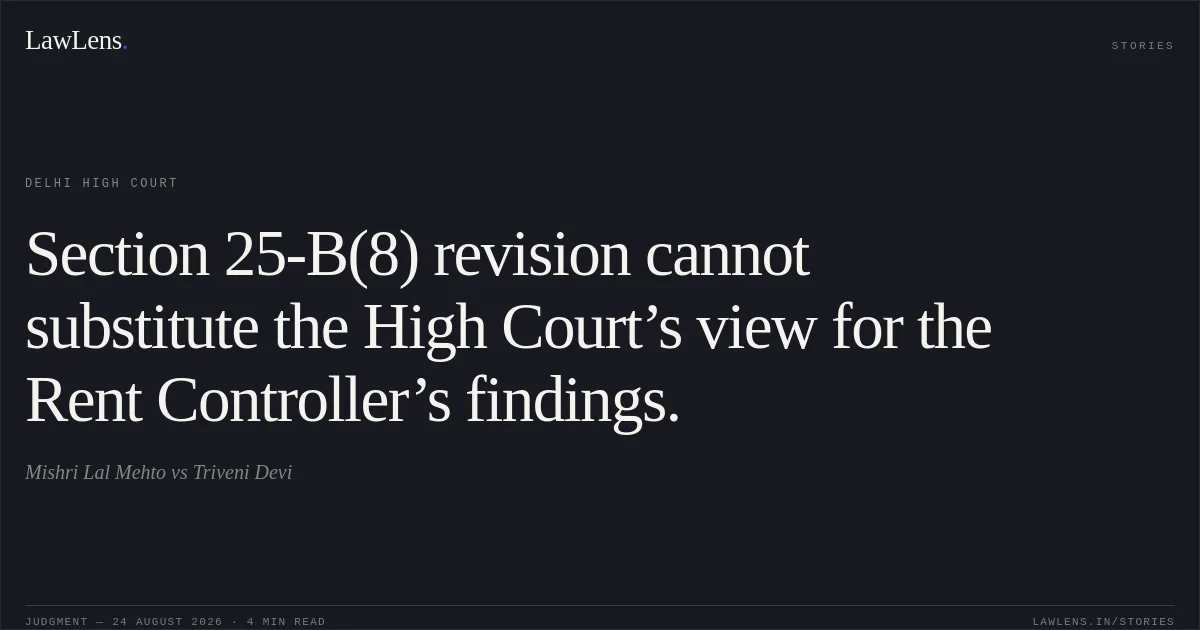
The petitioner-tenant challenged, under the proviso to Section 25B(8) of the Delhi Rent Control Act, 1958 (“DRC Act”), the order dated 17 April 2026 by which the Additional Rent Controller dismissed his application for leave to defend, allowed the respondent-landlord’s eviction petition, and directed his eviction from the tenanted premises.
Source reference: p.1, para. 1The tenant contended that the landlord was a chronic litigant and that the eviction proceedings were motivated by prior disputes concerning rent enhancement and recovery.
Source reference: p.2, paras. 2, 5He also disputed the landlord’s site plan, alleged the availability of alternative accommodation, and argued that the landlord’s bona fide residential requirement was fabricated because other rooms in the property were occupied by commercial tenants.
Source reference: pp.2–3, paras. 3–5The ARC rejected these objections, holding that the tenant had raised no triable issue regarding bona fide requirement, reasonably suitable alternative accommodation, or identification of the premises.
Source reference: pp.5–8, para. 15Issues
Whether the ARC erred in dismissing the tenant’s application for leave to defend by finding that the landlord’s claimed bona fide requirement was not displaced by the tenant’s allegations of prior litigation, existing accommodation, or commercial tenancies in other rooms.
Source reference: pp.9–13, paras. 17–31Whether the dispute regarding the landlord’s site plan raised a triable issue warranting leave to defend.
Source reference: pp.10–11, paras. 21–24Whether the tenant established the existence of reasonably suitable alternative accommodation available to the landlord.
Source reference: pp.13–14, paras. 32–35Whether the ARC’s order disclosed a jurisdictional error, manifest illegality, material irregularity, perversity, or an error apparent on the face of the record warranting interference under Section 25B(8) of the DRC Act.
Source reference: pp.3–5, paras. 8–14; pp.14–15, paras. 36–39Law Applied
The Court applied the proviso to Section 25B(8) of the DRC Act, under which the High Court exercises limited supervisory and revisional—not appellate—jurisdiction over an order of the Rent Controller.
Source reference: pp.3–5, paras. 8–14Relying on Sarla Ahuja v. United India Insurance Co. Ltd., (1998) 8 SCC 119; Hindustan Petroleum Corporation Ltd. v. Dilbahar Singh, (2014) 9 SCC 78; and Abid-Ul-Islam v. Inder Sain Dua, (2022) 6 SCC 30, the Court held that it must examine the legality and propriety of the decision-making process and cannot substitute its own factual assessment merely because another view is possible.
Source reference: pp.3–4, paras. 9–11The Court also relied on Pankaj Pahwa v. Prem Wati & Ors., 2024:DHC:9322, and Sanjeev Hiranandani v. Sunny Grover, 2025:DHC:11285, for the restricted scope of revisional scrutiny.
Source reference: p.4, paras. 10–12On bona fide requirement, the Court applied the principles that the landlord is generally the best judge of the manner in which the premises should be used and that a tenant cannot dictate how the landlord should arrange or adjust family members, as reflected in Baldev Singh Bajwa v. Monish Saini, (2005) 12 SCC 778; Raghavendra Kumar v. Firm Prem Machinery & Co., (2000) 1 SCC 679; Kishan Lal v. R.N. Bakshi, 169 (2010) DLT 769; and Praveen v. Mulakh Raj, RC.REV. 417/2016.
Source reference: pp.5–7, paras. 25–32However, the landlord’s assertion remains subject to judicial scrutiny, and alternative accommodation defeats the claim only where it is reasonably suitable for the stated requirement, as recognised in M.M. Quasim v. Manohar Lal Sharma, (1981) 3 SCC 36.
Source reference: p.7, paras. 34–37Reasoning
The Court held that the tenant’s allegation that the landlord was a chronic litigant did not, without supporting material demonstrating mala fides, create a triable issue; prior tenancy litigation did not bar the landlord from invoking a statutory eviction remedy.
Source reference: pp.9–10, paras. 17–20The site-plan objection was also insufficient because the tenant did not contend that the premises were unidentifiable, while his own plan was found to be vague; a site plan need only adequately identify the premises in dispute and need not comprehensively depict the occupation of every room in the property.
Source reference: pp.10–11, paras. 21–24Regarding bona fide requirement, the ARC had considered the family’s accommodation and the tenant’s proposed classification of rooms, but correctly declined to require the landlord or her family to adjust themselves according to the tenant’s preferred arrangement.
Source reference: pp.11–12, paras. 25–29The existence of other commercial tenants did not establish that the landlord’s requirement was fabricated, nor could the tenant dictate which occupant the landlord should seek to evict.
Source reference: pp.12–13, paras. 30–31Finally, the alleged alternative properties were unsupported by ownership documents or particulars, had been specifically denied by the landlord, and the sons’ alleged shops could not be treated as reasonably suitable residential accommodation.
Source reference: pp.13–14, paras. 32–35Since the ARC had considered all material objections and its findings were neither perverse nor legally erroneous, appellate reappreciation of the evidence was impermissible.
Source reference: pp.14–15, paras. 36–39Holding
The High Court answered the issues against the petitioner.
It found no jurisdictional error, manifest illegality, material irregularity, perversity, or failure to consider a material plea in the ARC’s order.
Source reference: pp.14–15, paras. 36–39The revision petition was accordingly dismissed as devoid of merit, and the pending applications were also disposed of.
Source reference: p.15, paras. 40–41Acts & Sections Cited
1 provisions across 1 statute referred to in this judgment. Linked provisions open on LawLens.
Delhi Rent Control Act, 19581
Original Court PDF
Mishri Lal MehtovsTriveni Devi
Click to open original judgment
Original judgment, available to read, download and summarize on LawLens.in