Facts
The petitioners are accused in a criminal complaint (S.C.C. No. 7117 of 2019) filed under Section 138 of the Negotiable Instruments Act
Source reference: para. 1During the proceedings, the petitioners sought to produce various documents—including a Sale Deed (2012), a Correction Deed (2014), and revised development maps—to substantiate their defense regarding a land price reduction agreement
Source reference: para. 2The Trial Court, via an order on Exh. 34, permitted the production of these documents
Source reference: para. 13Subsequently, the petitioners filed an application (Exh. 36) under Section 294 of the Code of Criminal Procedure (Cr.P.C.) requesting the Court to direct the complainant to admit or deny the genuineness of the produced documents
Source reference: para. 2, 13The Trial Court rejected the application on 14.11.2025, reasoning that the documents were irrelevant as the cheques in question were issued following a later compromise in 2017
Source reference: para. 6, 14, 20Issues
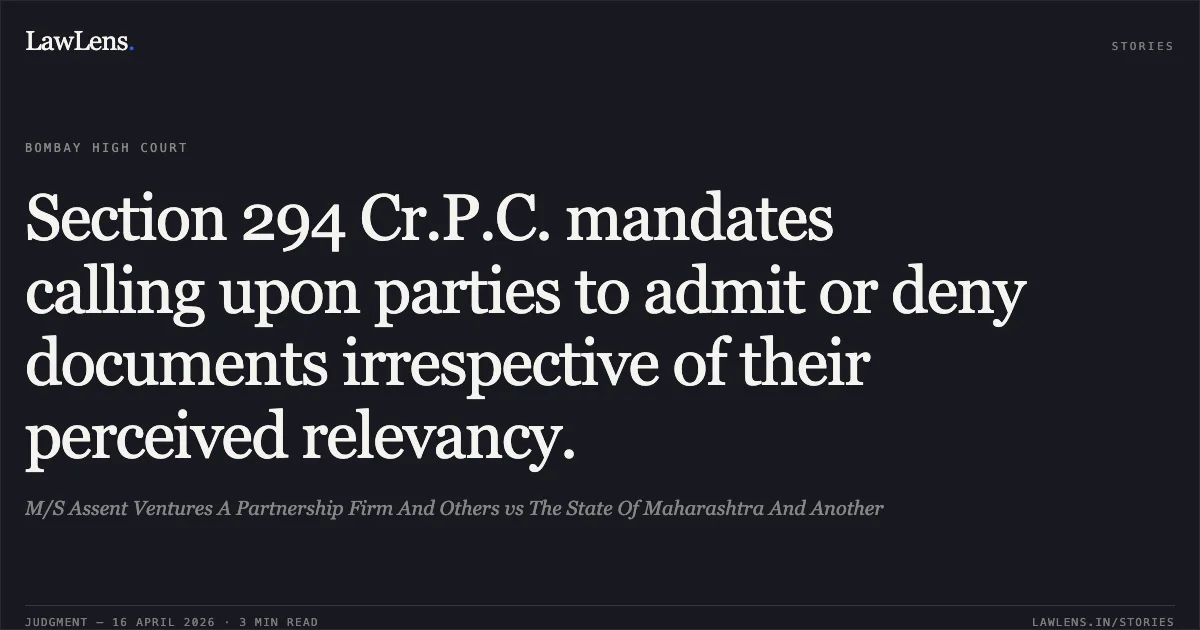
1. Whether the procedure under Section 294 of the Cr.P.C., which requires the Court to call upon a party to admit or deny the genuineness of a document, is mandatory or discretionary
Source reference: para. 21, 232. Whether a Trial Court can reject a Section 294 application on the grounds of "relevancy" after it has already permitted the production of the documents in question
Source reference: para. 14, 24Law Applied
The Court primarily applied Section 294 of the Cr.P.C., which stipulates that where any document is filed, the prosecution or the accused "shall" be called upon to admit or deny its genuineness
Source reference: para. 15, 21It relied on the Full Bench decision in Shaikh Farid Hussainsab vs. State of Maharashtra, which established that Section 294 was introduced to dispense with the waste of time associated with formal proof and to facilitate speedy trials
Source reference: para. 18, 19The Court further applied principles of statutory interpretation, noting that the word "shall" in the context of Section 294 denotes a mandatory obligation rather than a discretionary power
Source reference: para. 22, 23Reasoning
The High Court observed that Section 294 Cr.P.C. does not prohibit filing documents at a subsequent stage and creates a mandatory procedural step once documents are included in a list
Source reference: para. 15, 16The Court noted that the Trial Court’s predecessor had already allowed the production of the documents (Exh. 34), yet the current Trial Court failed to address the mandatory second step of calling for admission or denial
Source reference: para. 13, 14The Court reasoned that calling for admission/denial does not prejudice the complainant, as they remain free to deny genuineness or challenge admissibility during the trial
Source reference: para. 17Furthermore, the Court clarified that Section 294 is a tool for procedural efficiency; thus, a Trial Court cannot bypass this mandate by performing a premature evaluation of "relevancy" at the stage of admitting or denying genuineness
Source reference: para. 20, 23The High Court concluded that the Trial Court’s refusal to follow the "shall" mandate of the statute was an arbitrary exercise of power
Source reference: para. 21, 25Holding
The High Court allowed the writ petition and quashed the Trial Court’s order dated 14.11.2025
It held that Section 294 Cr.P.C. is mandatory, leaving the Trial Court no discretion to refuse calling upon a party to admit or deny documents once their production is permitted
Source reference: para. 21, 24The Trial Court was directed to call upon the complainant to admit or deny the documents and was further instructed to dispose of the 2019 complaint expeditiously, preferably within six months
Source reference: para. 27(C), (D)Acts & Sections Cited
3 provisions across 3 statutes referred to in this judgment. Each provision opens on LawLens.
Code of Criminal Procedure, 19731
Negotiable Instruments Act, 18811
Code of Civil Procedure, 19081
Original Court PDF
M/S Assent Ventures A Partnership Firm And OthersvsThe State Of Maharashtra And Another
Click to open original judgment
Original judgment, available to read, download and summarize on LawLens.in