Facts
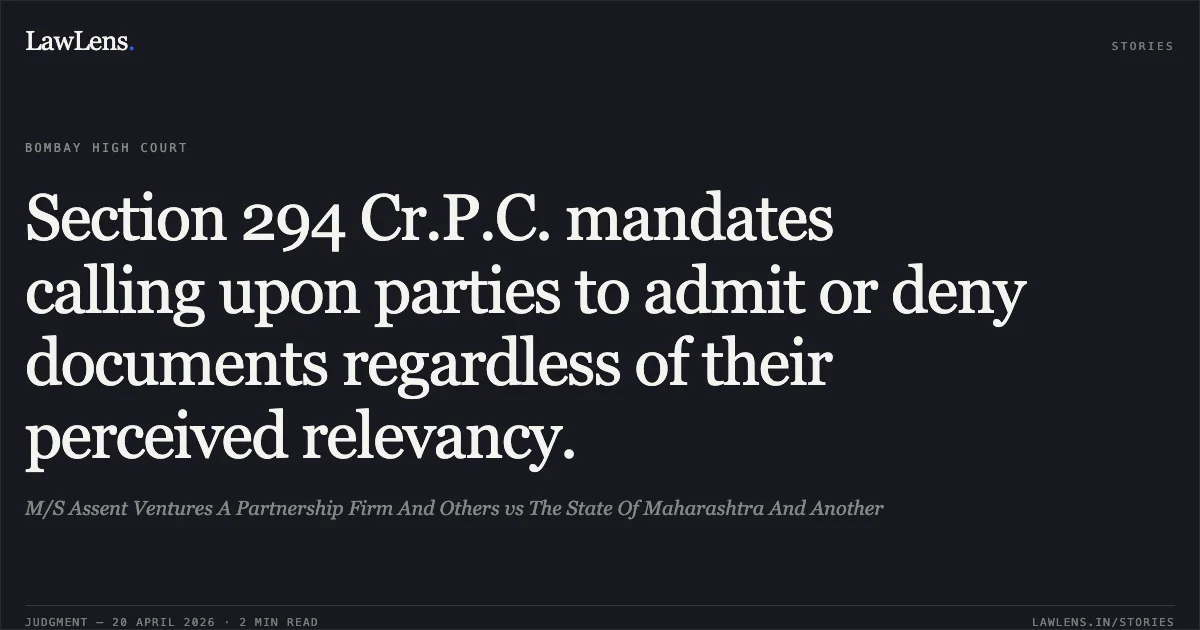
The petitioners, accused in a complaint under Section 138 of the Negotiable Instruments Act (S.C.C. No. 4454 of 2019), filed an application under Section 294 of the Code of Criminal Procedure (Cr.P.C.).
Source reference: para. 1-2They sought to produce specific documents, including a Sale Deed, Correction Deed, and revised maps, and requested the Trial Court to direct the complainant to admit or deny these documents.
Source reference: para. 2While the Trial Court allowed the production of the documents (Exh. 21), it rejected the prayer to call upon the complainant to admit or deny their genuineness, citing that the documents lacked relevancy as the cheques in question were issued following a subsequent compromise between the parties.
Source reference: para. 13-14, 20The petitioners challenged this order, asserting that the Section 294 procedure is mandatory.
Source reference: para. 12Issues
1. Whether the procedure under Section 294 of the Cr.P.C., requiring the court to call upon the opposing party to admit or deny the genuineness of documents, is mandatory ("shall") or discretionary ("may").
Source reference: para. 21-222. Whether the Trial Court can refuse to exercise its power under Section 294 Cr.P.C. based on a preliminary assessment of the "relevancy" of the documents.
Source reference: para. 14, 20Law Applied
The court primarily applied Section 294 of the Cr.P.C., which mandates that where any document is filed by the prosecution or the accused, the particulars shall be included in a list, and the other party "shall" be called upon to admit or deny its genuineness.
Source reference: para. 15The court relied on the Full Bench decision in Shaikh Farid Hussainsab v. State of Maharashtra, which held that Section 294 was introduced to dispense with the waste of time involved in formal proof and facilitate speedy trials.
Source reference: para. 19The court further applied the principle that the word "shall" in Section 294 indicates mandatory intent rather than judicial discretion.
Source reference: para. 21-22Reasoning
The High Court reasoned that the Trial Court committed a fundamental error by conflating the "genuineness" of a document with its "relevancy".
Source reference: para. 14, 17Under Section 294 Cr.P.C., the court’s role is limited to facilitating the admission or denial of a document’s genuineness to potentially dispense with formal proof.
Source reference: para. 18The Court observed that since the Trial Court had already permitted the production of the documents under Exh. 21, there was no legal basis to prevent them from being put to the complainant.
Source reference: para. 14, 24The High Court emphasized that "relevancy" and "admissibility" are matters for final adjudication and do not exempt the court from the mandatory procedural requirement of Section 294.
Source reference: para. 23By using the word "shall," the legislature intended to remove discretion to ensure trials are not unnecessarily protracted.
Source reference: para. 22Holding
The High Court quashed and set aside the Trial Court's order dated 14.11.2025.
It held that the provisions of Section 294 Cr.P.C. are mandatory and the Trial Court is bound to call upon the opposing party to admit or deny the genuineness of documents once they are on record.
Source reference: para. 21-23The Trial Court was directed to call upon the complainant to admit or deny the documents and was further instructed to dispose of the 2019 complaint expeditiously, preferably within six months.
Source reference: para. 27(C)-(D)Acts & Sections Cited
2 provisions across 2 statutes referred to in this judgment. Each provision opens on LawLens.
Code of Criminal Procedure, 19731
Negotiable Instruments Act, 18811
Original Court PDF
M/S Assent Ventures A Partnership Firm And OthersvsThe State Of Maharashtra And Another
Click to open original judgment
Original judgment, available to read, download and summarize on LawLens.in