Facts
The Central Government issued notifications in 2015 and 2016 to acquire land in Village Gandheli for widening National Highway No. 211
Source reference: p. 12The Competent Authority for Land Acquisition (CALA) determined compensation at rates ranging from Rs. 486/- to Rs. 1,500/- per square meter
Source reference: p. 13Aggrieved, the landowners invoked Section 3G(5) of the National Highways Act, 1956 (NH Act), for arbitration.
Source reference: p. 13The Arbitrator enhanced the compensation to a uniform rate of Rs. 1,742/- per square meter
Source reference: p. 13NHAI challenged these awards under Section 34 of the Arbitration and Conciliation Act, 1996 (1996 Act), before the Principal District Judge, Aurangabad, who dismissed the applications on October 16, 2025
Source reference: p. 13NHAI appealed to the High Court under Section 37, primarily contending that the awards were passed nearly six years after the reference—well beyond the mandate prescribed by Section 29A of the 1996 Act—and that the Arbitrator committed patent illegality by granting uniform rates regardless of land classification
Source reference: p. 14-16Issues
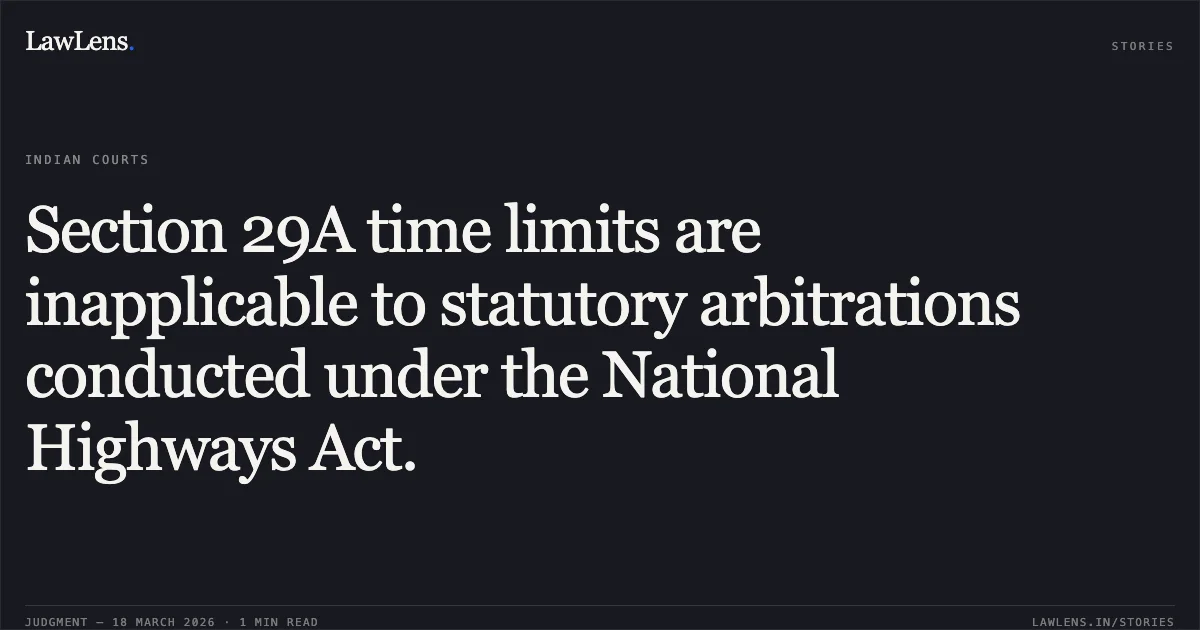
1. Whether Section 29A of the Arbitration and Conciliation Act, 1996, applies to arbitration proceedings conducted under Section 3G(5) of the National Highways Act, 1956
Source reference: p. 12, para. 3(a)2. If Section 29A applies, whether an award passed beyond the statutory mandate without a court-ordered extension is void for want of jurisdiction
Source reference: p. 12, para. 3(b)3. Whether the Arbitrator’s determination of uniform compensation failed to comply with Section 26 of the RFCTLARR Act, 2013, constituting patent illegality
Source reference: p. 12, para. 3(c)Law Applied
The Court primarily interpreted Section 3G(5) and (6) of the NH Act, which designates the Central Government as the exclusive authority to appoint arbitrators
Source reference: p. 22It relied on the principle from Girnar Traders v. State of Maharashtra, holding that subsequent amendments to a referred statute (the 1996 Act) do not apply if they render the principal statute (the NH Act) unworkable
Source reference: p. 26-27It further cited National Highways Authority of India v. Sayedabad Tea Company Ltd., which established the NH Act as a self-contained code, excluding the application of Section 11 of the 1996 Act
Source reference: p. 31-33For compensation standards, it applied Section 26 of the RFCTLARR Act, 2013, and the interpretation in M.P. Road Development Corp. v. Vincent Daniel, requiring collectors/arbitrators to consider the highest 50% of sale deeds and provide reasons for discarding evidence
Source reference: p. 38, 48-49Finally, it applied the restricted scope of "patent illegality" under Section 34 as defined in PSA Sical Terminals Pvt. Ltd. v. Board of Trustees
Source reference: p. 43-45Reasoning
Regarding Section 29A, the Court reasoned that the NH Act provides for "institutional" arbitration where the Central Government appoints an "officer" (by designation, such as the Collector) rather than a specific individual
Source reference: p. 36-37Applying Section 29A—which allows Civil Courts to extend mandates, reduce fees, or substitute arbitrators—would conflict with the Central Government's exclusive power under Section 3G(5) and render the statutory scheme unworkable
Source reference: p. 31, 37Thus, Section 29A is inconsistent with the NH Act.
Source reference: no citationOn the merits of compensation, the Court found no patent illegality. While NHAI argued that the Arbitrator ignored land classifications, the Court noted that the Arbitrator properly applied Section 26 of the 2013 Act by reviewing 171 relevant sale deeds
Source reference: p. 47The Court observed that the CALA had arbitrarily discarded 199 out of 228 sale instances without reasons, whereas the Arbitrator's decision to grant a uniform rate based on potential value was a plausible view supported by evidence
Source reference: p. 47-48, 51Under Section 37, the Court cannot re-appreciate evidence or substitute its view for that of the Arbitrator
Source reference: p. 51Holding
The Court concluded that Section 29A of the 1996 Act does not apply to statutory arbitrations under the National Highways Act, 1956
It further held that the Arbitrator’s award was not perverse or patently illegal as it was based on an appreciation of comparable sale instances in compliance with Section 26 of the 2013 Act
Source reference: p. 51, para. 75The Court dismissed all the Arbitration Appeals, upholding the arbitral awards and the District Court’s judgment
Source reference: p. 51, para. 76Acts & Sections Cited
11 provisions across 2 statutes referred to in this judgment. Each provision opens on LawLens.
Arbitration and Conciliation Act, 19967
Right to Fair Compensation and Transparency in Land Acquisition, Rehabilitation and Resettlement Act, 20134
Original Court PDF
National Highway Authority of India, PIU Aurangabad Thru. its Project Director Amrish MankarvsSuresh Pandharinath Matre and Another
Click to open original judgment
Original judgment, available to read, download and summarize on LawLens.in