Facts
On 3 June 2007, the complainant, Komalben Chimanbhai Patel, was at her residence with her relatives when accused Hitesh Patel allegedly came during an altercation concerning the flow of wastewater through a canal adjoining the parties’ properties. He allegedly abused and assaulted the complainant with a wooden log and fists and kicks. It was further alleged that the other accused joined the assault and that the complainant and other witnesses sustained injuries; a neighbour allegedly suffered an injury while intervening.
Source reference: p.2; para.13The complainant lodged C.R. No. II-109/2007 at Kheda Town Police Station for offences under Sections 323, 337, 504 and 114 of the Indian Penal Code and Section 3(1)(x) of the Scheduled Castes and Scheduled Tribes (Prevention of Atrocities) Act, 1989. After investigation, a charge-sheet was filed and charges were framed. The accused denied the allegations in their statements under Section 313 of the Code of Criminal Procedure, 1973. The Special Judge, Kheda at Nadiad, acquitted all the accused by judgment dated 11 September 2009. The State preferred the present appeal under Section 378(1) and (3) CrPC.
Source reference: pp.1–3; paras.1,2.1–5Issues
1. Whether the trial Court was justified in acquitting the accused of the offences charged?
Source reference: p.6; para.12(1)2. Whether the trial Court properly appreciated the oral and documentary evidence led by the prosecution?
Source reference: p.6; para.12(2)3. Whether the impugned acquittal suffered from any illegality, irregularity or perversity warranting appellate interference?
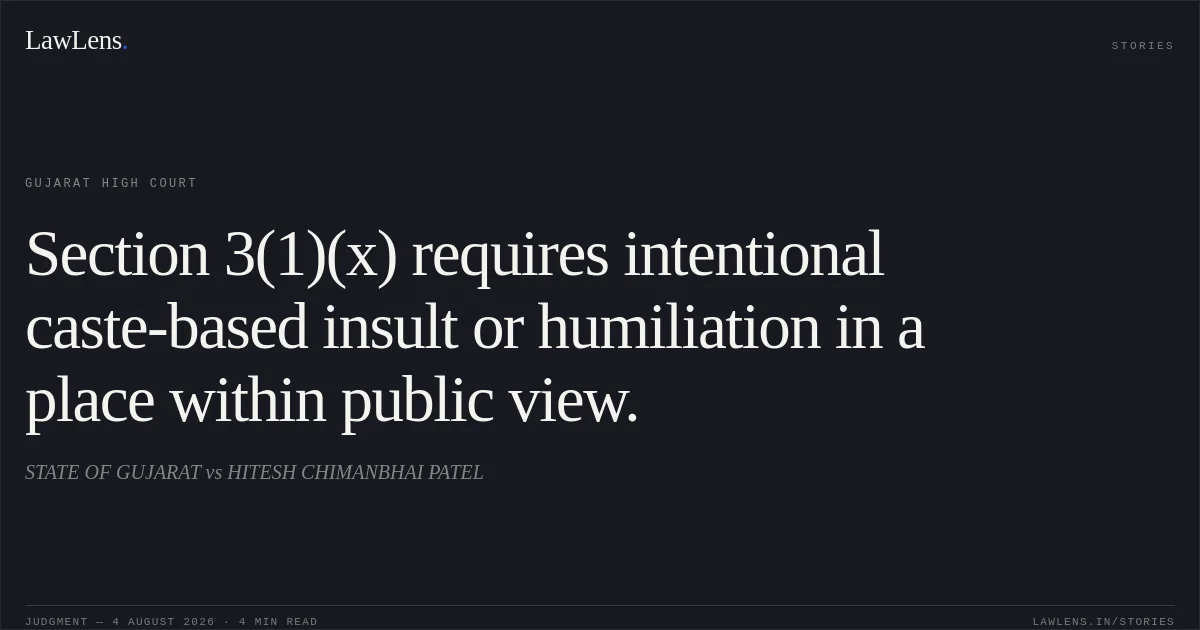
Source reference: p.6; para.12(3)4. Whether the prosecution proved the essential ingredients of Section 3(1)(x) of the SC/ST Act, including intentional caste-based insult or humiliation in a place within public view?
Source reference: pp.8–13; paras.14–15Law Applied
The Court applied Sections 323, 337, 504 and 114 of the IPC, which respectively concern voluntarily causing hurt, causing hurt by a rash or negligent act, intentional insult likely to provoke breach of peace, and abetment by several persons; and Section 3(1)(x) of the SC/ST Act, which required intentional insult or intimidation of a member of a Scheduled Caste or Scheduled Tribe with intent to humiliate in a place within public view.
Source reference: p.1; paras.1–2Relying on Shajan Skaria v. State of Kerala, AIR 2024 SC 4557, and the principles in Hitesh Verma v. State of Uttarakhand and Ramesh Chandra Vaishya, the Court held that mere abuse of a person belonging to an SC/ST community is insufficient; the insult must be caste-based and intended to humiliate the victim on account of caste, and the statutory requirement of public view must also be satisfied. For appeals against acquittal, the Court applied Chandrappa v. State of Karnataka, (2007) 4 SCC 415, as reaffirmed in Rajesh Prasad v. State of Bihar, (2022) 3 SCC 471, Babu Sahebagouda Rudragoudar v. State of Karnataka, (2024) 8 SCC 149, and Ramesh v. State of Karnataka, (2024) 9 SCC 169: although an appellate court may reappreciate the evidence, the accused enjoy a double presumption of innocence, and an acquittal should not be disturbed where two reasonable views are possible unless the trial Court’s findings are manifestly illegal or perverse.
Source reference: pp.9–16; para.15, paras.17–20Reasoning
The Court found that the prosecution witnesses were predominantly relatives or members of the same family and that no independent witness from the locality was examined, despite the alleged incident occurring near the complainant’s residence. Their allegations of assault with a wooden implement and stone-pelting were not corroborated by the medical evidence: except for Valiben, the witnesses had no external injuries, while Valiben had only a simple contused lacerated wound which the doctor accepted could have resulted from a fall on a paved or metal road. The Court also noted prior animosity between the parties concerning the proposed Gobar Gas Plant and the role of the accused’s father as Sarpanch, creating a possible motive for false implication.
Source reference: p.7; para.14; p.8; para.14As to Section 3(1)(x) of the SC/ST Act, the Court held that the alleged occurrence near the complainant’s house was not shown to have taken place in a place within public view. Further, the prosecution did not establish that any abusive words were caste-related or that the accused intended to humiliate the complainant because of her caste identity. In light of the material contradictions, omissions and lack of medical corroboration, the Court held that the trial Court’s view was a reasonable one and did not disclose perversity, illegality or misappreciation of evidence warranting reversal.
Source reference: pp.8–16; paras.14–15, paras.17–22Holding
The High Court answered the issues in favour of the accused. It held that the prosecution failed to prove the charged IPC offences and the essential ingredients of Section 3(1)(x) of the SC/ST Act beyond reasonable doubt, and that the trial Court’s acquittal was neither illegal nor perverse.
The State’s appeal was dismissed, the judgment and order of acquittal dated 11 September 2009 were confirmed, the bail bonds were cancelled, and the record and proceedings were directed to be returned to the trial Court.
Source reference: p.17; para.23Acts & Sections Cited
7 provisions across 3 statutes referred to in this judgment. Each provision opens on LawLens.
Code of Criminal Procedure, 19732
Indian Penal Code, 18604
Scheduled Castes and the Scheduled Tribes (Prevention of Atrocities) Act, 19891
Original Court PDF
STATE OF GUJARATvsHITESH CHIMANBHAI PATEL
Click to open original judgment
Original judgment, available to read, download and summarize on LawLens.in