Facts
Urmila, aged approximately 21 years, was married to appellant Shiv Narain @ Surya Narain on 12 May 1987.
Source reference: para. 2The prosecution alleged that she was harassed for dowry, including a demand for a scooter, and that on the intervening night of 19/20 September 1991 the accused persons murdered her and threw her body into a nearby well to destroy evidence.
Source reference: para. 15, 25Urmila was reported missing by her husband on 20 September 1991. Her dead body was recovered from a well on 21 September 1991, and an inquest was conducted.
Source reference: para. 20–22A formal complaint was ultimately lodged on 2 October 1991, approximately twelve days after recovery of the body.
Source reference: para. 21The accused were charge-sheeted under Sections 498-A, 304-B, 201 and 120-B IPC; no charge under Section 302 IPC was framed.
Source reference: para. 21, 25The post-mortem revealed a solitary ante-mortem head injury. The medical evidence indicated that the injury could have resulted from Urmila falling into the well and striking her head against a tubewell pipe.
Source reference: para. 29The trial court nevertheless convicted the accused under Sections 498-A, 304-B, 201 and 304-B read with Section 120-B IPC and imposed concurrent sentences, including seven years’ rigorous imprisonment under Section 304-B IPC.
Source reference: para. 1, 7Appeals were preferred; appeals filed by certain co-accused abated upon their deaths.
Source reference: para. 8–9Issues
Whether the prosecution proved that Urmila’s death constituted a “dowry death” under Section 304-B IPC, particularly whether she was subjected to cruelty or harassment for, or in connection with, a dowry demand soon before her death?
Source reference: para. 26–30, 36Whether the statutory presumption under Section 113-B of the Indian Evidence Act, 1872, was attracted in the absence of reliable evidence of dowry-related cruelty or harassment soon before death?
Source reference: para. 27–29, 39Whether the convictions under Sections 201 and 304-B read with Section 120-B IPC could stand when murder was neither charged under Section 302 IPC nor proved by the prosecution?
Source reference: para. 25, 29, 37, 40Whether the delay in lodging the FIR and the material inconsistencies in the prosecution evidence created a reasonable doubt warranting acquittal?
Source reference: para. 22–24, 40–41Law Applied
Section 304-B IPC requires proof that: (i) the woman’s death was caused by burns, bodily injury, or occurred otherwise than under normal circumstances; (ii) it occurred within seven years of marriage; and (iii) soon before her death she was subjected by her husband or his relative to cruelty or harassment for, or in connection with, a dowry demand.
Source reference: para. 26Section 113-B of the Indian Evidence Act permits a mandatory presumption of dowry death only after the prosecution first establishes such dowry-related cruelty or harassment soon before death.
Source reference: para. 27Section 299 IPC concerns culpable homicide and requires an act accompanied by the requisite intention or knowledge; its ingredients are distinct from those of Section 304-B IPC.
Source reference: para. 28The Court relied on Karan Singh v. State of Haryana, 2025 INSC 133, and Mahesh Kumar v. State of Haryana, (2019) 8 SCC 128, for the principle that proof of cruelty or harassment for dowry soon before death is indispensable before the presumption under Section 113-B can arise.
Source reference: para. 14, 39The decisions in Vijay Pal Singh v. State of Uttarakhand, 2015 AIR SC 684, and Dhian Singh v. State of Punjab, (2004) 7 SCC 759, were distinguished on their facts.
Source reference: para. 18, 38Reasoning
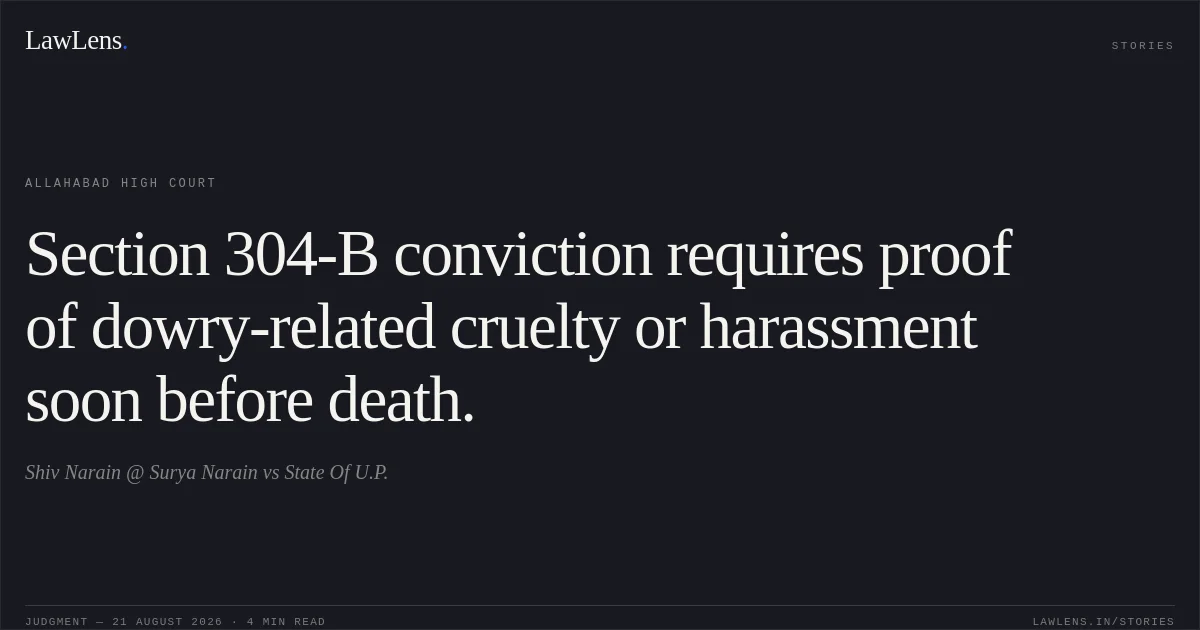
The Court held that the prosecution failed to establish the essential “soon before death” requirement under Section 304-B IPC.
Source reference: para. 30–32The alleged demand for a scooter was introduced for the first time during the parents’ depositions and was absent from the FIR and their earlier statements.
Source reference: para. 30–31The prosecution evidence showed that the alleged demand was made in or around November 1987, nearly four years before Urmila’s death, with no reliable evidence of any subsequent dowry demand or harassment.
Source reference: para. 30–32The parents admitted that Urmila had lived continuously in her matrimonial home for approximately two and a half years and that she had been enrolled in a stitching and embroidery course; no complaint was made by her during her lifetime.
Source reference: para. 32, 35–36Relevant relatives who could have corroborated the alleged harassment were not examined.
Source reference: para. 33At the inquest, the complainant and relatives described the death as probable drowning and did not accuse the appellants of murder or dowry death.
Source reference: para. 20–24The post-mortem disclosed only one head injury, consistent with an accidental fall into the well, and no injuries indicating that the body had been thrown there after murder.
Source reference: para. 29Since murder was neither charged under Section 302 IPC nor proved, the finding that the accused had murdered Urmila and caused disappearance of evidence under Section 201 IPC was unsustainable.
Source reference: para. 25, 29, 40In the absence of proof of the foundational facts required under Section 304-B, the presumption under Section 113-B did not arise.
Source reference: para. 39The unexplained delay in lodging the FIR and the material inconsistencies further created reasonable doubt.
Source reference: para. 22–24, 40–41Holding
The Court answered the issues in favour of the appellants.
It held that the prosecution failed to prove dowry-related cruelty or harassment soon before Urmila’s death; consequently, the offence under Section 304-B IPC and the presumption under Section 113-B of the Evidence Act were not attracted.
Source reference: para. 36, 39, 41The convictions under Sections 498-A, 304-B, 201 and 304-B read with Section 120-B IPC were set aside.
Source reference: para. 42Shiv Narain @ Surya Narain, Jai Narayan and Pateshwar were acquitted of all charges, and their bail and surety bonds were discharged.
Source reference: para. 42The connected appeals were accordingly allowed, with the record directed to be returned to the trial court.
Source reference: para. 43Original Court PDF
Shiv Narain @ Surya NarainvsState Of U.P.
Click to open original judgment
Original judgment, available to read, download and summarize on LawLens.in