Facts
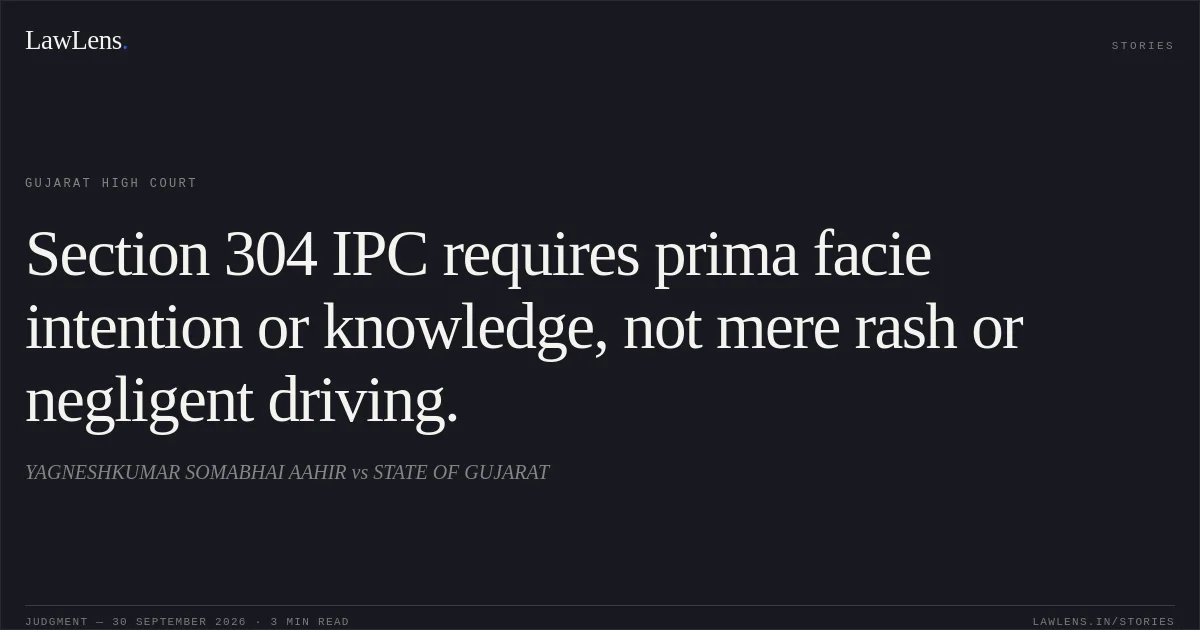
The petitioner sought, under Section 482 of the Code of Criminal Procedure, 1973 and Articles 226 and 227 of the Constitution, to quash the invocation of Section 304 IPC in an FIR arising from a fatal collision between his Brezza car and a bicycle carrying two children.
Source reference: pp. 1–6, paras. 1–5The seven-year-old child died; the FIR alleged that the car was driven at excessive speed and negligently in a residential area.
Source reference: pp. 1–6, paras. 1–5The petitioner contended that the allegations, at most, disclosed an offence under Section 304A IPC and denied any intention or knowledge necessary for Section 304 IPC.
Source reference: pp. 1–6, paras. 1–5The State and complainant opposed the petition, relying on the accident-scene material and alleging that the driver fled without assisting the injured child.
Source reference: pp. 1–6, paras. 1–5The Court considered the FIR and charge-sheet material, including the absence of a recorded statement from the surviving child who was allegedly present during the accident.
Source reference: pp. 13–16, paras. 13–15Issues
Whether the FIR and charge-sheet material, taken at face value, disclosed the intention or knowledge required to invoke Section 304 IPC in relation to the fatal road accident
Source reference: pp. 6–8, paras. 7–10Whether quashing the Section 304 IPC allegation at this stage would impermissibly require the Court to conduct a “mini-trial”
Source reference: pp. 6–7, paras. 7–8Law Applied
The Court applied Section 304 IPC, which it treated as requiring intention or knowledge of the kind specified in Section 299 IPC, and Section 304A IPC, which applies to causing death by a rash or negligent act without such intention or knowledge.
Source reference: pp. 7–8, paras. 9–10; p. 11, para. 12It held that the distinction turns on the accused’s mental state and that rashness, negligence, high speed, or loss of control alone does not establish the mens rea required for culpable homicide; the facts must disclose circumstances supporting the requisite intention or knowledge.
Source reference: pp. 8, 11–13, paras. 10, 12–12.2The Court relied on Yunusbhai Anwarbhai Karodia v. State of Gujarat, Naresh Giri v. State of Madhya Pradesh, State of Gujarat v. Haidarali Kalubhai, and Dalapatbhai Rameshbhai Vasava concerning the distinction between Sections 304 and 304A IPC in fatal-accident cases.
Source reference: pp. 8–10, para. 11It also held that the High Court may examine whether the uncontroverted allegations and investigation material disclose the essential ingredients of the offence, without weighing evidence as at trial.
Source reference: pp. 6–7, paras. 7–8Reasoning
The Court found that the material described a fatal collision and alleged excessive speed and negligent driving, but did not disclose facts supporting an intention to cause death or the knowledge required for Section 304 IPC.
Source reference: pp. 13–16, paras. 13–15It noted that the car had turned turtle, the bicycle was only slightly damaged, the surviving child was not recorded as an eyewitness, and there was no allegation or material of intoxication.
Source reference: pp. 13–16, paras. 13–15It further held that leaving the scene after the collision could not establish the mental state required at the time of the accident.
Source reference: pp. 13–16, paras. 13–15On that material, the allegations could support prosecution for rash or negligent driving, but did not justify retaining the graver Section 304 charge; examining that legal sufficiency did not amount to a mini-trial.
Source reference: pp. 13–16, paras. 13–15Holding
The Court partly allowed the petition and quashed the invocation, inclusion, and framing of charges under Section 304 IPC, together with consequential proceedings to that extent.
It directed that the trial proceed under Sections 279 and 304A IPC and Sections 134, 177, and 184 of the Motor Vehicles Act, 1988, independently on the evidence and without being influenced by the Court’s observations concerning deletion of Section 304 IPC.
Source reference: p. 17, paras. 17.2–17.3The separate application to vacate interim relief was disposed of as no longer surviving.
Source reference: p. 18, order in Criminal Misc. Application No. 1 of 2024Acts & Sections Cited
8 provisions across 3 statutes referred to in this judgment. Each provision opens on LawLens.
Code of Criminal Procedure, 19731
Indian Penal Code, 18604
Motor Vehicles Act, 19883
Original Court PDF
YAGNESHKUMAR SOMABHAI AAHIRvsSTATE OF GUJARAT
Click to open original judgment
Original judgment, available to read, download and summarize on LawLens.in