01Facts
The petitioners invoked Section 482 of the Code of Criminal Procedure, 1973, seeking quashing of FIR C.R. No. I-243 of 2014 registered at Danilimda Police Station, Ahmedabad City, for offences under Sections 498A, 306 and 114 of the Indian Penal Code, 1860, and all consequential proceedings.
¶ 1 · p. 1The FIR alleged that the deceased, Mehjabin, had married petitioner No. 1 in Criminal Misc. Application No. 3200 of 2015 on 31 October 2008. Following a firing incident in January 2009, she suffered paralysis. It was alleged that, when her husband came out on parole, the petitioners taunted and physically and mentally harassed her and demanded that she divorce him. On 16 December 2014, she allegedly inflicted knife injuries upon herself and subsequently died on 21 December 2014.
¶ 2 · p. 2The petitioners contended that they were residing separately, that the allegations were vague and omnibus, and that the deceased had previously lodged an FIR against her own mother and sister-in-law alleging ill-treatment.
¶ 3–3.3 · pp. 2–4The State and the complainant opposed quashing on the ground that the FIR disclosed a prima facie case and that the High Court should not conduct a mini-trial at the stage of exercising inherent jurisdiction.
¶ 4 · p. 4The High Court examined the FIR, the charge-sheet papers, the deceased’s earlier complaint and the dying declaration.
¶ 5–6 · pp. 4–502Issues
i.Whether the FIR and consequential criminal proceedings disclosed the ingredients of Sections 498A, 306 and 114 IPC against the petitioners so as to warrant continuation of the prosecution.
¶ 5–7, 11 · pp. 4–5, 13ii.Whether the allegations were sufficiently specific and proximate to establish cruelty or abetment of suicide, or were instead vague, omnibus and an abuse of the process of law warranting exercise of jurisdiction under Section 482 CrPC.
¶ 6–7, 11–12 · pp. 5, 13–1403Law Applied
The Court exercised the inherent jurisdiction under Section 482 CrPC to prevent abuse of process and secure the ends of justice.
¶ 1 · p. 1Section 498A IPC requires cruelty by the husband or his relatives, consisting either of wilful conduct likely to drive the woman to suicide or cause grave injury, or harassment connected with an unlawful demand for property or valuable security.
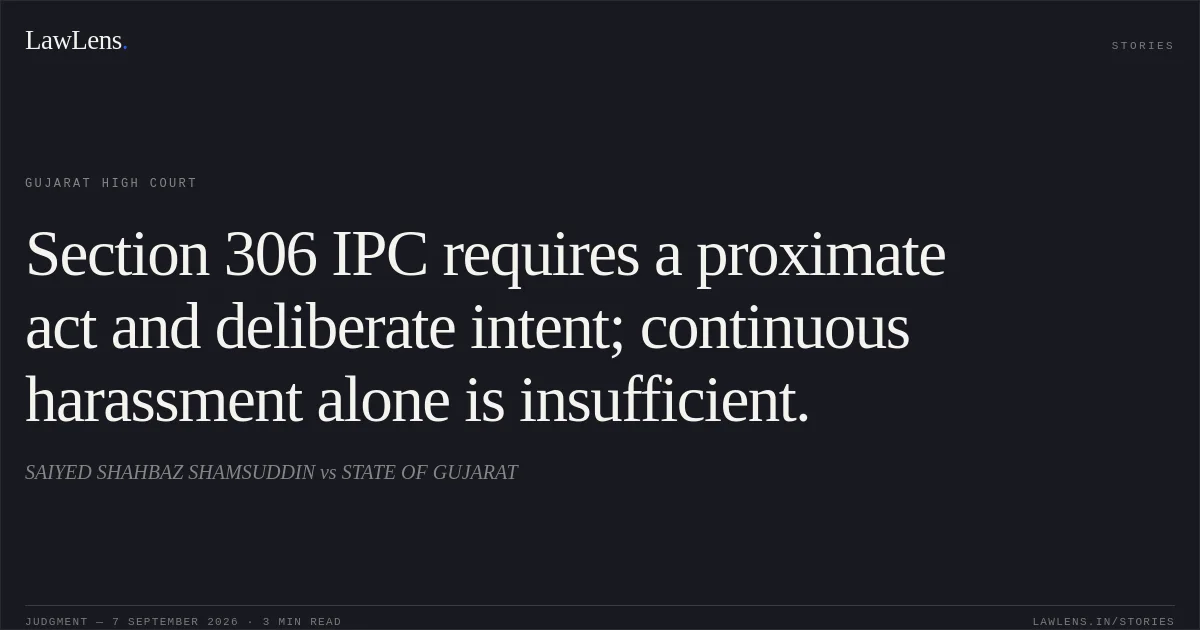
¶ 8 · pp. 6–8For Section 306 IPC, read with Section 107 IPC, there must be abetment involving a proximate act of instigation or intentional aid and the requisite mens rea; mere harassment or a general exhortation to “go and die” is insufficient without a conscious and deliberate intention to drive the victim to suicide.
¶ 10 · pp. 12–13Relying on Preeti Gupta v. State of Jharkhand, Kahkashan Kausar @ Sonam v. State of Bihar, Geeta Mehrotra v. State of U.P., K. Subba Rao v. State of Telangana and Abhinav Mohan Delkar v. State of Maharashtra, the Court emphasised that vague and omnibus allegations against relatives, particularly those residing separately, should not be permitted to result in an abuse of criminal process.
¶ 8–10 · pp. 6–13Provisions in the judgment · 8 · Linked ones open on LawLens
Code of Criminal Procedure, 1973 Section 482
Indian Penal Code, 1860 Section 306Section 114Section 323Section 324Section 498Section 107
Gujarat Police Act, 1951. Section 135
04Reasoning
The Court found that the allegations against the petitioners lacked specific dates, times, places or particular acts of cruelty and did not identify any dowry-related demand.
¶ 6 · p. 5The petitioners’ separate residence was undisputed, and the husband was serving a life sentence and could only have been present when released on parole or furlough.
¶ 3.1, 5–6 · pp. 3–5The deceased’s earlier FIR against her own mother and sister-in-law, in which she stated that she was living separately and referred to her husband’s imprisonment, weakened the later general allegations against the petitioners.
¶ 5, 11 · pp. 4–5, 13Further, the dying declaration did not implicate the petitioners or disclose circumstances attracting Section 306 IPC.
¶ 6 · p. 5Applying the requirement of proximate instigation and deliberate mens rea, the Court held that the material did not show continuous or immediate harassment which directly led to the deceased’s death; mere allegations of taunts or exhortations to die could not, without more, constitute abetment.
¶ 7, 10–11 · pp. 5, 12–1305Holding
The Court answered the issues in favour of the petitioners. It held that the FIR contained vague and omnibus allegations, failed to establish the ingredients of Sections 498A or 306 IPC, and amounted to an abuse of the process of law.
¶ 11 · p. 13Accordingly, FIR C.R. No. I-243 of 2014 registered at Danilimda Police Station, Ahmedabad City, and all consequential proceedings were quashed and set aside insofar as they concerned the petitioners in both applications.
¶ 12 · p. 14The petitions were allowed, the rule was made absolute, and direct service was permitted.
¶ 13 · p. 14Original Court PDF
SAIYED SHAHBAZ SHAMSUDDINvsSTATE OF GUJARAT
Click to open original judgment
Original judgment, available to read, download and summarize on LawLens.in