01Facts
The respondent (complainant) instituted proceedings under Section 200 CrPC read with Section 138 of the Negotiable Instruments Act, 1881 (C.C. No. 3595/2021, Addl. Civil Judge and JMFC, Magadi).
¶ 2The petitioner (accused) entered the witness box as DW-1 and produced a CD, which was marked in evidence.
¶ 2When the CD was played during final arguments, it did not play, and it was found to contain no recording.
¶ 2Both counsel stated that the CD had never been played before final arguments.
¶ 8The petitioner then sought to recall himself as DW-1 under Section 311 CrPC to produce a fresh CD containing a recording of a conversation between the complainant and the petitioner's brother, allegedly transferred from his mobile phone.
¶ 3The respondent opposed the application on the grounds that final arguments had commenced, that delay would result, and that the petitioner should have verified the CD before production.
¶ 3 · ¶ 6The Trial Court dismissed the application.
¶ 4The petitioner challenged that order under Section 482 CrPC (Section 528 BNSS).
¶ 1It is not established whether the CD was blank when produced or became unavailable later.
¶ 902Issues
i.1. Whether the Trial Court was justified in rejecting the accused's Section 311 CrPC application to recall DW-1 and produce a fresh CD containing a recording, where the originally marked CD was found to contain no recording at the stage of final arguments.
¶ 3 · ¶ 4 · ¶ 11ii.2. Whether the accused's request could be rejected solely because the matter had reached the stage of final arguments, given the prejudice to his defence and the respondent's ability to contest the electronic record.
¶ 1103Law Applied
Section 311 CrPC is the procedural basis for recalling a witness and producing additional evidence, although the statutory test is not quoted or analysed.
¶ 3 · ¶ 13(iii)A party producing an electronic record ordinarily must ensure that the medium contains the material relied upon, and that it must be verified before it is produced.
¶ 9The proponent of an electronic record must produce the requisite certificate and comply with the legal requirements for its proof.
¶ 13(iii)The respondent must be afforded an opportunity to cross-examine on the source, transfer, certificate and contents of the electronic record, and to raise objections as to its genuineness, authenticity and admissibility.
¶ 11 · ¶ 13(iv)–(v)Provisions in the judgment · 5 · Linked ones open on LawLens
Code of Criminal Procedure, 1973 Section 482Section 200Section 311
Bharatiya Nagarik Suraksha Sanhita, 2023 Section 528
Negotiable Instruments Act, 1881 Section 138
04Reasoning
The verification lapse of the petitioner did not by itself justify rejecting the application, because the CD had been marked without its contents being played and the cause of the missing recording remained unascertained.
¶ 9The recording was stated to be relevant to the defence and still available on the petitioner's mobile phone, so refusal would risk prejudice to his defence.
¶ 10 · ¶ 11The respondent's interests could be protected through cross-examination on the source and transfer of the recording, the accompanying certificate, and its contents, with the CD to be played before the Trial Court at the time of production.
¶ 11Admissibility and authenticity are matters for the Trial Court after cross-examination, rather than grounds to bar production at the arguments stage.
¶ 11 · ¶ 12To prevent the exercise from becoming a general re-opening of the evidence, the relief is limited to the single recording referred to in the application.
¶ 12 · ¶ 13(iii)05Holding
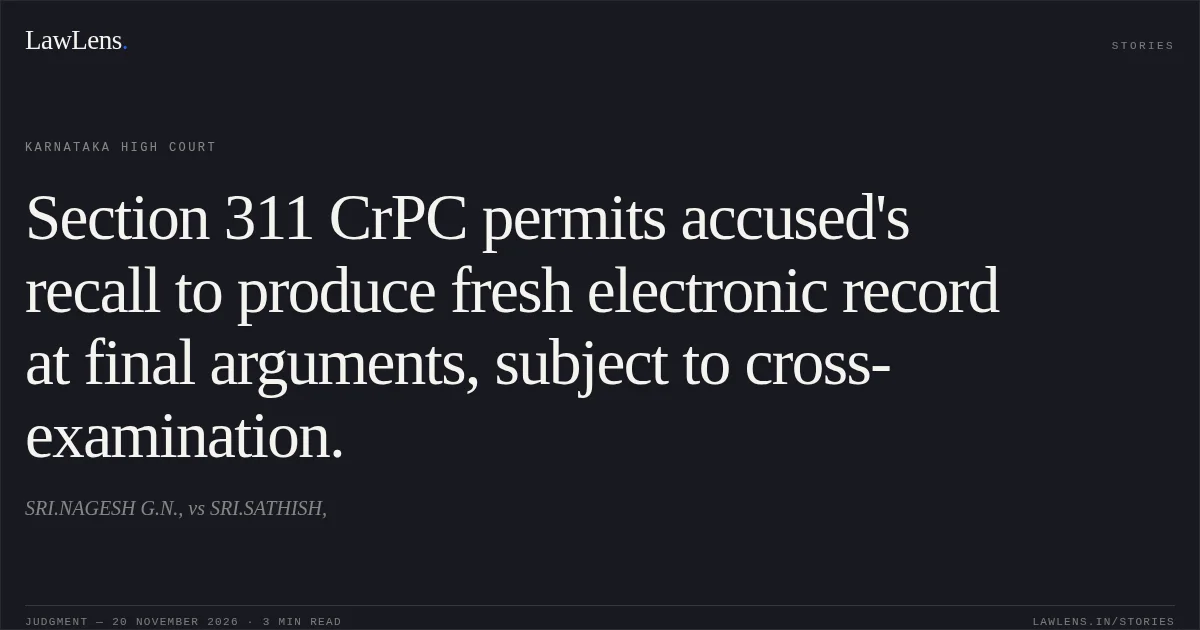
The Trial Court was not justified in rejecting the application solely on the ground that final arguments had begun, and recalling DW-1 for the limited purpose of producing a fresh CD would serve the ends of justice without irreparable prejudice to the respondent.
¶ 11 · ¶ 13The Criminal Petition is allowed, and the Trial Court's order dated 20.06.2025 in C.C. No. 3595/2021 is set aside. The petitioner is permitted to recall DW-1 solely to produce the fresh CD, subject to producing the requisite certificate and complying with legal requirements for proof of the electronic record. The respondent may cross-examine DW-1 on the source, transfer, certificate and contents of the CD and raise all permissible objections. The Trial Court is directed to determine the admissibility and evidentiary value of the electronic record in accordance with law. The permission granted is not a finding on the genuineness, authenticity or admissibility of the recording.
¶ 12 · ¶ 13(i)–(v)Original Court PDF
SRI.NAGESH G.N.,vsSRI.SATHISH,
Click to open original judgment
Original judgment, available to read, download and summarize on LawLens.in