Facts
Respondent No. 2 alleged that he invested ₹4.20 crore with the petitioners on an agreement that they would repay ₹6.19 crore; cheques issued towards repayment were dishonoured.
Source reference: p. 3, 7He lodged a complaint alleging offences under Sections 406 and 420 read with Section 34 IPC, and an FIR was registered in Crime No. 408/2017.
Source reference: p. 3, 7The petitioners sought quashing under Section 482 CrPC, arguing that the dispute was civil, that arbitration and proceedings under Section 138 of the Negotiable Instruments Act were already underway, and that Section 32A of the Insolvency and Bankruptcy Code, 2016 (“IBC”) barred prosecution following insolvency proceedings and approval of resolution plans.
Source reference: p. 4–5The High Court noted that petitioner No. 1 was in liquidation and that petitioner Nos. 2 and 3 had been admitted to resolution plans.
Source reference: p. 5, 7Issues
Whether Section 32A IBC barred continuation of the FIR against petitioner No. 1, the company in liquidation.
Source reference: p. 7–8Whether Section 32A IBC also barred proceedings against petitioner Nos. 2 and 3, or persons responsible for the corporate debtor’s business who were allegedly involved in the offences.
Source reference: p. 7–8, 10–11Whether the civil, arbitration, or cheque-dishonour proceedings warranted quashing the FIR alleging cheating and criminal breach of trust.
Source reference: p. 4, 7–8Law Applied
Section 482 CrPC empowers the High Court to quash criminal proceedings where appropriate.
Source reference: no citationSections 406, 420 and 34 IPC concern criminal breach of trust, cheating and joint liability.
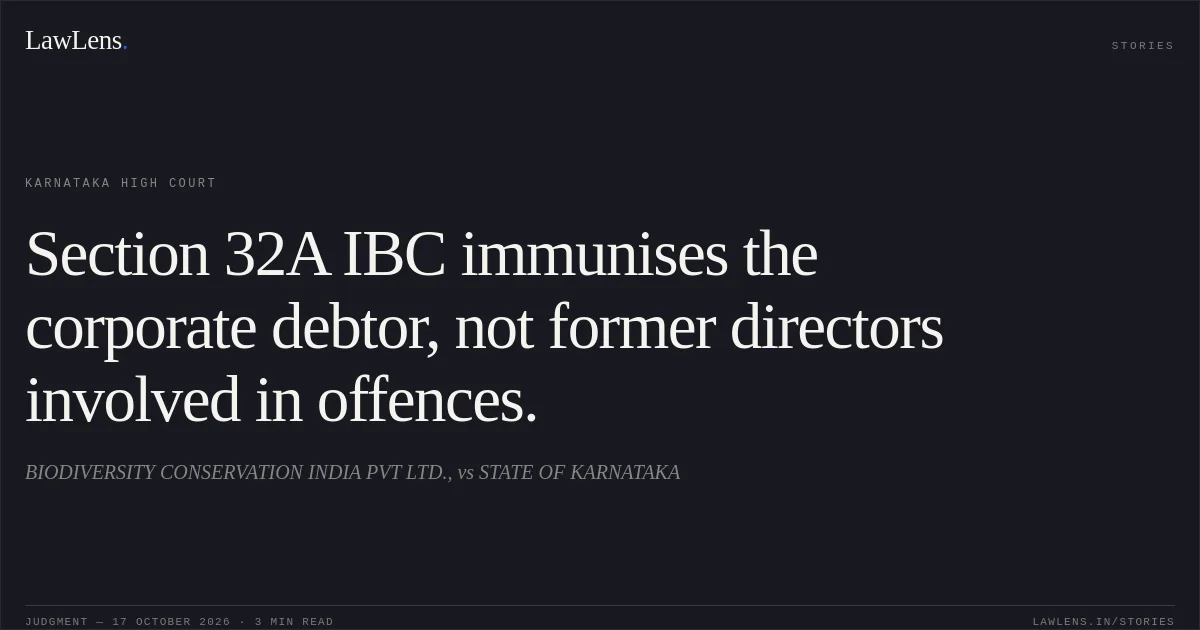
Source reference: no citationUnder Section 32A IBC, subject to its statutory conditions, a corporate debtor’s liability for an offence committed before commencement of the corporate insolvency resolution process ceases after approval of a qualifying resolution plan or liquidation sale, and the corporate debtor is protected from prosecution; the statutory proviso preserves the liability of persons who were in charge of, responsible for, or otherwise involved in the commission of the offence.
Source reference: p. 6–7, 8–13The Court relied on Manish Kumar v. Union of India, (2021) 5 SCC 1, Tata Steel BSL Ltd. v. Union of India, W.P. (Crl.) 3037/2019, and Ajay Kumar Radheyshyam Goenka v. Tourism Finance Corporation of India Ltd., (2023) 10 SCC 545, including the latter’s recognition that IBC proceedings do not, by themselves, terminate criminal proceedings against natural persons.
Source reference: p. 6–7, 8–13Reasoning
The Court accepted that petitioner No. 1, as the corporate debtor in liquidation, was protected from prosecution under Section 32A and that the complainant did not dispute the corporate debtor’s immunity.
Source reference: p. 7–8It treated petitioner Nos. 2 and 3 differently: the complaint alleged that the investment had been procured with an intention to cheat from the outset, and the Court held that Section 32A’s proviso preserved the liability of persons associated with the corporate debtor who were directly or indirectly involved in the alleged offence.
Source reference: p. 7–9Relying on Tata Steel BSL and Ajay Kumar Radheyshyam Goenka, the Court concluded that corporate-debtor immunity did not extinguish the potential liability of former officers or other responsible persons; parallel proceedings under the NI Act or arbitration did not warrant quashing the FIR at this stage.
Source reference: p. 9–13Holding
The petition was allowed in respect of petitioner No. 1, and the FIR in Crime No. 408/2017 was quashed against it.
The petition was rejected in respect of petitioner Nos. 2 and 3, leaving the criminal proceedings against them to continue.
Source reference: p. 14Acts & Sections Cited
9 provisions across 5 statutes referred to in this judgment. Each provision opens on LawLens.
Code of Criminal Procedure, 19732
Indian Penal Code, 18603
Negotiable Instruments Act, 18812
Limited Liability Partnership Act, 20081
Companies Act, 20131
Original Court PDF
BIODIVERSITY CONSERVATION INDIA PVT LTD.,vsSTATE OF KARNATAKA
Click to open original judgment
Original judgment, available to read, download and summarize on LawLens.in